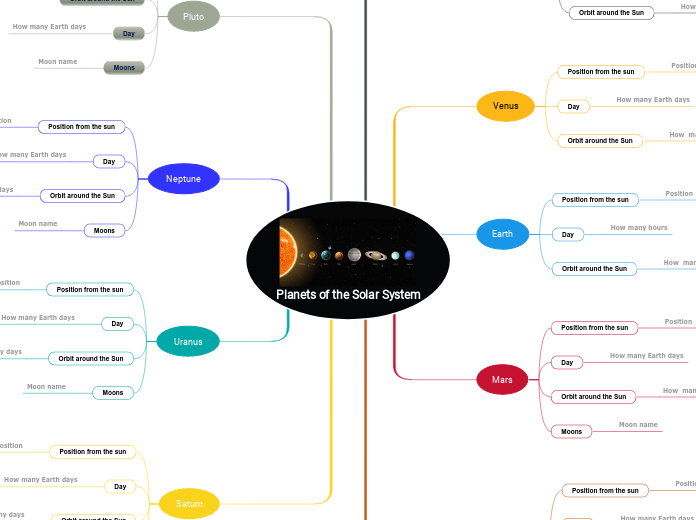
Explore the eight planets of the Solar System and Pluto, a dwarf planet, with this interactive mind map template. Learn about their order from the Sun, rotation periods, orbits, and natural satellites. Read interesting facts about each world, then complete the placeholders to test your knowledge of astronomy. Learn about the Solar System planets and their characteristics like their position from the Sun, the time they need to rotate or spin on their axis, and how many days they need to orbit around the sun measured in Earth days. Pluto was considered the ninth planet until 2006, when the International Astronomical Union reclassified it as a dwarf planet. Smaller than Earth's Moon, Pluto follows an elliptical orbit in the outer Solar System. Its icy surface features glaciers and mountains made of water ice. Pluto also has a thin atmosphere that changes as its distance from the Sun varies. Pluto has five known moons. Find their names and add them to the topics. Pluto is a dwarf planet. Its rotation period is the time it takes to complete one full turn on its axis. Enter this period in Earth days. How long does Pluto take to complete one orbit around the Sun? Enter the duration in Earth days. Pluto is a dwarf planet, not one of the eight planets. Describe where its orbit lies in the outer Solar System instead of assigning it a planet number. The Solar System consists of the Sun and the objects bound to it by gravity. It includes eight planets, dwarf planets, natural satellites, asteroids, comets, and smaller bodies. Explore each planet's position, rotation period, orbital period, and moons. Complete the placeholders using the information you research. Jupiter is the largest planet in the Solar System. This gas giant is composed mainly of hydrogen and helium. Its colorful cloud bands and Great Red Spot—a huge, long-lived storm—are easily recognizable. Jupiter has a powerful magnetic field and many moons, including the four Galilean moons. Jupiter has many moons. Identify the four large moons known as the Galilean moons and enter their names. How long does Jupiter take to complete one orbit around the Sun? Enter the duration in Earth days. A planet's rotation period is the time it takes to complete one full turn on its axis. Research the rotation period of Jupiter and enter it in Earth days. Eight planets orbit the Sun. Count outward from the Sun and write Jupiter's position in the planetary order. Saturn is a gas giant best known for its spectacular rings, made largely of ice particles mixed with rocky material. Galileo initially mistook its rings for objects on either side of the planet. Saturn is composed mainly of hydrogen and helium and has numerous moons. Research Saturn's natural satellites. Enter one moon's name in each topic and add more topics if needed. How long does Saturn take to complete one orbit around the Sun? Enter the duration in Earth days. A planet's rotation period is the time it takes to complete one full turn on its axis. Research the rotation period of Saturn and enter it in Earth days. Eight planets orbit the Sun. Count outward from the Sun and write Saturn's position in the planetary order. Uranus is an ice giant with a blue-green appearance caused by methane in its atmosphere. It rotates in a retrograde direction and has a remarkably tilted axis. Its orbital period is about 84 Earth years, and each season lasts roughly 21 years. Uranus also has faint rings and numerous moons. Research Uranus's natural satellites. Enter one moon's name in each topic and add more topics if needed. How long does Uranus take to complete one orbit around the Sun? Enter the duration in Earth days. A planet's rotation period is the time it takes to complete one full turn on its axis. Research the rotation period of Uranus and enter it in Earth days. Eight planets orbit the Sun. Count outward from the Sun and write Uranus's position in the planetary order. Neptune is the most distant of the eight planets from the Sun. This cold ice giant has an atmosphere with extremely strong winds. It was discovered in 1846 after mathematical predictions suggested its location. Neptune has many natural satellites, including Triton. Neptune has many moons, including Triton, its largest. Find the names of Triton and at least four other Neptunian moons. How long does Neptune take to complete one orbit around the Sun? Enter the duration in Earth days. A planet's rotation period is the time it takes to complete one full turn on its axis. Research the rotation period of Neptune and enter it in Earth days. Eight planets orbit the Sun. Count outward from the Sun and write Neptune's position in the planetary order. Mars is a cold, rocky planet whose iron-rich dust gives it a reddish appearance. Its surface has mountains, valleys, canyons, and enormous volcanoes. Mars also experiences dust devils and dust storms, some of which can spread across much of the planet. Mars has two small natural satellites. Find their names and add them to the topics. How long does Mars take to complete one orbit around the Sun? Enter the duration in Earth days. A planet's rotation period is the time it takes to complete one full turn on its axis. Research the rotation period of Mars and enter it in Earth days. Eight planets orbit the Sun. Count outward from the Sun and write Mars's position in the planetary order. About 71% of Earth's surface is covered by water. Earth is the only planet currently known to support life, and its atmosphere is mainly nitrogen and oxygen. It has one natural satellite: the Moon. How long does Earth take to complete one orbit around the Sun? Enter the duration in Earth days. A planet's rotation period is the time it takes to complete one full turn on its axis. Research the rotation period of Earth and enter it in Earth days. Eight planets orbit the Sun. Count outward from the Sun and write Earth's position in the planetary order. Venus is similar in size to Earth but has a much denser atmosphere, mainly made of carbon dioxide. Clouds of sulfuric acid cover the planet. An intense greenhouse effect raises its average surface temperature to about 465 °C. Venus rotates slowly in the opposite direction to most planets and has no natural moons. How long does Venus take to complete one orbit around the Sun? Enter the duration in Earth days. A planet's rotation period is the time it takes to complete one full turn on its axis. Research the rotation period of Venus and enter it in Earth days. Eight planets orbit the Sun. Count outward from the Sun and write Venus's position in the planetary order. Mercury is the smallest planet in the Solar System and the closest to the Sun. It is only slightly larger than Earth's Moon and has no natural satellites. With almost no atmosphere to retain heat, its surface can reach about 430 °C during the day and fall to about −180 °C at night. Its rocky, heavily cratered surface resembles the Moon's. How long does Mercury take to complete one orbit around the Sun? Enter the duration in Earth days. A planet's rotation period is the time it takes to complete one full turn on its axis. Research the rotation period of Mercury and enter it in Earth days. Eight planets orbit the Sun. Count outward from the Sun and write Mercury's position in the planetary order. Tankekartor hjälper dig att brainstorma, se samband mellan begrepp, organisera tankar och komma på nya idéer. Med en mall kommer du ändå igång ännu enklare, eftersom den ger dig en färdig ram med information om ett visst ämne och vägledande instruktioner. En mall för tankekartor är helt enkelt en struktur som samlar alla delar av ett ämne och fungerar som utgångspunkt för din egen tankekarta. Det är ett praktiskt sätt att skapa en tankekarta om ett visst ämne, både i jobbet och i undervisningen. Med Mindomos smarta mallar för tankekartor kan du tänka och arbeta utan ansträngning. Du kan välja bland en mängd mallar för tankekartor från Mindomos konton för företag och utbildning, eller skapa egna mallar från grunden. Alla tankekartor kan göras om till mallar genom att du lägger till vägledande kommentarer i något av ämnena.Solar System Planets
Om den här mallen
Solar System planets
Pluto
Planets of the Solar System
Jupiter
Saturn
Uranus
Neptune
Mars
Moons
Moon name
Earth
How many hours
Venus
Mercury
Orbit around the Sun
How many days
Rotation period
How many Earth days
Position from the Sun
Position
Varför använda en mall för tankekartor från Mindomo?
En mall innehåller bland annat:
-
Produkter
-
Användningsområden
- Allmänna användningsområden
- Tankekartor för utbildning
- Tankekartor för företag
- Tankekartor för personlig utveckling
- Digitala hjälpmedel
- Teamsamarbete
- Kampanjunderlag för marknadsförare
- Kundworkshoppar för konsulter
- Onboardingprogram för HR och L&D
- Kunskapshantering
- Kompetensmatris för team
- Uppdragsbibliotek
- Roller
- Marknadsförare
- HR och L&D
- Konsulter
- Projektledning
- Planering av marknadsföringskampanjer
- Utrullning av personalutbildning
- Arbetsomfattning
- Organisera idéer
- Problemträd
- Utbildningsbehovsanalys
- Fördelar med tankekartor
-
Lösningar
- Guider
- Skapa presentationer med tankekartor
- Lär dig med tankekartor
- Planera och organisera med tankekartor
- Prioritera uppgifter med tankekartor
- Ta anteckningar med tankekartor
- Verkliga kundberättelser
- Utbildningsinnehåll i stor skala för 11 000 läkare
- Teamets arbetsflöde: från provperiod till oumbärligt på två månader
- 10 år utan bildspel: arkitekturföreläsningar i ny form
- Läs alla berättelser
-
Resurser
- Lär dig grunderna
- Vad är en tankekarta?
- Hur gör man en tankekarta?
- Vad är en begreppskarta?
- Tankekartsidéer för studenter
- Guider och support
- Videoguider
- Hjälpcenter
- Forum
- Exempel och mallar
- Idéer för tankekartor
- 29 exempel på tankekartor
- Funktionssidor
- Utbildning
- Uppgifter för lärare
- Arbete och privat
- Skrivbordsapp
- Mindomo-bloggen
- Priser
- Logga in
- Registrera dig
- Instrumentpanel
Allmänna användningsområden
Fördelar med tankekartor
Varför visuellt tänkande gör det lättare att minnas och planera.
Lär dig grunderna
Guider och support
Exempel och mallar
Funktionssidor
 Blogg
Mindomo-bloggen
Guider, exempel och forskning om visuellt tänkande.
Bläddra bland alla artiklar