
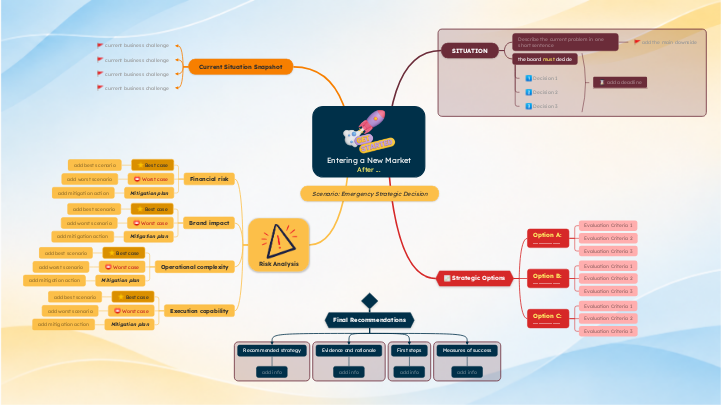
This interactive business strategy mind map template helps you analyze a company's revenue decline and evaluate possible solutions. Explore the current business challenges, compare strategic options such as entering a new market, launching a new product, or restructuring operations, and assess potential risks. Use the interactive instructions and placeholders to evaluate each option, develop mitigation plans, and make an informed strategic recommendation. Use this template to plan how your company will succeed when entering a new market, whether it is a new country, region or customer segment. Break your market entry strategy into clear parts: Add your findings to each branch to evaluate the opportunity and decide on the best way to enter the market. Recommend a strategy based on your findings. Explain your reasoning, outline immediate actions and define how results will be measured. Decide how the company will know whether its strategy is working. Add one measurable indicator, including a target or review period. Identify what should happen immediately after the board makes its decision. Add a specific first action. State who should do it and when. Support your choice with evidence and show why it compares favorably with alternatives. Add one fact, estimate or comparison supporting your recommendation. Choose the most suitable strategy based on your analysis, not just its potential upside. Name your preferred option and explain your main reason for choosing it. Use this scenario to practice making a board-level strategic decision. Complete the analysis before choosing a solution. Set a realistic deadline for the board's decision. Include the full date and allow time for reviewing evidence. Complete this strategic decision case. Describe the problem, compare three options, assess current challenges and risks, then recommend a course of action. Replace each placeholder with your own concise findings. For each risk area, describe a realistic best case, worst case and practical way to reduce the risk. Base your scenarios on explicit assumptions. Consider whether the company has the people, skills and capacity to carry out the decision. Identify how the company could reduce this execution risk. Add one practical action that would reduce execution risk. Imagine a realistic negative outcome for the company's ability to deliver. What could go wrong? Write one concise worst-case execution scenario. Imagine a realistic positive outcome for the company's ability to deliver. What conditions would make it possible? Write one concise best-case execution scenario. State an assumption if needed. Consider the effect on everyday processes, systems and coordination. Identify how the company could reduce this operational risk. Add one practical action that would reduce operational risk. Imagine a realistic negative outcome for the company's operations. What could go wrong? Write one concise worst-case operational scenario. Imagine a realistic positive outcome for the company's operations. What conditions would make it possible? Write one concise best-case operational scenario. State an assumption if needed. Consider how customers and partners might respond and how the company's reputation could change. Identify how the company could reduce this reputational risk. Add one practical action that would reduce reputational risk. Imagine a realistic negative outcome for the company's brand reputation. What could go wrong? Write one concise worst-case reputational scenario. Imagine a realistic positive outcome for the company's brand reputation. What conditions would make it possible? Write one concise best-case reputational scenario. State an assumption if needed. Consider the financial effects of the options: cash flow, profitability, costs and investment. Identify how the company could reduce this financial risk. add mitigation action Add one practical action that would reduce financial risk. Imagine a realistic negative outcome for the company's financial position. What could go wrong? add worst scenario Write one concise worst-case financial scenario. Imagine a realistic positive outcome for the company's financial position. What conditions would make it possible? add best scenario Write one concise best-case financial scenario. State an assumption if needed. Identify the main business challenges. State each problem briefly and distinguish the symptoms from possible causes. Add another challenge. Avoid repeating an issue already listed. Identify a further challenge that could affect the company's options. Add another challenge. Is it a cause of the problem or a symptom? Add a current business challenge. Keep it specific and supported by an observation. Evaluate each option using three relevant criteria. Choose criteria that reveal its costs, benefits, feasibility or risks. Use comparable evidence where possible. Replace the dotted line with the third strategic option. Consider different strengths and trade-offs. Choose a third criterion for Option C. Consider effects on teams or long-term operations. Choose a second criterion for Option C. Consider likely savings and implementation costs. Choose one criterion for Option C. What would determine whether the change is worthwhile? Replace the dotted line with the second strategic option. Evaluate it using three relevant criteria. Choose a third criterion for Option B. Consider required resources or time to launch. Choose a second criterion for Option B. Consider customer needs or expected demand. Choose one criterion for Option B. What would show whether the idea can work? Replace the dotted line with the first strategic option. Then choose three criteria to assess it. Choose a third criterion for Option A. Consider investment, expected impact or timing. Choose a second criterion for Option A. Consider potential obstacles or feasibility. Choose one criterion for Option A. What would you need to know before investing? Summarize the company's problem and the decision its board needs to make. List three realistic strategic responses to the problem. Keep them distinct so they can be compared. Name a third alternative for the board to consider. Name a second strategy that differs meaningfully from the first. Name your first possible strategy. Describe the action, not its expected result. Write one sentence describing the main business problem. Include the most relevant fact from the case. State the main negative consequence of the problem. What does it mean for the business? Mindmaps hjælper dig med at brainstorme, skabe sammenhænge mellem begreber og organisere og generere ideer. Mindmap-skabeloner gør det dog nemmere at komme i gang, fordi de er rammer med information om et bestemt emne og vejledende instruktioner. Mindmap-skabeloner giver dig grundlæggende den struktur, der samler alle elementerne i et bestemt emne, og fungerer som udgangspunkt for dit eget mindmap. De er en praktisk ressource, når du skal lave et mindmap om et bestemt emne, uanset om det er til arbejde eller uddannelse. Mindomo giver dig smarte mindmap-skabeloner, så du kan arbejde og tænke ubesværet. Du kan vælge mellem en række mindmap-skabeloner fra Mindomos erhvervs- og uddannelseskonti, eller du kan lave dine egne mindmap-skabeloner fra bunden. Ethvert mindmap kan gøres til en mindmap-skabelon ved at tilføje vejledende noter til et af emnerne.Market Entry Strategy Template
Om denne skabelon
Market entry strategy template
Final Recommendations
Draft a short decision memoMeasures of success
First steps
Evidence and rationale
Record the source or assumptionRecommended strategy
add info
Scenario: Emergency Strategic Decision
add a deadline
Entering a New Market After ...
Add case assumptions or supporting figuresRisk Analysis
Execution capability
Operational complexity
Brand impact
Financial risk
Mitigation plan
Worst case
Best case
Current Situation Snapshot
Add supporting data or sourcescurrent business challenge
Strategic Options
Option C: .........................
Option B: .........................
Option A: .........................
Evaluation Criteria 3
Evaluation Criteria 2
Evaluation Criteria 1
SITUATION
the board must decide
Decision 3
Decision 2
Decision 1
Describe the current problem in one short sentence
add the main downside
Hvorfor bruge en mindmap-skabelon fra Mindomo?
En skabelon har forskellige funktioner:
-
Produkter
-
Anvendelser
- Generelle anvendelser
- Mindmaps til uddannelse
- Mindmaps til erhvervslivet
- Mindmaps til personlig udvikling
- Hjælpemiddelteknologi
- Teamsamarbejde
- Kampagnebriefs til marketingfolk
- Workshops om kundeafdækning for konsulenter
- Onboardingforløb for HR og L&D
- Videnstyring
- Kompetencematrix for teamet
- Projektbibliotek
- Roller
- Marketingfolk
- HR og L&D
- Konsulenter
- Projektledelse
- Planlægning af marketingkampagner
- Udrulning af medarbejderuddannelse
- Arbejdsbeskrivelse
- Idéorganisering
- Problemtræer
- Uddannelsesbehovsanalyse
- Fordele ved mindmapping
-
Løsninger
- Guider
- Lav præsentationer med mindmaps
- Lær med mindmaps
- Planlæg og organiser med mindmaps
- Prioritér opgaver med mindmaps
- Tag noter med mindmaps
- Ægte kundehistorier
- Skalering af uddannelsesindhold til 11.000 læger
- Teamworkflow: fra afprøvning til uundværlig på to måneder
- 10 år uden slides: arkitekturforelæsninger gentænkt
- Læs alle historier
-
Ressourcer
- Lær det grundlæggende
- Hvad er et mindmap?
- Hvordan laver man et mindmap?
- Vejledninger og support
- Videovejledninger
- Hjælpecenter
- Forum
- Eksempler og skabeloner
- Top 29 eksempler på mindmaps
- Hvad er et konceptkort?
- Funktionssider
- Uddannelse
- Læreropgaver
- Arbejde og privat
- Desktop
- Mindomo-bloggen
- Priser
- Log ind
- Tilmeld dig
- Dashboard
Fordele ved mindmapping
Hvorfor visuel tænkning gør det lettere at huske og planlægge.
Lær det grundlæggende
Vejledninger og support
Eksempler og skabeloner
Funktionssider
 Blog
Mindomo-bloggen
Guides, eksempler og forskning om visuel tænkning.
Se alle artikler


