Our senses help us to understand what's happening around us. This template explains the five senses for kids, with simple words, asking them to complete with examples of things they can feel, smell, taste, hear or see. They will learn about the sense of taste, touch, sight, smell, and hear. They will have fun learning new things! Senses send messages through receptor cells to our brain, using our nervous system. How we taste: List a thing you can taste. Add a describing word for that thing. How we smell: List a thing you can smell. Add a describing word for that thing. How we hear: List a thing you can hear. Add a describing word for that thing. How we see: List a thing you can see. Add a describing word for that thing. How we feel: List a thing you can feel. Add a describing word for that thing. Mindmaps helpen je bij brainstormen, het leggen van verbanden tussen concepten, organiseren en ideeën bedenken. Met een mindmapsjabloon ga je nog makkelijker aan de slag: het is een kader met informatie over een specifiek onderwerp en begeleidende instructies. Een sjabloon geeft je dus de structuur die alle elementen van een onderwerp samenbrengt, en dient als startpunt voor je eigen mindmap. Zo maak je op een praktische manier een mindmap over een bepaald onderwerp, zowel in het bedrijfsleven als in het onderwijs. Mindomo biedt slimme mindmapsjablonen waarmee je moeiteloos kunt werken en denken. Je kunt kiezen uit verschillende mindmapsjablonen van de zakelijke of educatieve accounts van Mindomo, of je eigen mindmapsjablonen maken. Elke mindmap kun je omzetten in een sjabloon door extra notities toe te voegen aan een van de onderwerpen.The five senses diagram for kids
Let's learn more about them!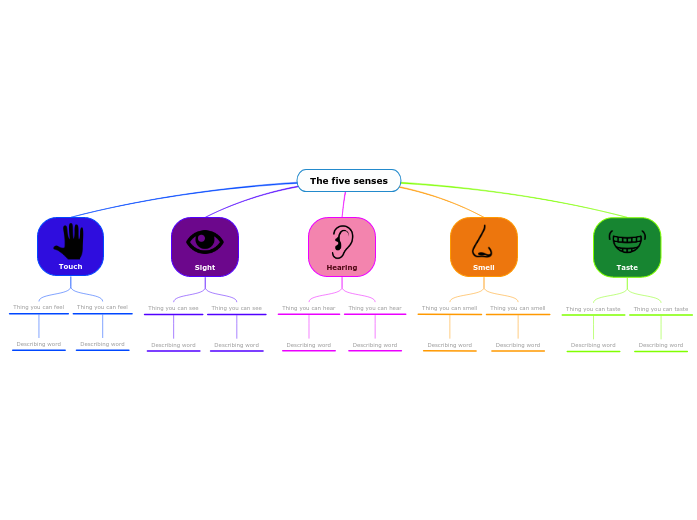
Over dit sjabloon
The five senses for kids
The five senses
Taste
Tongues also have chemical sensors to give a sense of taste.Thing you can taste
Example: cake, chocolate, pizza
You can choose from the examples below:Smell
Our noses have sensors that detect chemicals that make up a smell.Thing you can smell
Example: laundry detergent on clothes, perfume, food from the restaurant
You can choose from the examples below:Hearing
Our ears have sound sensors in the inner ears.
They also have sensors that work on keeping you balanced and aware of where you are in your environment.Thing you can hear
Example: clock ticking, birds chirping
You can choose from the examples below:Sight
Our eyes translate light into image signals so the brain can process them.Thing you can see
Example: sunset, picture
You can choose from the examples below:Touch
The receptors from our skin send touch signals to the brain.Thing you can feel
Example: sand, a fine silk coat, a fluffy teddy bearDescribing word
You can choose from the examples below:Waarom een mindmapsjabloon van Mindomo gebruiken?
Een sjabloon biedt verschillende functies:
-
Producten
-
Toepassingen
- Algemene toepassingen
- Mindmaps voor het onderwijs
- Mindmaps voor bedrijven
- Mindmaps voor persoonlijke ontwikkeling
- Ondersteunende technologie
- Teamsamenwerking
- Campagnebriefs voor marketeers
- Verkenningsworkshops met klanten voor consultants
- Onboardingtrajecten voor HR en L&D
- Kennismanagement
- Vaardighedenmatrix voor teams
- Opdrachtenbibliotheek
- Rollen
- Marketeers
- HR en L&D
- Consultants
- Projectmanagement
- Planning van marketingcampagnes
- Uitrol van medewerkerstrainingen
- Werkomschrijving
- Ideeën ordenen
- Probleembomen
- Analyse van opleidingsbehoeften
- Voordelen van mindmappen
-
Oplossingen
- Handleidingen
- Presentaties maken met mindmaps
- Leren met mindmaps
- Plannen en organiseren met mindmaps
- Taken prioriteren met mindmaps
- Notities maken met mindmaps
- Klantverhalen uit de praktijk
- Educatieve content opschalen voor 11.000 artsen
- Teamworkflow: van proefperiode naar onmisbaar in twee maanden
- 10 jaar zonder slides: architectuurcolleges opnieuw bedacht
- Alle verhalen lezen
-
Hulpbronnen
- De basis
- Wat is een mindmap?
- Hoe maak je een mindmap?
- Wat is een conceptmap?
- Mindmapideeën voor studenten
- Handleidingen en support
- Videohandleidingen
- Helpcentrum
- Forum
- Voorbeelden en sjablonen
- Mindmapideeën
- Tool voor ondersteunende technologie
- Top 29 mindmapvoorbeelden
- Functiepagina's
- Onderwijs
- Opdrachten voor docenten
- Werk en privé
- Desktop
- De Mindomo-blog
- Prijzen
- Inloggen
- Aanmelden
- Dashboard
Voordelen van mindmappen
Waarom visueel denken onthouden en plannen makkelijker maakt.
De basis
Handleidingen en support
Voorbeelden en sjablonen
Functiepagina's
 Blog
De Mindomo-blog
Gidsen, voorbeelden en onderzoek over visueel denken.
Alle artikelen bekijken