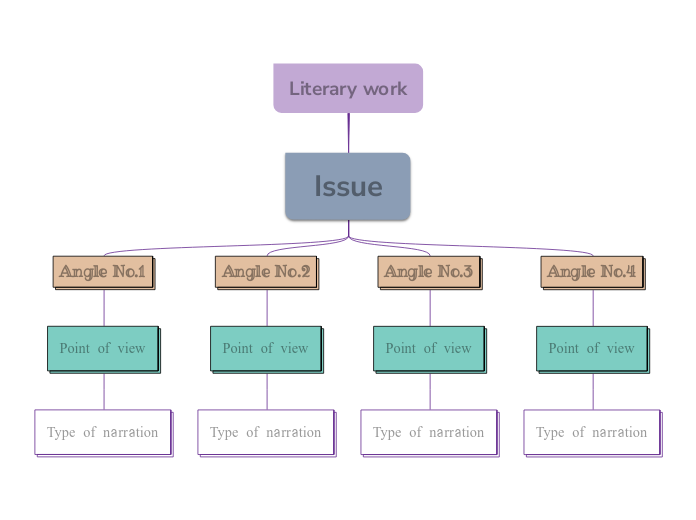
This mind map will help you discover the multiple perspectives from which you can analyze an issue from your literary work. Identifying multiple author’s perspectives can be difficult if you do not organize your ideas. Use this mind map template to look at an issue from four different angles. Type in the name of the multiple-perspectives text. Identify an important issue from the text that is being presented from different angles. Type it in. Decide on the fourth point of view Point of view How is the viewpoint introduced in the story? Whose character does the third point of view belong to? What does the character think, say or do that suggests their perspective on the issue? What kind of narration introduces the viewpoint? Decide on the second point of view Type in a quote that points out the character's position about the issue. How is the viewpoint introduced in the story? Decide on the first point of view you are going to present. Type in a relevant quote that highlights the character's point of view towards Type of narration What type of narration introduces the viewpoint? Mapy myśli pomagają w burzy mózgów, w dostrzeganiu powiązań między pojęciami oraz w porządkowaniu i generowaniu pomysłów. Szablony map myśli ułatwiają jednak start, bo zawierają gotowy szkielet z informacjami na dany temat i wskazówkami, jak go uzupełnić. Zapewniają strukturę, która łączy wszystkie elementy tematu i służy jako punkt wyjścia dla twojej własnej mapy myśli. To praktyczne rozwiązanie, gdy chcesz szybko stworzyć mapę myśli na konkretny temat – zarówno w biznesie, jak i w edukacji. Mindomo oferuje inteligentne szablony map myśli, dzięki którym praca i myślenie przychodzą bez wysiłku. Możesz wybierać spośród szablonów map myśli dostępnych na kontach biznesowych i edukacyjnych Mindomo albo tworzyć własne szablony od podstaw. Każdą mapę myśli możesz zamienić w szablon, dodając do jej tematów notatki ze wskazówkami.Narrative Points of View
O tym szablonie
Identifying Multiple author’s perspectives
Literary work
Example: Bridge to Terabithia by Katherine PatersonIssue
Example: Jesse's drawing talent.Angle No.4
Type in the name of the last character whose perspective on the issue you are going to present.
Example: Leslie Burke, Jesse's new next-door neighbor, and best friend.
Type in a relevant quote that highlights the character's point of view. Try to follow a citation format: author's name, chapter, and page.
Example: I can't get the poetry of the trees,' he said. She nodded. Don't worry,' she said. You will someday. He believed her.' (Paterson, 4. 24)
Choose an answer:Angle No.3
Type in his/her name.
Example: Mr. Aarons, Jesse's father.
Type in a quote and try to maintain the citation format.
Example: 'He would like to show his drawings to his dad, but he didn't dare. (...) He'd thought his dad would be pleased. He wasn't. What are they teaching in that damn school? he had asked.' (Paterson, 2.8)
Choose an answer:Angle No.2
Name the character (it can either be the main character or one of the supporting characters) whose point of view you are presenting.
Example: Miss Edmunds, Jesse's music teacher.
Try to follow a citation format: author's name, chapter, and page.
Example: 'She said he was unusually talented, and she hoped he wouldn't let anything discourage him.' (Paterson, 2. 8)
Choose an answer:Angle No.1
Type in the name of the character (it can either be the main character or one of the supporting characters) whose point of view belongs to.
Example: Jesse Oliver Aarons, Jr., the main character of the novel, a fifth-grader living in a rural Southern area.Point of view
Issue.
Try following a citation format: author's name, chapter, and page.
Example: 'Jesse drew the way some people drank whiskey. (...) Lord, he loved to draw. (...) When he was in first grade, he told his father that he wanted to be an artist when he grew up.' (Paterson, 2. 7)
Choose an answer:Dlaczego warto używać szablonów map myśli Mindomo?
Szablony oferują różne funkcje:
-
Produkty
-
Zastosowania
- Zastosowania ogólne
- Mapy myśli dla edukacji
- Mapy myśli dla biznesu
- Mapy myśli dla rozwoju osobistego
- Technologia wspomagająca
- Współpraca zespołowa
- Briefy kampanii dla marketerów
- Warsztaty rozpoznania potrzeb klienta dla konsultantów
- Ścieżki onboardingu dla HR i L&D
- Zarządzanie wiedzą
- Matryca kompetencji zespołu
- Biblioteka projektów
- Role
- Marketerzy
- HR i L&D
- Konsultanci
- Zarządzanie projektami
- Planowanie kampanii marketingowych
- Wdrażanie szkoleń dla pracowników
- Zakres prac
- Organizacja pomysłów
- Drzewa problemów
- Analiza potrzeb szkoleniowych
- Korzyści z mapowania myśli
-
Rozwiązania
- Przewodniki
- Twórz prezentacje z mapami myśli
- Ucz się z mapami myśli
- Planuj i organizuj z mapami myśli
- Ustalaj priorytety zadań z mapami myśli
- Rób notatki z mapami myśli
- Prawdziwe historie klientów
- Skalowanie treści edukacyjnych dla 11 000 lekarzy
- Praca zespołu: od wersji próbnej do niezbędnego narzędzia w dwa miesiące
- 10 lat bez slajdów: nowe podejście do wykładów z architektury
- Przeczytaj wszystkie historie
-
Zasoby
- Podstawy
- Co to jest mapa myśli?
- Jak tworzyć mapy myśli?
- Poradniki i pomoc
- Samouczki wideo
- Centrum pomocy
- Forum
- Przykłady i szablony
- Top 29 przykładów map myśli
- Co to jest mapa pojęć?
- Strony funkcji
- Edukacja
- Zadania dla nauczycieli
- Praca i życie prywatne
- Wersja desktopowa
- Blog Mindomo
- Cennik
- Zaloguj się
- Zarejestruj się
- Panel główny
Zarządzanie wiedzą
Korzyści z mapowania myśli
Dlaczego myślenie wizualne ułatwia zapamiętywanie i planowanie.
Poradniki i pomoc
Przykłady i szablony
Strony funkcji
 Blog
Blog Mindomo
Poradniki, przykłady i badania dotyczące myślenia wizualnego.
Przeglądaj wszystkie artykuły