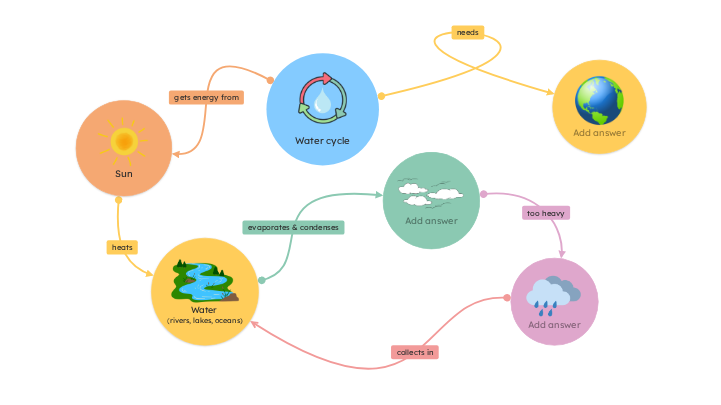
A fill-in concept map that follows water through its cycle. Starting from the Sun's heat and water in rivers, lakes and oceans, students complete three missing links: clouds forming through condensation, precipitation and gravity. Pictures, arrows and wiki hints guide them toward each answer. This water cycle diagram template helps students understand how water moves continuously between Earth’s surface and the atmosphere. The concept map uses pictures, arrows, and connector labels as clues to guide students through the role of the sun, bodies of water, evaporation, condensation, precipitation, and gravity. Use this interactive template in science and geography lessons to check understanding of each stage of the water cycle. Students replace each placeholder with the correct term and a short explanation, then follow the arrows to describe how water evaporates, forms clouds, falls back to Earth, and collects again in rivers, lakes, and oceans. Complete this water cycle concept map. Use the pictures and connector labels as clues, then replace each placeholder with the correct term and a short explanation. Follow the arrows to explain how water moves through the cycle. What provides the heat that drives the water cycle? Name the energy source and briefly explain how its heat changes liquid water into water vapor. Name places on Earth's surface where water collects. Give examples of bodies of water and explain what happens when the collected water is heated. Water evaporates and rises into the air. As the vapor cools, it condenses into tiny water droplets or ice crystals. Name what these form in the sky and describe condensation in your own words. Name the process in which water falls from clouds to Earth's surface. Give examples of its forms, then follow the arrow back to where the water collects. Identify the force that pulls falling rain and other precipitation toward Earth. Write its name and explain how it helps water return to rivers, lakes and oceans. Every Mindomo template opens with its structure already in place: descriptive topics, guiding notes attached to the branches where people usually get stuck, and a default shape that new topics inherit. Edit it in the browser, switch it to a concept map, outline or Gantt chart without redrawing anything, and export it in more than twenty formats. See how mind map templates work, or browse the full gallery by category.Water Cycle Diagram Template
About this template
Water cycle diagram template
Water cycle
Sun
Water (rivers, lakes, oceans)
Add answer
Why use a Mindomo mind map template?
-
Products
-
Uses
- General Uses
- Mind Maps for Education
- Mind Maps for Business
- Mind Maps for Personal Development
- Assistive Technology
- Team Collaboration
- Campaign briefs for marketers
- Client discovery workshops for consultants
- Onboarding journeys for HR & L&D
- Knowledge Management
- Team Skills Matrix
- Engagement Library
- Roles
- Marketers
- HR & L&D
- Consultants
- Project Management
- Marketing campaign planning
- Employee training rollouts
- Scope of Work
- Idea Organization
- Issue Trees
- Training Needs Analysis
- Mind Mapping Benefits
-
Solutions
- Guides
- Make Presentations with Mind Maps
- How to Learn with Mind Maps
- Plan and Organize with Mind Maps
- Prioritize Tasks with Mind Maps
- Take Notes with Mind Maps
- Real Customer Stories
- Scaling educational content for 11,000 doctors
- Team workflow: from trial to indispensable in two months
- 10 years without slides: rethinking architecture lectures
- Read all stories
-
Resources
- Learn the basics
- What is a Mind Map?
- How to Mind Map?
- What is a Concept Map?
- Benefits of Mind Mapping
- Guides & Support
- Video tutorials
- Help center
- Forum
- Examples & templates
- Top 29 Mind Map Examples
- Concept Map Templates
- How to Make a Gantt Chart
- Mindomo's Efficiency in Education
- Feature pages
- Education
- Teacher Assignments
- Work & Personal
- Desktop
- The Mindomo blog
- Pricing
- Log In
- Sign Up
- Dashboard
Mind Mapping Benefits
Why visual thinking makes recall and planning easier.
Learn the basics
Guides & Support
Examples & templates
Feature pages
 Blog
The Mindomo blog
Guides, examples and research on visual thinking.
Browse all articles