This issue trees template helps consultants, strategy teams, analysts, and project leads break complex business problems into clear, manageable components. It organizes key questions, hypotheses, evidence needs, owners, and priorities in one structured visual workspace. Use this template to frame problems, test assumptions, identify the analyses required, assign responsibility, and prepare for partner or stakeholder reviews. It supports market-entry studies, growth strategy, profitability analysis, operational improvement, and other consulting engagements by making the problem-solving logic transparent and easy to follow. Core question. Every branch below must be a genuine, non-overlapping child of this question — the MECE check that gets run once and re-run every time a branch moves. Can existing partners actually carry this offering to market on our timeline? Medium impact, low effort - quick to validate. Partner capacity interviews; onboarding timeline from the most recent comparable launch. Existing distribution partners can onboard the new offering within one quarter. Add the task owner and priority level Legal review of foreign-ownership rules; precedent from comparable entrants. Current licensing rules allow market entry within two quarters without a local JV. Is there room for a fast mover, or is the field already locked up? Is there room for a fast mover, or is the field already locked up? Competitor share data; win/loss interviews with regional buyers. No incumbent holds more than 15% share, leaving room for a fast mover. Is there real, durable demand for this offering in the APAC region? High impact, low effort - chase that task first. Third-party market-sizing report; win-rate data from comparable adjacent markets. Details about the evidence APAC demand for this offering is growing at 3x the rate of our home market. Detail your hypothesis Les cartes mentales vous aident à faire un brainstorming, à établir des relations entre les concepts, à organiser et à générer des idées. Cependant, les modèles de cartes mentales offrent un moyen plus facile de commencer, car il s'agit de cadres qui contiennent des informations sur un sujet spécifique avec des instructions d'orientation. Par essence, les modèles de cartes mentales assurent la structure qui combine tous les éléments d'un sujet spécifique et servent de point de départ à votre carte mentale personnelle. Ils constituent une ressource qui offre une solution pratique pour créer une carte heuristique sur un sujet particulier, que ce soit dans le domaine des affaires ou de l'éducation. Mindomo vous propose des modèles de cartes mentales intelligentes qui vous permettent de fonctionner et de penser sans effort. Vous pouvez choisir parmi une variété de cartes mentales vierges provenant des comptes professionnels ou éducatifs de Mindomo, ou vous pouvez créer vos propres modèles de cartes heuristiques à partir de zéro. Toute carte heuristique peut être transformée en modèle de carte heuristique en ajoutant des notes d'orientation à l'un de ses sujets.Issue Trees template
Example issue tree for a market-entry engagement. Every branch carries its own hypothesis, evidence need, and owner/priority - the structure the partner review actually checks.
Keywords: market entry, issue tree, consulting framework, hypotheses, evidence needs, branch ownership, prioritization, partner review, strategic analysis, decision structure.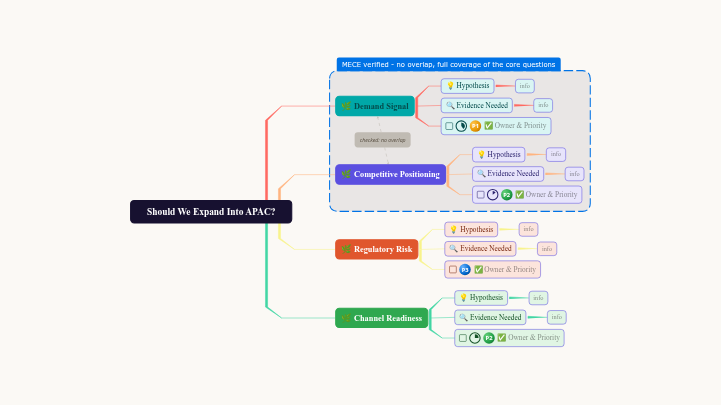
Issue trees template
Should We Expand Into APAC?
🌿 Channel Readiness
Add the task owner and the priority level.🌿 Regulatory Risk
🌿 Competitive Positioning
Add the owner and priority level.🌿 Demand Signal
✅ Owner & Priority
Add an owner and priority level.🔍 Evidence Needed
💡 Hypothesis
info
Pourquoi utiliser un modèle de carte mentale Mindomo?
Un modèle a plusieurs fonctionnalités: