
Syntax Template

Interactive map · Syntax Template
Mind map: Syntax Template

Syntax Template

Free with a Mindomo account. Opens your own copy in the editor.

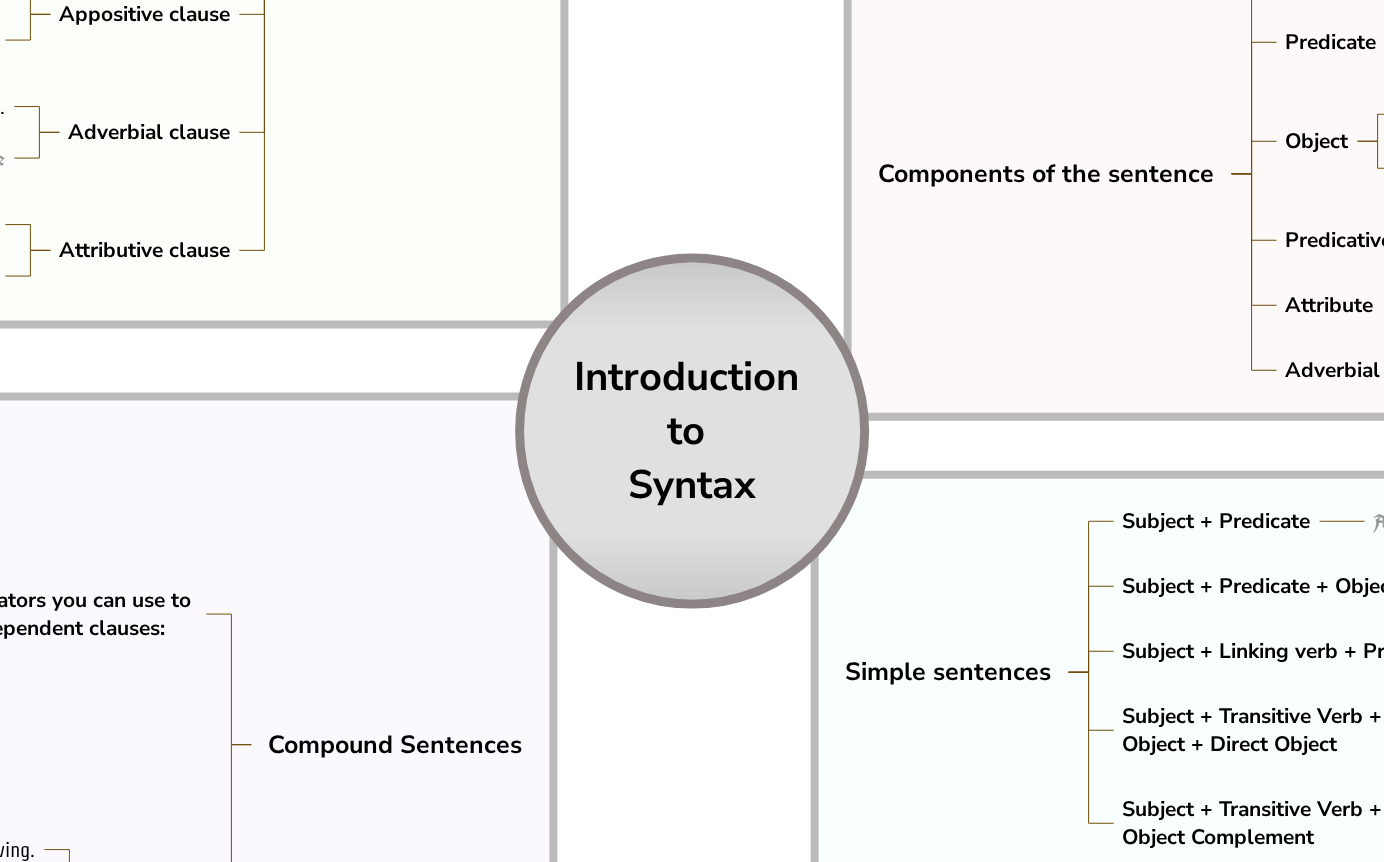
Use this mind map to become familiar with the phrase components and to have a better understanding of the different types of subordinate clauses.

  • Free
  • Grammar
  • Mind map
  • 39 topics
  • 3,434 views

Free with a Mindomo account. Opens your own copy in the editor.

About this template

Introduction to Syntax

Use this template to learn about the syntax and understand phrase components and subordinate clauses. The components of the sentence are subject, predicate, object, predicative, attribute, and adverbial. These are used to form different types of sentences: simple sentences, compound sentences, and complex sentences.

What’s inside this template

Syntax Template: what the map covers

Central topic

Introduction to Syntax

In linguistics, syntax is the set of rules, principles, and processes that govern the structure of sentences in a given language, usually including word order.

Components of the sentence

6 topics

Subject

The subject of a sentence is the person, place, thing, or idea that is doing or being something. You can find the subject of a sentence if you can find the verb. Ask the question, "Who or what 'verbs' or 'verbed'?" and the answer to that question is the subject.

Predicate

The predicate of a sentence is the part that modifies the subject in some way. Because the subject is the person, place, or thing that a sentence is about, the predicate must contain a verb explaining what the subject does and can also include a modifier.

Object

Traditional grammar defines the object in a sentence as the entity that is acted upon by the subject.

  • Direct object — The direct object is the receiver of the action mentioned in the sentence.
  • Indirect object — The indirect object identifies the person/thing for whom/which the action of the verb is performed. The indirect object is usually a person or a thing.

Predicative

The predicative is defined as an adjective or noun forming or contained in the predicate. Its main trait is that it serves to express a property that is assigned to a "subject". For e.g.: The dog is old.

Attribute

The attribute is defined as a quality or characteristic of a person, place or thing.

Adverbial

An adverbial is an individual word (that is, an adverb), a phrase, or a clause that can modify a verb, an adjective, or a complete sentence.
Simple sentences

5 topics

Subject + Predicate

See the example below and try to create your own simple sentences. Tim drives.

Subject + Predicate + Object

See the example below and try to create your own simple sentences. Tim drives the car.

Subject + Linking verb + Predicative

See the example below and try to create your own simple sentences. Tim is the driver.

Subject + Transitive Verb + Indirect Object + Direct Object

See the example below and try to create your own simple sentences. Tim is driving the car with his mother.

Subject + Transitive Verb + Object + Object Complement

See the example below and try to create your own simple sentences. Tim is driving the red car.

Complex Sentences

6 topics

A complex sentence is a sentence that contains an independent clause and one or more dependent clauses. An independent clause can stand alone as a sentence, but a dependent clause even though it has a subject and a verb cannot stand alone.

Object Clause

The object clause is a phrase on which a verb performs an action. It falls at the end of a sentence, and is governed by a verb or a preposition.

  • We didn’t realize she was so ill.

Predicative clause

A predicative clause may be introduced by conjunctions - that, whether, whether... or, as, as if, as though, because, lest, the way - or connectives. The latter may be conjunctive pronouns - who, whoever, what, whatever, which - or conjunctive adverbs - where, wherever, when, whenever, how, why.

  • The question is whether we can manage without him.

Subject clause

The subject clause is a dependent clause that acts as a subject.

  • We like the person who teaches us German.

Appositive clause

An appositive clause follows another noun or noun phrase in apposition to it; that is, it provides information that further identifies or defines it.

  • Chopin, a Polish composer, was one of the most celebrated pianists of his day.

Adverbial clause

An adverbial clause is a group of two or more words that function as an adverb in a sentence.

  • We couldn't park anywhere near the park.

Attributive clause

Attributive clauses serve as an attribute to a noun (pronoun) in the main clause. This noun or pronoun is called the antecedent of the clause.

  • He went to the next house, which stood in a small garden.

Compound Sentences

2 topics

A compound sentence is a sentence that has at least two independent clauses joined by a comma, semicolon or conjunction. An independent clause is a clause that has a subject and verb and forms a complete thought.

Coordinators you can use to join independent clauses:

When independent clauses are joined with coordinators (also called coordinating conjunctions), commas and semicolons, they do more than just join the clauses. They add meaning and flow to your writing.

  • For
  • And
  • Nor
  • But
  • Or
  • Yet
  • So

Examples:

Create your own compound sentences, using the coordinators above.

  • Tim is tired, yet he's driving.

How to use it

  1. 1

    Open the template

    Click “Use this template” and sign in with a free account.

  2. 2

    Make it yours

    Replace the topics and fill in the notes.

  3. 3

    Share it

    Share, present or export it, or switch it to an outline or Gantt view.