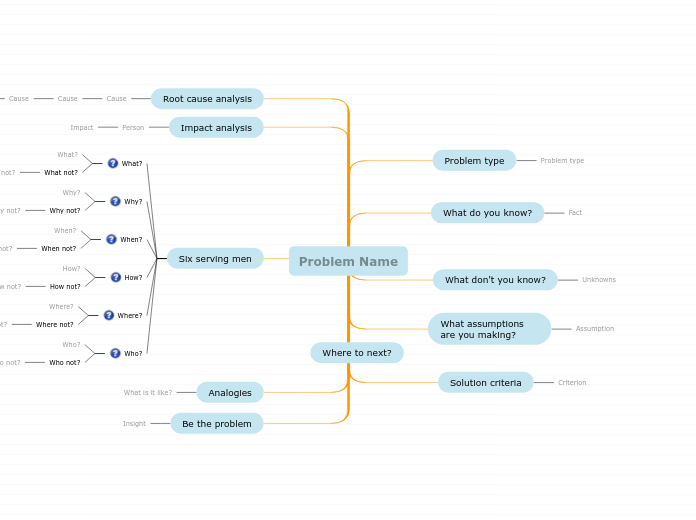

Enter your problem's name and categorize it, whether you want to sort something out, create or just change something. Identify all the information you know as well as the one you don't know about it: include measurements, statistics, surveys or any known data together with uncertain or missing information, anything that will help you frame the entire difficulty. Specify the suppositions you make and think of results in case your presumptions are not valid. Give at least as much importance to the final outcome of a problem, as to the problem state itself. Try out the impersonation technique and be the problem as if it were a person. Once you do this, observe if anything changes, how things are perceived from this perspective, what are the opportunities and obstacles from this approach? Apply the problem analysis method 'Six serving men' and answer openly to each of the six essential questions, both positive and negative to better track the triggers and the situations when the problem manifests itself. The problem description toolbox goes hand in hand with the 5 Whys approach, so include it in the problem's final assessment and go to the root cause of the original issue. Where to next? Name the problem Add a statement describing the problem as if it were a person. What is 'Problem Name' like? Who does not cause 'Problem Name'? Who causes 'Problem Name'? Where does 'Problem Name' not happen? Where does 'Problem Name' happen? How does 'Problem Name' not happen? How does 'Problem Name' happen? When does 'Problem Name' not happen? When does 'Problem Name' happen? Why is 'Problem Name' not a problem? Why is 'Problem Name' a problem? What does not cause 'Problem Name'? What causes 'Problem Name'? Who is affected? How is Person affected by 'Problem Name'? Root Cause analysis Why does 'Problem Name' happen? Why does 'Cause' happen? Why does 'Cause' happen? Why does 'Cause' happen? Why does 'Cause' happen? Add solution criteria Add an assumption Add an unknown factor Add a piece of data Describe the problem type マインドマップは、ブレインストーミングや概念同士の関係づけ、アイデアの整理・創出に役立ちます。 マインドマップテンプレートには、特定のテーマに関する情報と作成のヒントがあらかじめ組み込まれているため、より簡単に始められます。テーマに必要な要素がそろった構造が用意されているので、自分だけのマインドマップの出発点として使えます。ビジネスでも教育でも、特定のトピックについてマインドマップを作成するときに役立つ実用的なリソースです。 Mindomoでは、便利なスマートマインドマップテンプレートをご用意しています。 マインドマップテンプレートは、Mindomoのビジネスアカウントや教育アカウントで用意されたものから選べるほか、独自のテンプレートを一から作成することもできます。どのマインドマップも、トピックにガイドノートを追加するだけでテンプレートに変換できます。このテンプレートについて
Problem analysis template
Where to next?
When you have a comprehensive description of the problem, you can move towards finding solutions.
Consider brainstorming as a next step or Share the mind map with your colleagues.Problem Name
Identify the problem or issue in a few words and press Enter. This will become the title of your map.Be the problem
Insight
Analogies
What is it like?
For example, how would the problem behave at a wedding, at a concert, in a supermarket, or underwater?Six serving men
Who?
Who not?
Where?
Where not?
How?
How not?
When?
When not?
Why?
Why not?
What?
What not?
Impact analysis
Person
Type in a name or role of someone who is affected by 'Problem Name'Impact
Rate the impact by clicking an icon:Root cause analysis
For analytical problems, root cause analysis can help to unravel indirect causes of problems, leading to more effective solutions. One way to do this is to keep asking 'Why?' down to five levels, to understand the reasons behind the reasons.Cause
Enter a reason that 'Problem Name' happens.
Enter a reason that 'Cause' happens.
(Level 2 of 5)
Enter a reason that 'Cause' happens.
(Level 3 of 5)
Enter a reason that 'Cause' happens.
(Level 4 of 5)
Enter a reason that 'Cause' happens.
(Level 5 of 5)Solution criteria
Criterion
Make sure you consider:What assumptions are you making?
Assumption
Identify an assumption you are making in both the description of the problem and the logical solution.What don't you know?
Unknowns
Identify information or data that is not known or not reliable, and what you can do to find it. Think about:What do you know?
Fact
Add data or a reference to the problem. Think about:Problem type
Select the problem type or enter your own description.Mindomoのマインドマップテンプレートを使う理由
テンプレートには次のような機能があります:
-
製品
-
用途
-
ソリューション
-
リソース
- 基本を学ぶ
- マインドマップとは?
- マインドマップの作り方
- ガイドとサポート
- ビデオチュートリアル
- ヘルプセンター
- フォーラム
- 作例とテンプレート
- マインドマップの作例29選
- コンセプトマップとは?
- 機能ページ
- 教育
- 教師向け課題機能
- 仕事・個人
- デスクトップ
- Mindomoブログ
- 料金
- ログイン
- 新規登録
- ダッシュボード
ナレッジマネジメント
マインドマップのメリット
視覚的思考が記憶と計画を楽にする理由。