Pricing
Log In Sign Up Dashboard
  • Products
    • Create
    • AI Mind Map Generator
    • Outlining Software
    • Gantt Chart Software
    • Get Mindomo
    • Download Mindomo
    • Browser Extension
    • What's New
    • Mind Map Templates
    • Compare all features
  • Uses
    • General Uses
    • Mind Maps for Education
    • Mind Maps for Business
    • Mind Maps for Personal Development
    • Assistive Technology
    • Team Collaboration
    • Campaign briefs for marketers
    • Client discovery workshops for consultants
    • Onboarding journeys for HR & L&D
    • Knowledge Management
    • Team Skills Matrix
    • Engagement Library
    • Roles
    • Marketers
    • HR & L&D
    • Consultants
    • Project Management
    • Marketing campaign planning
    • Employee training rollouts
    • Scope of Work
    • Idea Organization
    • Issue Trees
    • Training Needs Analysis
    • Mind Mapping Benefits
  • Solutions
    • Guides
    • Make Presentations with Mind Maps
    • How to Learn with Mind Maps
    • Plan and Organize with Mind Maps
    • Prioritize Tasks with Mind Maps
    • Take Notes with Mind Maps
    • Real Customer Stories
    • Scaling educational content for 11,000 doctors
    • Team workflow: from trial to indispensable in two months
    • 10 years without slides: rethinking architecture lectures
    • Read all stories
  • Resources
    • Learn the basics
    • What is a Mind Map?
    • How to Mind Map?
    • What is a Concept Map?
    • Benefits of Mind Mapping
    • Guides & Support
    • Video tutorials
    • Help center
    • Forum
    • Examples & templates
    • Top 30 Mind Map Examples
    • Concept Map Templates
    • How to Make a Gantt Chart
    • Mindomo's Efficiency in Education
    • Feature pages
    • Education
    • Teacher Assignments
    • Work & Personal
    • Desktop
    • The Mindomo blog
  • Pricing
  • Log In
  • Sign Up
  • Dashboard
Create
  • AI Mind Map Generator Turn a prompt or a document into a diagram in seconds.
  • Outlining Software Write a structured outline and see it as a map.
  • Gantt Chart Software Turn topics into tasks and see the whole timeline.
Get Mindomo
  • Download Mindomo Work offline on Windows, macOS and Linux.
  • Browser Extension Save sources, or generate a mind map with AI.
  • What's New New See the latest features and improvements.
Templates Mind Map Templates Start from a map that already works, then make it yours.
Compare all features
General Uses
  • Mind Maps for Education
  • Mind Maps for Business
  • Mind Maps for Personal Development
  • Assistive Technology
Team Collaboration
  • Campaign briefs for marketers
  • Client discovery workshops for consultants
  • Onboarding journeys for HR & L&D
Knowledge Management
  • Team Skills Matrix
  • Engagement Library
Roles
  • Marketers
  • HR & L&D
  • Consultants
Project Management
  • Marketing campaign planning
  • Employee training rollouts
  • Scope of Work
Idea Organization
  • Issue Trees
  • Training Needs Analysis
Mind Mapping Benefits Why visual thinking makes recall and planning easier.
Guides
  • Make Presentations with Mind Maps
  • How to Learn with Mind Maps
  • Plan and Organize with Mind Maps
  • Prioritize Tasks with Mind Maps
  • Take Notes with Mind Maps
Real Customer Stories
  • Healthcare Scaling educational content for 11,000 doctors
  • Teams Team workflow: from trial to indispensable in two months
  • Education 10 years without slides: rethinking architecture lectures
Read all stories
Learn the basics
  • What is a Mind Map?
  • How to Mind Map?
  • What is a Concept Map?
  • Benefits of Mind Mapping
Guides & Support
  • Video tutorials
  • Help center
  • Forum
Examples & templates
  • Top 30 Mind Map Examples
  • Concept Map Templates
  • How to Make a Gantt Chart
  • Mindomo's Efficiency in Education
Feature pages
  • Education
  • Teacher Assignments
  • Work & Personal
  • Desktop
Blog The Mindomo blog Guides, examples and research on visual thinking. Browse all articles
  1. Mind maps
  2. /
  3. Eat That Frog by Brian Tracy: Summary
‹ Mind maps

Eat That Frog by Brian Tracy: Summary

MT

by Mindomo Team
Updated November 20, 2026

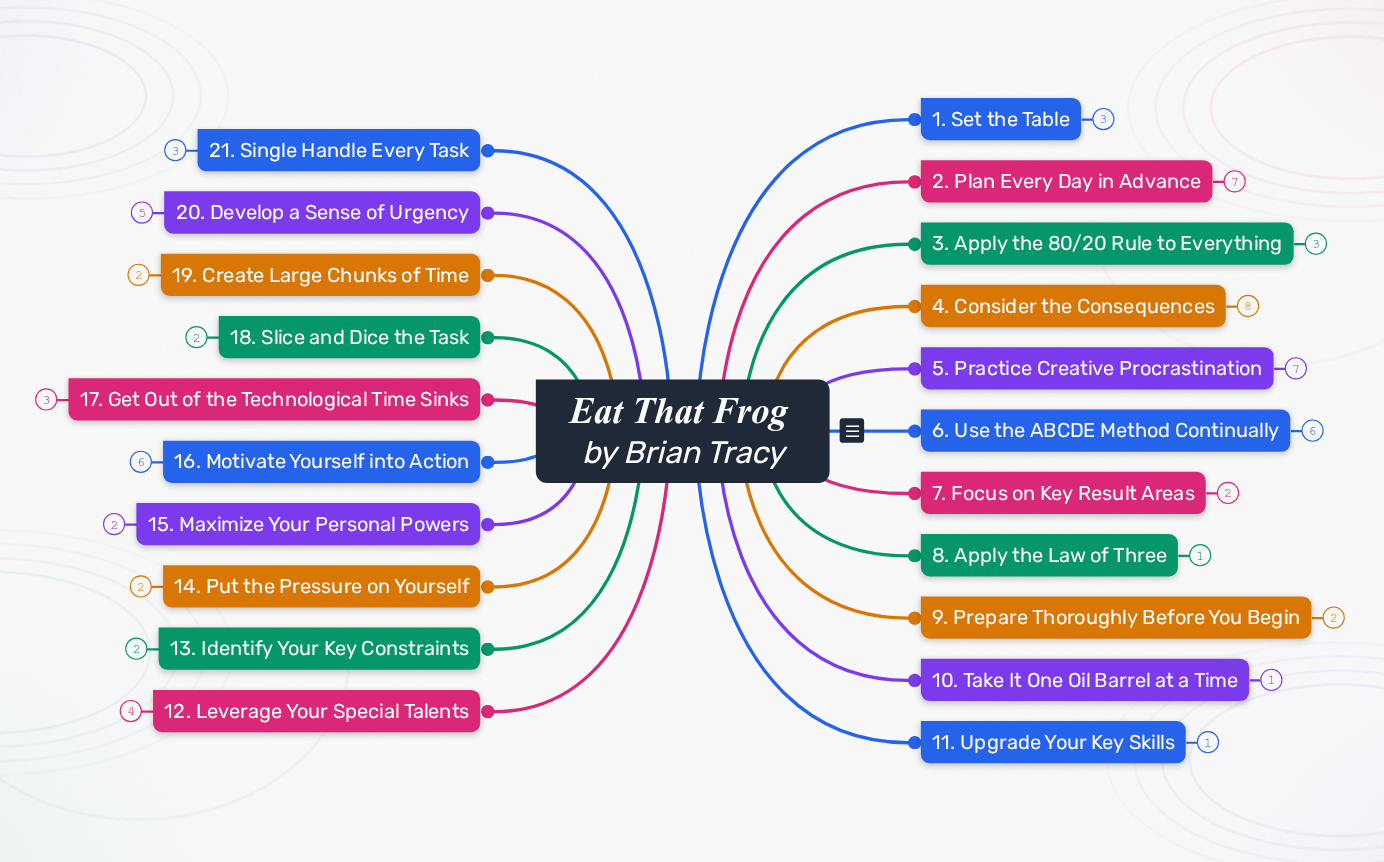
Interactive map · Eat That Frog by Brian Tracy: Summary
Mind map: Eat That Frog by Brian Tracy: Summary

Eat That Frog by Brian Tracy: Summary

Loading the interactive map…

Free with a Mindomo account. The copy is yours to edit.

This map summarizes Brian Tracy’s methods for overcoming procrastination. It explains how to prioritize important tasks, plan ahead, and maintain focused action.

  • Mind map
  • 93 topics
  • 4,620 views

Free with a Mindomo account. The copy is yours to edit.

What’s inside this mind map

Eat That Frog by Brian Tracy: Summary: the full outline

Key concepts

  • 80/20 Rule
  • ABCDE Method
  • Creative Procrastination
  • Key Result Areas
  • Law of Three
  • Single Handle Every Task

Central topic

Eat That Frog Summary "Your ‘frog’ is your biggest, most important task, the one you are most likely to procrastinate on if you don’t do something about it.” “The first rule of frog eating is this: If you have to eat two frogs, eat the ugliest one first.” “Continually remind yourself that one of the most important decisions you make each day is what you will do immediately and what you will do later if you do it at all.” “The second rule of frog eating is this: If you have to eat a live frog at all, it doesn’t pay to sit and look at it for very long.” “The key to reaching high levels of performance and productivity is to develop the lifelong habit of tackling your major task first thing each morning.”


1. Set the Table2. Plan Every Day in Advance3. Apply the 80/20 Rule to Everything4. Consider the Consequences5. Practice Creative Procrastination6. Use the ABCDE Method Continually7. Focus on Key Result Areas8. Apply the Law of Three9. Prepare Thoroughly Before You Begin10. Take It One Oil Barrel at a Time11. Upgrade Your Key Skills21. Single Handle Every Task20. Develop a Sense of Urgency19. Create Large Chunks of Time18. Slice and Dice the Task17. Get Out of the Technological Time Sinks16. Motivate Yourself into Action15. Maximize Your Personal Powers14. Put the Pressure on Yourself13. Identify Your Key Constraints12. Leverage Your Special Talents

1. Set the Table

3 topics
  • “Think on paper.”
  • “One of the very worst uses of time is to do something very well that need not be done at all.”
  • “Think about your goals and review them every morning. Take action on the most important task you can accomplish to achieve your most important goal at the moment.”

2. Plan Every Day in Advance

7 topics
  • “Always work from a list.”
  • “Make your list the night before for the workday ahead.”
  • “You need different lists for different purposes.”
  • “Create a master list on which you write down everything you can think of that you want to do sometime in the future.”
  • “Second, you should have a monthly list that you make at the end of the month for the month ahead.”
  • “Third, you should have a weekly list where you plan your entire week in advance.”
  • “Finally, you should transfer items from your monthly and weekly lists onto your daily list.”

3. Apply the 80/20 Rule to Everything

3 topics
  • “Before you begin work, always ask yourself, ‘Is this task in the top 20 percent of my activities or in the bottom 80 percent?’”
  • “Resist the temptation to clear up small things first.”
  • “Your ability to choose between the important and the unimportant is the key determinant of your success in life and work.”

4. Consider the Consequences

8 topics
  • “Long-term thinking improves short-term decision making.”
  • “In your work, having a clear idea of what is really important to you in the long term makes it much easier for you to make better decisions about your priorities in the short term.”
  • “Before starting on anything, you should always ask yourself, ‘What are the potential consequences of doing or not doing this task?’”
  • “Future intent influences and often determines present actions.”
  • “Successful people are those who are willing to delay gratification and make sacrifices in the short term so that they can enjoy far greater rewards in the long term.”
  • “Motivation requires motive.”
  • The Law of Forced Efficiency: “There is never enough time to do everything, but there is always enough time to do the most important thing.”
  • “Do first things first and second things not at all.”

5. Practice Creative Procrastination

7 topics
  • “The difference between high performers and low performers is largely determined by what they choose to procrastinate on.”
  • “To set proper priorities, you must set posteriorities as well.”
  • “A priority is something that you do more of and sooner, while posteriority is something that you do less of and later, if at all.”
  • “You can get your time and your life under control only to the degree to which you discontinue lower-value activities.”
  • “Say no to anything that is not a high-value use of your time and your life.”
  • “Continually review your life and work to find time-consuming tasks and activities that you can abandon. Cut down on television watching and instead spend the time with your family, read, exercise, or do something else that enhances the quality of your life.”
  • “Ask yourself continually, ‘If I were not doing this already, knowing what I now know, would I start doing it again today?’”

6. Use the ABCDE Method Continually

6 topics
  • “An ‘A’ item is defined as something that is very important, something that you must do. This is a task that will have serious positive or negative consequences if you do it or fail to do it."
  • “A ‘B’ item is defined as a task that you should do.”
  • “The rule is that you should never do a B task when an A task is left undone.”
  • “A ‘C’ task is defined as something that would be nice to do but for which there are no consequences at all, whether you do it or not.”
  • “A ‘D’ task is defined as something you can delegate to someone else.”
  • “An ‘E’ task is defined as something that you can eliminate altogether, and it won’t make any real difference.”

7. Focus on Key Result Areas

2 topics
  • “Your weakest key result area sets the height at which you can use all your other skills and abilities.”
  • One of the greatest questions you will ever ask yourself: “What one skill, if I developed and did it in an excellent fashion, would have the greatest positive impact on my career?”

8. Apply the Law of Three

1 topic
  • “It is the quality of time at work that counts and the quantity of time at home that matters.”

9. Prepare Thoroughly Before You Begin

2 topics
  • Get everything you need at hand before you begin.
  • Brian’s personal rule is “Get it 80 percent right and then correct it later.

10. Take It One Oil Barrel at a Time

1 topic
  • Get your mind off the huge task in front of you and focus on a single action that you can take.

11. Upgrade Your Key Skills

1 topic
  • “Continuous learning is the minimum requirement for success in any field.”

21. Single Handle Every Task

3 topics
  • “Every great achievement of humankind has been preceded by a long period of hard, concentrated work until the job was done.”
  • “Your ability to select your most important task, to begin it, and then to concentrate on it single-mindedly until it is complete is the key to high levels of performance and personal productivity.”
  • “Single handling requires that once you begin, you keep working at the task without diversion or distraction until the job is 100 percent complete.”

20. Develop a Sense of Urgency

5 topics
  • “When you work on your most important tasks at a high and continuous level of activity, you can actually enter into an amazing mental state called ‘flow.’”
  • “One of the ways you can trigger this state of flow is by developing a sense of urgency.”
  • “With this ingrained sense of urgency, you develop a ‘bias for action.’”
  • “When you regularly take continuous action toward your most important goals, you activate the Momentum Principle of success. This principle says that although it may take tremendous amounts of energy to overcome inertia and get started initially, it then takes far less energy to keep going.”
  • “One of the simplest and yet most powerful ways to get yourself started is to repeat the words ‘Do it now! Do it now! Do it now!’ over and over to yourself.”

19. Create Large Chunks of Time

2 topics
  • “Your ability to carve out and use these blocks of high-value, highly productive time is central to your ability to make a significant contribution to your work and to your life.”
  • “Make work appointments with yourself and then discipline yourself to keep them. Set aside thirty-, sixty- and ninety-minute time segments that you use to work on and complete important tasks.”

18. Slice and Dice the Task

2 topics
  • “With [the salami slice] method, you lay out the task in detail and then resolve to do just one slice of the job for the time being, like eating a roll of salami one slice at a time—or like eating an elephant one bite at a time.”
  • “You use [the Swiss cheese] technique to get yourself into gear by resolving to punch a hole in the task, like a hole in a block of Swiss cheese. You Swiss cheese a task when you resolve to work for a specific time period on it. This may be as little as five or ten minutes, after which you will stop and do something else.”

17. Get Out of the Technological Time Sinks

3 topics
  • “For you to stay calm, clearheaded, and capable of performing at your best, you need to detach on a regular basis from the technology and communication devices that can overwhelm you if you are not careful.”
  • “For you to be able to concentrate on those few things that make the most difference in your business or personal life, you must discipline yourself to treat technology as a servant, not as a master.”
  • “Resist the urge to start turning on communication devices as soon as you wake up in the morning.”

16. Motivate Yourself into Action

2 topics
  • Optimism is the most important quality you can develop for personal and professional success and happiness.

Optimists have four special behaviors, all learned through practice and repetition:

  • They look for the good in every situation
  • They always seek the valuable lesson in every setback or difficulty
  • They always look for the solution to every problem
  • They think and talk continually about their goals

15. Maximize Your Personal Powers

2 topics
  • “Whenever you feel overtired and overwhelmed with too much to do and too little time, stop yourself and just say, ‘All I can do is all I can do.’”
  • “Take one full day off every week. During this day, either Saturday or Sunday, absolutely refuse to read, clear correspondence, catch up on things from the office, or do anything else that taxes your brain.”

14. Put the Pressure on Yourself

2 topics
  • “To reach your full potential, you must form the habit of putting the pressure on yourself and not waiting for someone else to come along and do it for you.”
  • Work as though you have only one day to get your most important jobs done.

13. Identify Your Key Constraints

2 topics
  • Successful people always begin the analysis of constraints by asking the question, “What is it in me that is holding me back?”
  • Keep asking, “What sets the speed at which I get the results I want?”

12. Leverage Your Special Talents

1 topic

Continually ask yourself these key questions:

  • “What am I really good at? What do I enjoy the most about my work?”
  • “What has been most responsible for my success in the past?”
  • “If I could do any job at all, what job would it be?”

Make a mind map like this one

Free with a Mindomo account. The copy is yours to edit.

Eat That Frog by Brian Tracy: Summary

  • About Mindomo
  • What's New New
  • Customer Stories
  • Blog
  • Pricing
  • Help Center
  • Forum
  • Contact
Products
  • AI Mind Map Generator
  • Concept Map Maker
  • Outlining Software
  • Gantt Chart Software
  • Task Management
  • Mind Map Templates
  • Desktop App
  • Browser Extension
Integrations
  • MCP Server
  • Developer API
  • Microsoft Teams
  • All Integrations
Compare
  • vs MindMeister
  • vs XMind
  • vs MindManager
  • Best Mind Mapping Software
  • Best Gantt Chart Software
Learn
  • What is a Mind Map?
  • What is a Concept Map?
  • How to Mind Map?
  • How to Make a Concept Map?
  • Top 30 Mind Map Examples
  • Concept Map Templates
  • Diagram Templates
  • Mind Map Ideas
  • Mind Map Ideas for Students
Guides
  • Take Notes with Mind Maps
  • Prioritize Tasks with Mind Maps
  • How to Create a Resume?
  • How to Make a Gantt Chart
  • Mind Mapping Benefits
  • Mindomo's Efficiency in Education
  • Assistive Technology

Terms of Use Privacy Policy AI Terms Data Processing Agreement Security Accessibility

Copyright © 2026 Expert Software Applications SRL. All rights reserved.

Str. Ciprian Porumbescu 5A, 300236 Timișoara, Romania · EUID ROONRC.J2002000147358 · VAT ID RO14440290