

Narrative Points of View

Interactive map · Narrative Points of View
Mind map: Narrative Points of View

Narrative Points of View

Free with a Mindomo account. Opens your own copy in the editor.

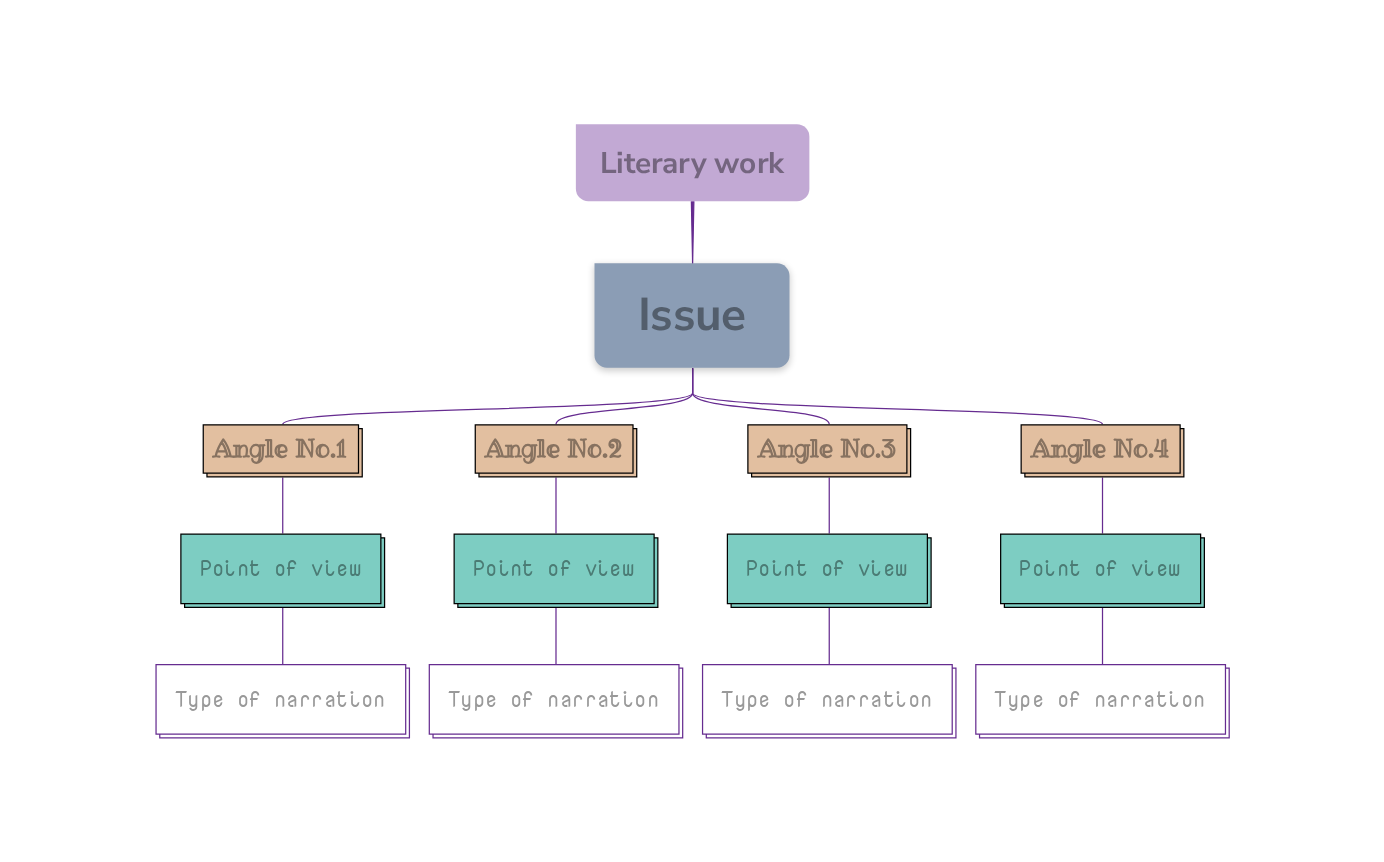
This mind map will help you discover the multiple perspectives from which you can analyze an issue from your literary work.

Free with a Mindomo account. Opens your own copy in the editor.

About this template

Identifying Multiple author’s perspectives

Identifying multiple author’s perspectives can be difficult if you do not organize your ideas. Use this mind map template to look at an issue from four different angles.

What’s inside this template

Narrative Points of View: what the map covers

Central topic

Literary work

Type in the name of the multiple-perspectives text. Example: Bridge to Terabithia by Katherine Paterson

Issue

Identify an important issue from the text that is being presented from different angles. Type it in. Example: Jesse's drawing talent.

Angle No.1

1 topic

Decide on the first point of view you are going to present. Type in the name of the character (it can either be the main character or one of the supporting characters) whose point of view belongs to. Example: Jesse Oliver Aarons, Jr., the main character of the novel, a fifth-grader living in a rural Southern area.

  • Point of view — Type in a relevant quote that highlights the character's point of view towards Issue. Try following a citation format: author's name, chapter, and page. Example: "Jesse drew the way some people drank whiskey. (...) Lord, he loved to draw. (...) When he was in first grade, he told his father that he wanted to be an artist when he grew up." (Paterson, 2. 7)
    • Type of narration: What type of narration introduces the viewpoint? Choose an answer: First person point of view - using the personal pronouns "I" or "we" Second person point of view - using the personal pronoun "you" Third person point of view - using the third-person pronouns "he", "she" and "they" Omniscient point of view - an all-seeing observer tells the story
Angle No.2

1 topic

Decide on the second point of view Name the character (it can either be the main character or one of the supporting characters) whose point of view you are presenting. Example: Miss Edmunds, Jesse's music teacher.

  • Point of view — Type in a quote that points out the character's position about the issue. Try to follow a citation format: author's name, chapter, and page. Example: "She said he was unusually talented, and she hoped he wouldn't let anything discourage him." (Paterson, 2. 8)
    • Type of narration: How is the viewpoint introduced in the story? Choose an answer: First person point of view Second person point of view Third person point of view Omniscient point of view

Angle No.3

1 topic

Whose character does the third point of view belong to? Type in his/her name. Example: Mr. Aarons, Jesse's father.

  • Point of view — What does the character think, say or do that suggests their perspective on the issue? Type in a quote and try to maintain the citation format. Example: "He would like to show his drawings to his dad, but he didn't dare. (...) He'd thought his dad would be pleased. He wasn't. What are they teaching in that damn school? he had asked." (Paterson, 2.8)
    • Type of narration: What kind of narration introduces the viewpoint? Choose an answer: First person point of view - using the personal pronouns "I" or "we" Second person point of view - using the personal pronoun "you" Third person point of view - using the third-person pronouns "he", "she" and "they" Omniscient point of view - an all-seeing observer tells the story
Angle No.4

1 topic

Decide on the fourth point of view Type in the name of the last character whose perspective on the issue you are going to present. Example: Leslie Burke, Jesse's new next-door neighbor, and best friend.

  • Point of view — Point of view Type in a relevant quote that highlights the character's point of view. Try to follow a citation format: author's name, chapter, and page. Example: I can't get the poetry of the trees," he said. She nodded. Don't worry," she said. You will someday. He believed her." (Paterson, 4. 24)
    • Type of narration: How is the viewpoint introduced in the story? Choose an answer: First person point of view - using the personal pronouns "I" or "we" Second person point of view - using the personal pronoun "you" Third person point of view - using the third-person pronouns "he", "she" and "they" Omniscient point of view - an all-seeing observer tells the story
How to use it

  1. 1

    Open the template

    Click “Use this template” and sign in with a free account.

  2. 2

    Make it yours

    Replace the topics and fill in the notes.

  3. 3

    Share it

    Share, present or export it, or switch it to an outline or Gantt view.