
Employee Offboarding Template

Interactive map · Employee Offboarding Template
Mind map: Employee Offboarding Template

Employee Offboarding Template

Free with a Mindomo account. Opens your own copy in the editor.

Handle every employee exit without losing knowledge, access, or the chance to learn from it with this Employee Offboarding HR template. Designed for HR teams, managers, and IT and operations staff who handle departures, this template helps track notice dates and who needs to know, capture what only the leaver knows, assign handovers to named receivers, reassign clients and stakeholders, revoke accounts and rotate shared credentials, recover equipment, and run an exit interview that produces something usable. Use it to protect institutional knowledge, close security gaps on the last day, spot patterns across repeated exits from the same team, and decide whether to replace, redistribute, or restructure the role.

Free with a Mindomo account. Opens your own copy in the editor.

About this template

Employee offboarding template

This employee offboarding template helps HR teams, managers, and IT departments coordinate a clear, secure, and consistent departure process. It brings together exit tasks, knowledge transfer, handover responsibilities, access removal, equipment returns, documentation, and exit conversations in one visual workspace.

Use this template to assign owners, track deadlines, protect company information, preserve essential knowledge, and ensure all administrative steps are completed. It supports voluntary resignations, retirements, contract endings, and other employee departures while creating a professional experience for both the departing employee and the organization.

What’s inside this template

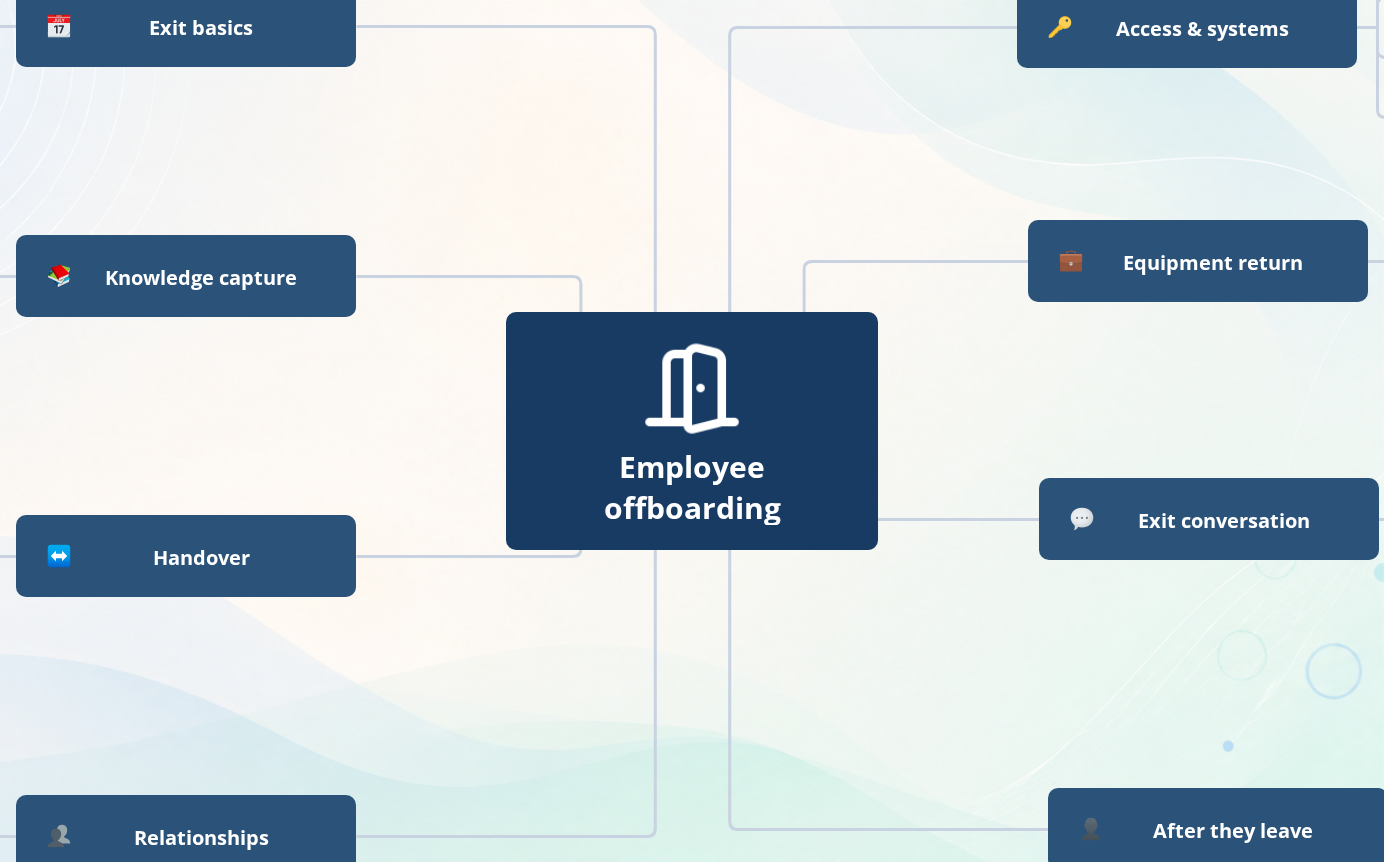
Employee Offboarding Template: what the map covers

Central topic

Use this map to coordinate a clear, secure and respectful employee departure from notice through post-exit follow-up.

Exit basics

4 topics

Record the key employment details, dates and communication responsibilities for the departure.

Last working day

Enter the employee's confirmed final working date.

Notice period ends

Enter the contractual end date of the employee's notice period.

Reason for leaving

Record the agreed category and a factual summary of why the employment is ending.

Who needs to know

List each person or group to inform, who will tell them and the appropriate timing.
Knowledge capture

4 topics

Identify knowledge, access and unfinished work that could be lost when the employee leaves.

Tasks nobody else does

List recurring or critical tasks for which no reliable cover currently exists.

Sole system admin access

Identify systems where the departing employee is the only administrator or privileged user.

Undocumented processes

Capture processes that currently rely on memory rather than clear documentation.

Work in progress

Record open work, its current status, next action, owner and relevant deadline.

Handover

5 topics

Assign each responsibility to a named receiver and confirm that the transfer is complete.

Task or system

Name the task, process or system being handed over.

Receiver

Assign a named person who will take ownership after the employee leaves.

Handover session

Schedule the walkthrough or shadowing session and record when it is complete.

Documented where

Link to or name the location of the supporting documentation.

Confirmed by receiver

Confirm that the receiver understands the handover and accepts ownership.

Relationships

4 topics

Reassign important internal and external relationships and make clear introductions.

Clients and accounts

List clients or accounts that need a new owner and note any sensitivities.

Internal stakeholders

Identify colleagues or teams who depend on the employee and assign a new contact.

Suppliers and partners

List external suppliers or partners that require a new company contact.

Introductions sent

Confirm that the departing employee or manager has made the required introductions.

Access & systems

4 topics

Plan the secure transfer or removal of accounts, credentials, email and files.

Accounts to revoke

List user accounts and permissions to remove at the agreed time.

Shared credentials to rotate

Identify shared passwords, keys or secrets that must be changed securely.

Email forwarding

Decide whether email should be forwarded, delegated, archived or closed, and for how long.

Files transferred

Confirm that relevant files have been moved to an accessible company-owned location.

Equipment return

3 topics

Track every company asset and access item that must be returned or disabled.

Laptop and devices

List laptops, phones, storage devices and peripherals that must be returned.

Building access

Record passes, keys or access cards to collect or deactivate.

Company property

List any other company-owned items, documents or materials to recover.

Exit conversation

5 topics

Capture candid feedback in a structured conversation led by someone other than the employee's manager.

Interview date

Schedule the exit interview early enough for a useful and unhurried conversation.

Not their manager

Choose a neutral interviewer who is not the employee's direct manager.

Why they are leaving

Capture the employee's own explanation, using their words as accurately as possible.

What would have kept them

Ask which realistic changes might have influenced their decision to stay.

What they would change

Record practical suggestions about the role, team, management or organisation.

After they leave

5 topics

Decide how the work will be covered and identify any wider workforce actions after the exit.

Replace or redistribute

Decide whether to recruit, redistribute the work or leave the position open.

Skills the team now lacks

Identify capabilities or experience that will be missing after the departure.

Compare against last three exits

Check recent exits from the team for repeated reasons, managers or conditions.

Recruitment brief owner

Assign the person responsible for preparing and approving the recruitment brief.

Target start date

Set a realistic desired start date based on business need and likely recruitment lead time.

Offboarding best practices

5 topics

Use these controls to keep offboarding timely, secure and consistently recorded.

Treat people respectfully

Handle the departure with dignity, fairness and discretion from notice through the final day.

Communicate clearly

Confirm responsibilities, dates and next steps clearly with the employee and everyone involved.

Run an exit interview

Hold a structured exit interview to understand the employee's experience and reasons for leaving.

Secure access and property

Revoke access at the agreed time and recover all company equipment, keys and other property.

Plan succession and the next hire

Decide how the work will be covered and whether, when and how to recruit a replacement.

How to use it

  1. 1

    Open the template

    Click “Use this template” and sign in with a free account.

  2. 2

    Make it yours

    Replace the topics and fill in the notes.

  3. 3

    Share it

    Share, present or export it, or switch it to an outline or Gantt view.