
American English vs British English

Interactive map · American English vs British English
Mind map: American English vs British English

American English vs British English

Free with a Mindomo account. Opens your own copy in the editor.

Spot the differences between the two versions of the English language:

American English (AmE) and Standard British English (BrE).

Free with a Mindomo account. Opens your own copy in the editor.

About this template

British English vs American English

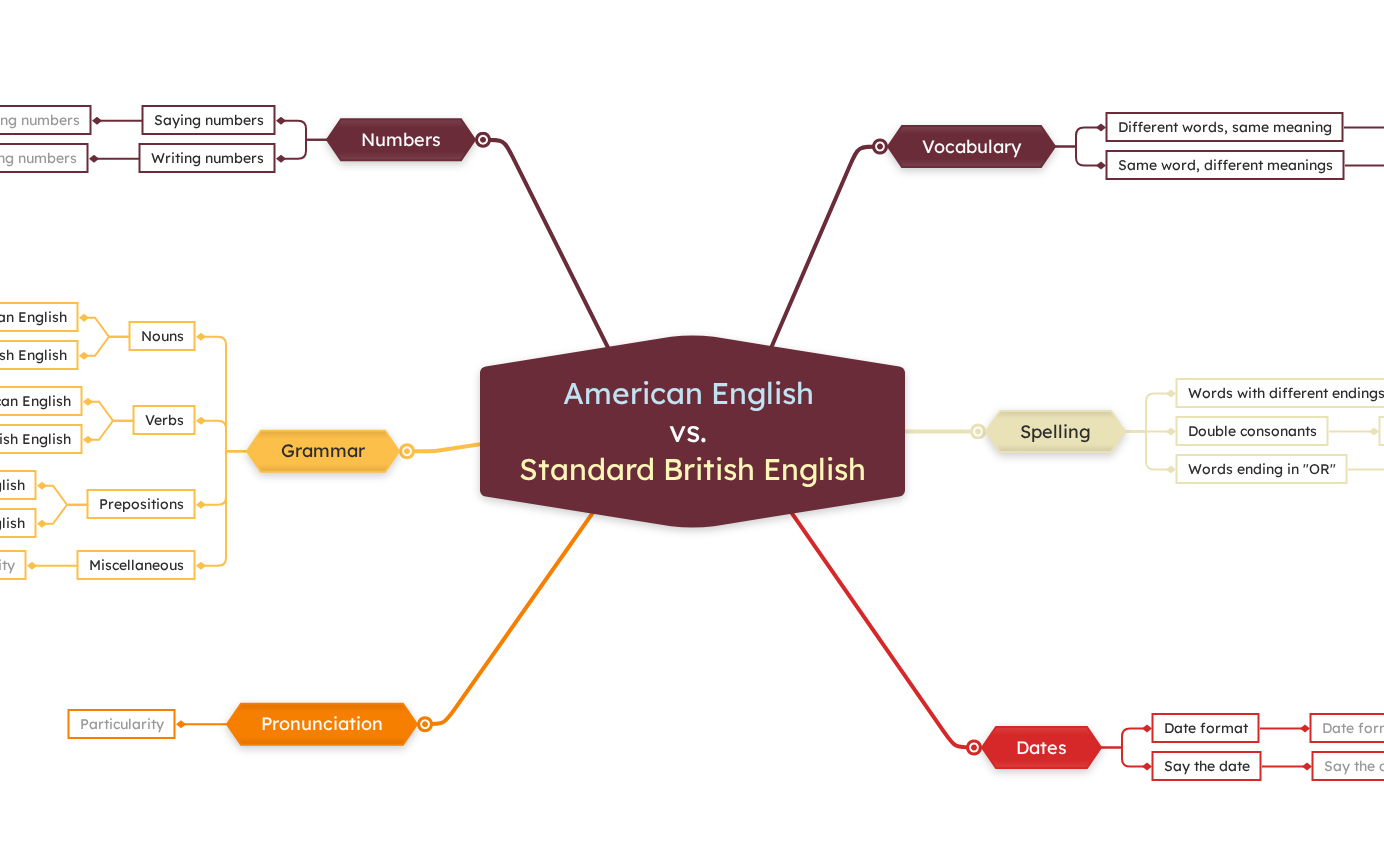
This British English vs American English template will help you learn the differences in vocabulary, spelling, dates, pronunciation, grammar, and numbers between American English and British English.

American English is spoken in the United States, and British English is spoken in the United Kingdom.

What’s inside this template

American English vs British English: what the map covers

Central topic

American English vs. Standard British English

Vocabulary

2 topics

Different words, same meaning

  • Particularity — Different words with the same meaning There are many objects that are described by different words in American and British English. Example: "Cookie" (AmE) and "biscuit" (BrE) both refer to the same sweet baked food. Type in some of these words.

Same word, different meanings

  • Particularity — The same word with different meanings Type in examples of words that have different meanings in American and Standard British English. Example: "bill" can both refer to paper money (AmE) and an invoice (BrE).
Spelling

3 topics

Words with different endings

  • Particularity — Words with different endings Type in the words which have one ending in American English and another one in Standard British English. Example: AmE has changed words ending in "re" in "er": "theater" and "theatre".

Double consonants

  • Particularity — Use of double consonants Type in the words that are written with double consonants only in one version of the language. Example: "traveler" (AmE) and "traveller" (BrE).

Words ending in "OR"

  • Particularity — Use of letter "U" in words ending in "OR" In American English, words ending in "OR" do not include the letter "U". Type in as many words as you can. Example: "color" (AmE) and "colour" (BrE).

Dates

2 topics

Date format

  • Date format — What is the difference in date format? The date is formatted differently in American English and Standard British English. Type in the two formats, taking into account that it has to include the day (DD), the month (MM) and the year (YYYY).

Say the date

  • Say the date — How do you say the date? AmE and BrE speakers say the date differently. Type in the two ways of saying the date in English, taking into account the order in which they say the day (DD), the month (MM) and the year (YYYY).

Numbers

2 topics

Saying numbers

  • Saying numbers — Type in some of these situations. Example: for the house numbers or bus numbers (or any short numbers of such), for example, 583, American speakers will say " five eighty-three", while British people will say " five eight three".

Writing numbers

  • Writing numbers — How is writing numbers different in American English from Standard British English? Type in some situations. Example: AmE speakers will drop the "and" before the tens and units, while the BrE speakers will always write numbers of such with "and": "two thousand fourteen" (AmE) or "two thousand and fourteen" (BrE).

Grammar

4 topics

Nouns

  • American English
    • Particularity: Noun differences Type in the particularities regarding the use of nouns in American English (AmE). For instance, collective nouns almost always take singular verb forms: The team was awarded first prize in the competition.
  • British English
    • Particularity: Noun differences Type in the particularities regarding the use of nouns in Standard British English (BrE). Here, collective nouns can take plural verb forms if the emphasis is on the individual members: The team were unable to agree on the defense strategy.

Verbs

  • American English
    • Particularity: Verb differences What are the particularities regarding the use of verbs in American English (AmE)? Type them in. Take into account the use of tenses, verb morphology, auxiliaries, transitivity, etc. Example: AmE occasionally uses simple past instead of past perfect to talk about an event in the recent past: I just arrived from work.
  • British English
    • Particularity: Verb differences What are the particularities regarding the use of verbs in Standard British English (BrE)? Type them in. Take into account the use of tenses, verb morphology, auxiliaries, transitivity, etc. Example: BrE uses present perfect along with the words "already", "just" and "yet" to talk about an event in the recent past: We have just arrived home.

Prepositions

  • American English
    • Particularity: Preposition differences Type in the particularities regarding the use of prepositions in American English (AmE). Example: American athletes play on a team.
  • British English
    • Particularity: Preposition differences Type in the particularities regarding the use of prepositions in Standard British English (BrE). Example: British sportsmen play in a team.

Miscellaneous

  • Particularity — Miscellaneous grammatical differences Type in any other miscellaneous particularities of the two language versions. Example: when naming rivers in AmE, the word "river" comes after the name: "Upper Delaware River". In BrE, "river" always comes in front of the name: "River Thames".

Pronunciation

1 topic

Particularity

What particularity in pronunciation have you spotted? Think of the sounds /o/ and /ae/, pronunciation of letter "T", unaccented syllables, etc. Example: sound /o/ is pronounced with rounded lips only in BrE.

How to use it

  1. 1

    Open the template

    Click “Use this template” and sign in with a free account.

  2. 2

    Make it yours

    Replace the topics and fill in the notes.

  3. 3

    Share it

    Share, present or export it, or switch it to an outline or Gantt view.