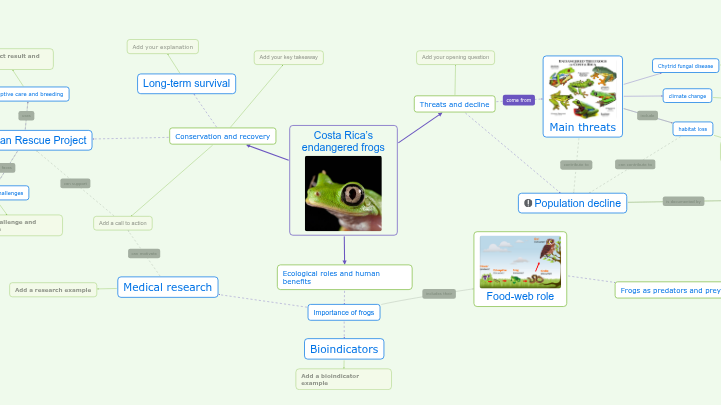
Explore Costa Rica’s endangered frogs with this interactive concept map template. Examine threats and population decline, ecological roles and human benefits, and conservation and recovery. Complete the input topics with explanations, examples and evidence from reliable sources. Use the labeled connections and wiki guidance to explain how the concepts relate and organise your findings for research, classroom activities or a report. This endangered frogs concept map helps students research and present the conservation of Costa Rica’s endangered frogs. It organizes the topic into threats and population decline, ecological roles and human benefits, the frog’s place in the food web, and conservation and recovery efforts such as the Amphibian Rescue Project. Use this template for science and biology projects, research reports, or class presentations. Students investigate threats like habitat loss, climate change, and chytrid fungal disease, explain why frogs matter as bioindicators and for medical research, and complete the input topics with evidence, verified statistics, and sources. Labeled links help them explain how each concept connects to the others. Describe a simple food-chain example involving a frog. Identify its prey and a predator, and explain what could change if the frog population declined. Explore five themes: threats, population decline, ecosystem roles, human benefits and solutions. Read each labeled arrow as a statement linking two concepts. Fill in the green input topics using evidence and sources. Check the climate–fungus relationship against your sources: effects can depend on species, location and conditions. Develop your main argument: why frogs matter, what the evidence shows and how conservation projects respond. Complete the supporting input topics with concise, sourced points. Explain why conserving frogs matters. Explore their ecological roles and research value using specific examples. Investigate one example of medical research involving amphibians. Distinguish potential applications from established treatments and cite the research. Add a research example Describe a specific research example and its stage of development. Include a reference. Explain what a bioindicator is and investigate why frogs may be used as indicators of environmental conditions. Include an example and a source. Add a bioindicator example Explain one example of frogs indicating environmental conditions. Add a source. Bring together the main findings without introducing a new argument. State your key takeaway and propose a realistic action your audience can take. Identify the conservation project you are discussing, where it operates and its aims. Explain its methods, results and limitations using reliable sources. Verify the project's methods with a source. Explain the purpose of captive care or breeding and how it relates to longer-term conservation goals. Add a project result and source Record one documented project result. State the project name, location, date and source. Identify one practical challenge facing the project. Explain its impact and suggest a realistic response. Add a challenge and response Identify one conservation challenge and explain a realistic way to address it. Suggest one concrete, realistic action and explain how it supports conservation. Summarize the most important message of your report in one or two sentences. Explain what frogs need for long-term survival. Connect your explanation to conservation measures and support it with evidence. Explain this idea in your own words, based on your source. State any limitations or uncertainties. Introduce the subject with an engaging opening. Explain the focus of your report and why your audience should care about frog conservation. Check the original source behind this statistic. Specify the date, geographic scope, animal group and what the percentage measures. Do not treat 'threatened', 'declining' and 'extinct' as interchangeable. Record a verified statistic, the group and region it covers, its meaning, the assessment date and the source. Write one question that will engage your audience and introduce the conservation issue. Investigate the threats listed below. Explain how each threat affects frogs and support your explanation with a specific example or source. Research the fungal disease mentioned in your source. Name it, explain its effects and cite the evidence you use. Add a disease explanation Name the disease, explain how it affects frogs and provide a source. Explain a possible link between changing climate conditions and frog survival. Use evidence and distinguish documented findings from predictions. Add climate evidence Summarize one sourced finding linking climate conditions to frog survival. Include the source and date. Describe a way habitat loss affects frogs. Identify the habitat involved, the cause of its loss and a possible protection measure. Add a habitat-loss example Name a specific example, explain its effect on frogs and include your source. Every Mindomo template opens with its structure already in place: descriptive topics, guiding notes attached to the branches where people usually get stuck, and a default shape that new topics inherit. Edit it in the browser, switch it to a concept map, outline or Gantt chart without redrawing anything, and export it in more than twenty formats. See how mind map templates work, or browse the full gallery by category.Endangered Frogs Concept Map
About this template
Endangered frogs concept map
Food-web role
Frogs as predators and prey
Costa Rica’s endangered frogs
Ecological roles and human benefits
Importance of frogs
Medical research
Bioindicators
Conservation and recovery
Amphibian Rescue Project
Captive care and breeding
Conservation challenges
Add a call to action
Add your key takeaway
Long-term survival
Add your explanation
Threats and decline
Population decline
Add a verified statistic and source
Add your opening question
Main threats
Chytrid fungal disease
climate change
habitat loss
Why use a Mindomo mind map template?
-
Products
-
Uses
- General Uses
- Mind Maps for Education
- Mind Maps for Business
- Mind Maps for Personal Development
- Assistive Technology
- Team Collaboration
- Campaign briefs for marketers
- Client discovery workshops for consultants
- Onboarding journeys for HR & L&D
- Knowledge Management
- Team Skills Matrix
- Engagement Library
- Roles
- Marketers
- HR & L&D
- Consultants
- Project Management
- Marketing campaign planning
- Employee training rollouts
- Scope of Work
- Idea Organization
- Issue Trees
- Training Needs Analysis
- Mind Mapping Benefits
-
Solutions
- Guides
- Make Presentations with Mind Maps
- How to Learn with Mind Maps
- Plan and Organize with Mind Maps
- Prioritize Tasks with Mind Maps
- Take Notes with Mind Maps
- Real Customer Stories
- Scaling educational content for 11,000 doctors
- Team workflow: from trial to indispensable in two months
- 10 years without slides: rethinking architecture lectures
- Read all stories
-
Resources
- Learn the basics
- What is a Mind Map?
- How to Mind Map?
- What is a Concept Map?
- Benefits of Mind Mapping
- Guides & Support
- Video tutorials
- Help center
- Forum
- Examples & templates
- Top 29 Mind Map Examples
- Concept Map Templates
- How to Make a Gantt Chart
- Mindomo's Efficiency in Education
- Feature pages
- Education
- Teacher Assignments
- Work & Personal
- Desktop
- The Mindomo blog
- Pricing
- Log In
- Sign Up
- Dashboard
Mind Mapping Benefits
Why visual thinking makes recall and planning easier.
Learn the basics
Guides & Support
Examples & templates
Feature pages
 Blog
The Mindomo blog
Guides, examples and research on visual thinking.
Browse all articles