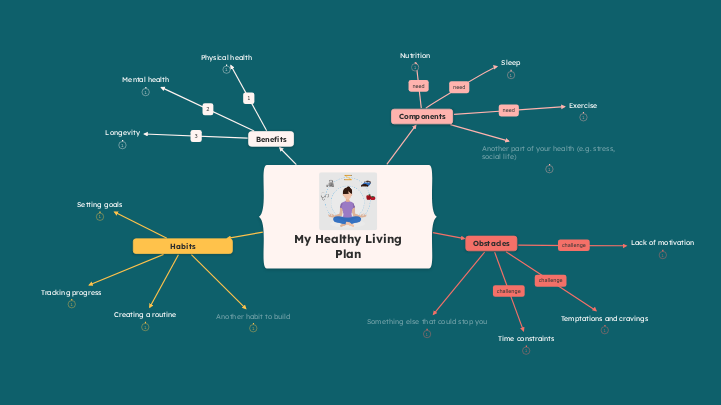
An interactive concept map template for building a personal healthy living plan. Explore four areas: benefits, components, habits and obstacles. Complete the prompts with your own goals, ideas and actions, use the wiki notes for guidance, and add more responses with +. Use the template for personal wellness planning, health education, coaching sessions or classroom activities. This healthy living plan template helps you build a personal plan for a healthier lifestyle. It is organized into four parts: the benefits you want to gain, the core components of health such as exercise, nutrition, and sleep, the habits that turn intentions into daily practice, and the obstacles that tend to get in the way. Use this template to set specific and realistic goals, create a routine, find time for physical activity, track your progress, and plan around cravings or a lack of motivation. Guiding questions in each section help you turn general advice into concrete actions, and you can add new components, habits, or obstacles as your plan evolves. A healthy lifestyle in four parts: why it's worth it (Benefits), what it's made of (Components), how to build it into daily life (Habits), and what tends to get in the way (Obstacles). Common barriers and practical ways around them. Lack of knowledge is another one — learn from reliable sources or ask a professional. Think about past attempts: what made you stop? Cost, injury, travel, family schedules, lack of knowledge. Name it, then plan around it. Fit activity into the day (stairs, walking meetings, short workouts) and save time with meal prepping and planning. Find intrinsic motivators — reasons that matter to you personally — and join fitness communities or classes for support and accountability. Keep healthy alternatives on hand and practice mindful eating: slow down, notice hunger and fullness, and eat without distractions. The core building blocks of healthy living. Stress management and social connections matter too and can be added as extra components. Healthy living is more than exercise and food. Consider stress management, social connections, hydration, time outdoors, screen time. Add one concrete action under each. Sleep drives rest, recovery and hormonal regulation; most adults need 7–9 hours. Good sleep hygiene means a consistent schedule and a dark, quiet, sleep-friendly bedroom. A balanced diet covers macronutrients (protein, carbs, fats) and micronutrients (vitamins, minerals). Meal planning helps with portion control, meal composition and healthier food choices. Mix three types: aerobic (walking, cycling, swimming), strength training, and flexibility. Health guidelines commonly suggest about 150 minutes of moderate activity a week — adjust to your own needs and fitness level. How to turn intentions into everyday practice. Seeking professional guidance (a doctor, trainer or nutritionist) and finding ways to stay motivated also help. Start small: one habit you could do even on a bad day. Attach it to something you already do ('after coffee, I stretch for 5 minutes'). Keep a journal or use apps and wearables to see progress over time. Celebrate milestones along the way. Build health into your schedule: manage your time, and treat exercise, meals and sleep as priorities rather than leftovers. Make goals specific and measurable ('walk 30 minutes, 4 days a week' rather than 'exercise more'), and keep them realistic and achievable. What you gain from living healthily — effects on body, mind and lifespan. These are the reasons that keep the habits going. Over the long term: a lower risk of chronic diseases, a stronger immune system, and aging gracefully. Healthy habits reduce stress, lift mood and sharpen thinking — better focus, memory and cognitive function. Regular exercise supports cardiovascular health, weight management and bone strength. Good nutrition provides the nutrients your body needs and helps prevent disease. Every Mindomo template opens with its structure already in place: descriptive topics, guiding notes attached to the branches where people usually get stuck, and a default shape that new topics inherit. Edit it in the browser, switch it to a concept map, outline or Gantt chart without redrawing anything, and export it in more than twenty formats. See how mind map templates work, or browse the full gallery by category.Healthy Living Plan Template
About this template
Healthy living plan template
My Healthy Living Plan
Obstacles
Something else that could stop you
Your plan to get past it
Time constraints
Where could you find 10 spare minutes?
Lack of motivation
Why does this matter to you personally?
Temptations and cravings
Your biggest craving, and a healthier swap
Components
Another part of your health (e.g. stress, social life)
One thing you'll do for it
Sleep
What keeps you from sleeping well?
Nutrition
One food swap you'll make this week
Exercise
Which activity would you actually enjoy?
Habits
Another habit to build
When and where will you do it?
Tracking progress
How will you track it? (app, journal, calendar)
Creating a routine
When in your day will it happen?
Setting goals
Your goal: what, how often, by when?
Benefits
Longevity
What do you want to still be able to do at 80?
Mental health
How do you want to feel day to day?
Physical health
Which physical change do you want to notice first?
Why use a Mindomo mind map template?
-
Products
-
Uses
- General Uses
- Mind Maps for Education
- Mind Maps for Business
- Mind Maps for Personal Development
- Assistive Technology
- Team Collaboration
- Campaign briefs for marketers
- Client discovery workshops for consultants
- Onboarding journeys for HR & L&D
- Knowledge Management
- Team Skills Matrix
- Engagement Library
- Roles
- Marketers
- HR & L&D
- Consultants
- Project Management
- Marketing campaign planning
- Employee training rollouts
- Scope of Work
- Idea Organization
- Issue Trees
- Training Needs Analysis
- Mind Mapping Benefits
-
Solutions
- Guides
- Make Presentations with Mind Maps
- How to Learn with Mind Maps
- Plan and Organize with Mind Maps
- Prioritize Tasks with Mind Maps
- Take Notes with Mind Maps
- Real Customer Stories
- Scaling educational content for 11,000 doctors
- Team workflow: from trial to indispensable in two months
- 10 years without slides: rethinking architecture lectures
- Read all stories
-
Resources
- Learn the basics
- What is a Mind Map?
- How to Mind Map?
- What is a Concept Map?
- Benefits of Mind Mapping
- Guides & Support
- Video tutorials
- Help center
- Forum
- Examples & templates
- Top 29 Mind Map Examples
- Concept Map Templates
- How to Make a Gantt Chart
- Mindomo's Efficiency in Education
- Feature pages
- Education
- Teacher Assignments
- Work & Personal
- Desktop
- The Mindomo blog
- Pricing
- Log In
- Sign Up
- Dashboard
Mind Mapping Benefits
Why visual thinking makes recall and planning easier.
Learn the basics
Guides & Support
Examples & templates
Feature pages
 Blog
The Mindomo blog
Guides, examples and research on visual thinking.
Browse all articles