Our senses help us to understand what's happening around us. This template explains the five senses for kids, with simple words, asking them to complete with examples of things they can feel, smell, taste, hear or see. They will learn about the sense of taste, touch, sight, smell, and hear. They will have fun learning new things! Senses send messages through receptor cells to our brain, using our nervous system. How we taste: List a thing you can taste. Add a describing word for that thing. How we smell: List a thing you can smell. Add a describing word for that thing. How we hear: List a thing you can hear. Add a describing word for that thing. How we see: List a thing you can see. Add a describing word for that thing. How we feel: List a thing you can feel. Add a describing word for that thing. Every Mindomo template opens with its structure already in place: descriptive topics, guiding notes attached to the branches where people usually get stuck, and a default shape that new topics inherit. Edit it in the browser, switch it to a concept map, outline or Gantt chart without redrawing anything, and export it in more than twenty formats. See how mind map templates work, or browse the full gallery by category.The five senses diagram for kids
Let's learn more about them!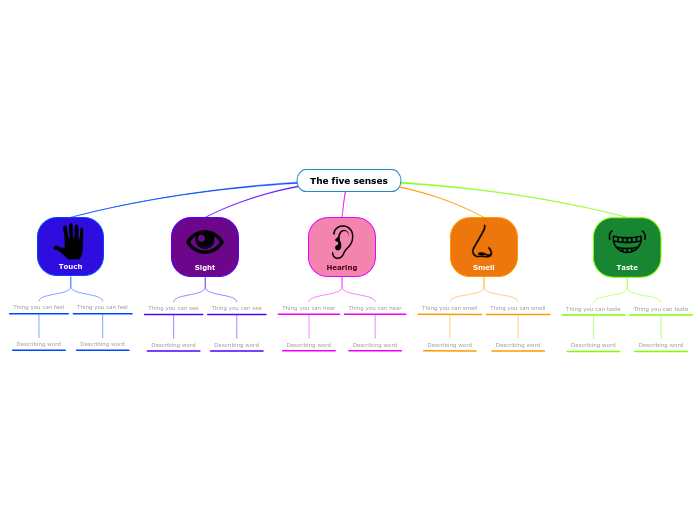
About this template
The five senses for kids
The five senses
Taste
Tongues also have chemical sensors to give a sense of taste.Thing you can taste
Example: cake, chocolate, pizza
You can choose from the examples below:Smell
Our noses have sensors that detect chemicals that make up a smell.Thing you can smell
Example: laundry detergent on clothes, perfume, food from the restaurant
You can choose from the examples below:Hearing
Our ears have sound sensors in the inner ears.
They also have sensors that work on keeping you balanced and aware of where you are in your environment.Thing you can hear
Example: clock ticking, birds chirping
You can choose from the examples below:Sight
Our eyes translate light into image signals so the brain can process them.Thing you can see
Example: sunset, picture
You can choose from the examples below:Touch
The receptors from our skin send touch signals to the brain.Thing you can feel
Example: sand, a fine silk coat, a fluffy teddy bearDescribing word
You can choose from the examples below:Why use a Mindomo mind map template?
-
Products
-
Uses
- General Uses
- Mind Maps for Education
- Mind Maps for Business
- Mind Maps for Personal Development
- Assistive Technology
- Team Collaboration
- Campaign briefs for marketers
- Client discovery workshops for consultants
- Onboarding journeys for HR & L&D
- Knowledge Management
- Team Skills Matrix
- Engagement Library
- Roles
- Marketers
- HR & L&D
- Consultants
- Project Management
- Marketing campaign planning
- Employee training rollouts
- Scope of Work
- Idea Organization
- Issue Trees
- Training Needs Analysis
- Mind Mapping Benefits
-
Solutions
- Guides
- Make Presentations with Mind Maps
- How to Learn with Mind Maps
- Plan and Organize with Mind Maps
- Prioritize Tasks with Mind Maps
- Take Notes with Mind Maps
- Real Customer Stories
- Scaling educational content for 11,000 doctors
- Team workflow: from trial to indispensable in two months
- 10 years without slides: rethinking architecture lectures
- Read all stories
-
Resources
- Learn the basics
- What is a Mind Map?
- How to Mind Map?
- What is a Concept Map?
- Benefits of Mind Mapping
- Guides & Support
- Video tutorials
- Help center
- Forum
- Examples & templates
- Top 29 Mind Map Examples
- Concept Map Templates
- Plan projects with a Gantt Chart Maker
- Mindomo's Efficiency in Education
- Feature pages
- Education
- Teacher Assignments
- Work & Personal
- Desktop
- The Mindomo blog
- Pricing
- Log In
- Sign Up
- Dashboard
Mind Mapping Benefits
Why visual thinking makes recall and planning easier.
Learn the basics
Guides & Support
Examples & templates
Feature pages
 Blog
The Mindomo blog
Guides, examples and research on visual thinking.
Browse all articles
Blog
The Mindomo blog
Guides, examples and research on visual thinking.
Browse all articles