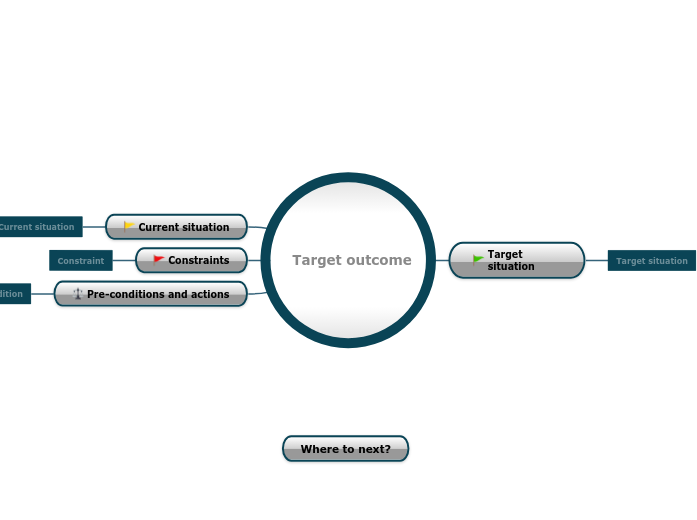
Using a means-end approach basically means looking at a target, which is the starting point, and figuring out the best way to get from point A to point B by breaking down the list of issues to make them more feasible on a daily basis. Pinpoint the desired result and describe it in a few lines. Before taking any actions, add some pre-conditions with a short description that will support you attain the final outcome. Because any situation has two sides, positive and negative, take into consideration the challenges that may occur while trying to shift from the current situation to the target one. Finally yet importantly, shortly explain your current status. Where to next? Name the target outcome Add a condition before 'Target outcome' What needs to be done before you can reach 'Condition'? Add a condition or action before 'Condition or action' What needs to be done before you can reach 'Condition or action'? What are the conditions of reaching this position? Action What needs to be done before you can achieve 'Condition or action'? Add a constraint that limits what you can do in moving from the current situation to the target situation. Describe your current situation Describe the target situation 心智圖能幫助您集思廣益、建立概念之間的關聯,並整理與激發想法。 而心智圖範本讓入門更容易,因為範本是已含特定主題資訊與引導說明的架構。換句話說,範本先替您搭好能涵蓋該主題所有要素的結構,可作為您個人心智圖的起點。無論用於商業或教育,心智圖範本都能為特定主題的心智圖提供實用的解決方案。 Mindomo 提供智慧心智圖範本,讓您輕鬆工作、順暢思考。 您可以從 Mindomo 商業版或教育版帳號中挑選各式心智圖範本,也可以從頭建立自己的範本。只要在主題上加入進一步的引導說明,任何心智圖都能變成心智圖範本。關於此範本
Means-end analysis
Where to next?
You can now download your map or Share it with your colleagues.Target outcome
Begin by identifying the target outcome in a few words and press Enter.
For example, you might be aiming to increase production capacity, so this would be your target outcome.Pre-conditions and actions
Condition
What are the pre-requisites or conditions before you can reach 'Target outcome'?
Add a short description of a condition that must exist before you can reach 'Target outcome'. Remember to observe the constraints that you listed.
Example:Condition or action
If this position is reachable from the current situation, then you can type in the next action instead.
If 'Condition' is already an action that can be done, then just press Enter.
Example: if 'Trained operators' is an intermediate step, then the pre-requisites could be:
What needs to be done before you can reach 'Condition or action'? What are the conditions of reaching this position? If this position is reachable from the current situation, then you can type in the next action instead.
If 'Condition or action' is already an action that can be done, then just press Enter.
If this position is reachable from the current situation, then you can type in the next action instead.
If 'Condition or action' is already an action that can be done, then just press Enter.
If 'Condition or action' is already an action that can be done, then just press Enter.Constraints
Constraint
A constraint may be:Current situation
Add a line describing where you are now.Target situation
Add a line describing where you want to be in the future.為什麼要使用 Mindomo 心智圖範本?
範本提供多種功能: