
A top-down, answer-first storyline bridge connecting Issue Tree logic to Statement of Work deliverables before deck development. It translates key questions and hypotheses into defined workstreams, outputs, and a clear presentation structure. This storyline answer-first template helps consultants, strategists, analysts, and business teams structure clear, persuasive communication by starting with the key answer and supporting it with logically organized arguments and evidence. It provides a visual framework for defining the main message, building supporting points, connecting insights, and shaping a coherent storyline before creating a presentation or report. Use this template to clarify the core recommendation, organize supporting arguments, validate the logic of your story, identify evidence gaps, and ensure each section contributes directly to the main conclusion. It is especially useful for executive presentations, consulting deliverables, strategic recommendations, and other situations where concise, top-down communication is essential. Use this bridge template to turn an engagement question into an answer-first storyline that is both logically sufficient and contractually grounded. Start with the one-sentence answer, derive three mutually reinforcing arguments from the Issue Tree, and test that each argument lands in a scoped Statement of Work deliverable before the deck is written. An argument that cannot attach to a scoped deliverable is either out of scope or a potential change order. Define the proposed next step. List the inputs needed to proceed. Name the owner and first-30-day plan. Describe the first action. Review likely concerns. Enter the point to acknowledge. Enter the evidence-based response. Enter the main objection. Develop the third supporting argument. State why Argument 3 matters. Name the scoped deliverable for Argument 3. Name the issue-tree branch answered by Argument 3. List the evidence for Argument 3. Write the claim for Argument 3. Develop the second supporting argument. State why Argument 2 matters. Name the scoped deliverable for Argument 2. Name the issue-tree branch answered by Argument 2. List the evidence for Argument 2. Write the claim for Argument 2. Develop the first supporting argument. State why Argument 1 matters. Name the scoped deliverable for Argument 1. Name the issue-tree branch answered by Argument 1. List the evidence for Argument 1. Write the claim for Argument 1. Capture the change that created urgency. Enter the consequence of inaction. Enter the event that created urgency. Define the engagement question. List the requirements for a complete answer. Enter the Issue Tree root question. マインドマップは、ブレインストーミングや概念同士の関係づけ、アイデアの整理・創出に役立ちます。 マインドマップテンプレートには、特定のテーマに関する情報と作成のヒントがあらかじめ組み込まれているため、より簡単に始められます。テーマに必要な要素がそろった構造が用意されているので、自分だけのマインドマップの出発点として使えます。ビジネスでも教育でも、特定のトピックについてマインドマップを作成するときに役立つ実用的なリソースです。 Mindomoでは、便利なスマートマインドマップテンプレートをご用意しています。 マインドマップテンプレートは、Mindomoのビジネスアカウントや教育アカウントで用意されたものから選べるほか、独自のテンプレートを一から作成することもできます。どのマインドマップも、トピックにガイドノートを追加するだけでテンプレートに変換できます。Storyline Answer-First Template
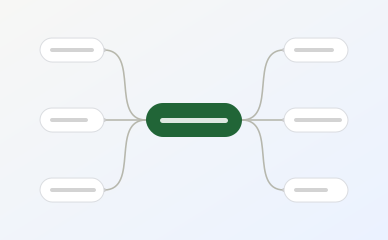
このテンプレートについて
Storyline answer-first template
Answer-First Map
The recommendation
What we need from the client
Owner and first 30 days
Action — [what to do first]
Objections
What we concede
Our answer — [evidence that settles it]
Objection — [what they will say]
Argument 3
Argument 2
Argument 1
So-what — [what the client should do about it]
Lands in — [which SOW deliverable carries this]
Answers — [which issue tree branch this closes]
Evidence — [exhibit, source, date]
Claim — [assertive headline, not a topic]
What changed
Cost of doing nothing
Trigger — [the event that made this urgent]
The question to answer
What a good answer must include
From the issue tree root question
Mindomoのマインドマップテンプレートを使う理由
テンプレートには次のような機能があります:
-
製品
-
用途
-
ソリューション
-
リソース
- 基本を学ぶ
- マインドマップとは?
- マインドマップの作り方
- ガイドとサポート
- ビデオチュートリアル
- ヘルプセンター
- フォーラム
- 作例とテンプレート
- マインドマップの作例29選
- コンセプトマップとは?
- 機能ページ
- 教育
- 教師向け課題機能
- 仕事・個人
- デスクトップ
- Mindomoブログ
- 料金
- ログイン
- 新規登録
- ダッシュボード
ナレッジマネジメント
マインドマップのメリット
視覚的思考が記憶と計画を楽にする理由。