
Brainstorming Toolbox Mind Map

Interactive map · Brainstorming Toolbox Mind Map
Mind map: Brainstorming Toolbox Mind Map

Brainstorming Toolbox Mind Map

Free with a Mindomo account. Opens your own copy in the editor.

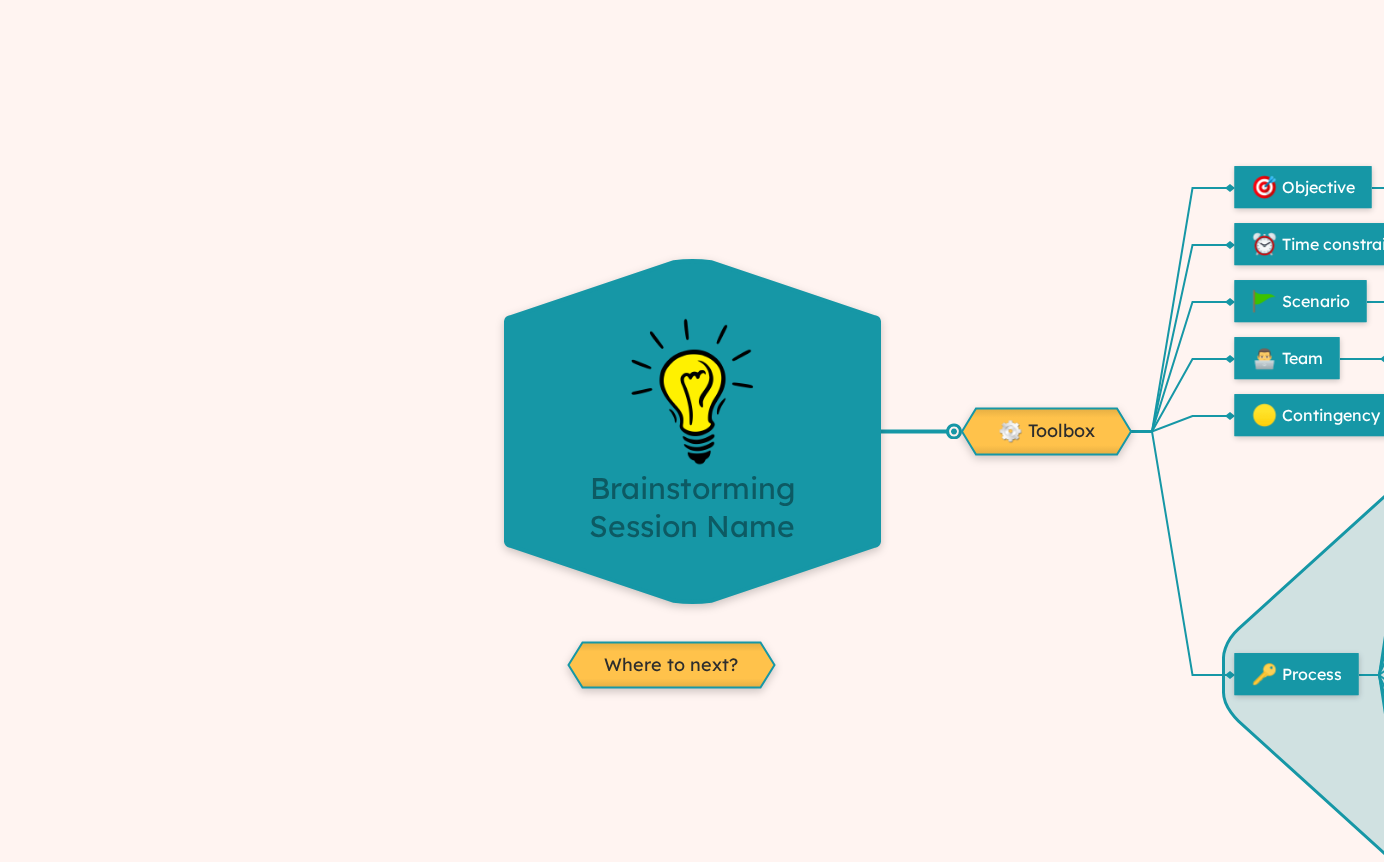
This mind map creates a toolbox map to support a brainstorming session.

Free with a Mindomo account. Opens your own copy in the editor.

About this template

How to run a brainstorming session

Learn how to run a brainstorming session using this brainstorming toolbox template.

To run a brainstorming session, you have to establish a specific objective.

Then, you have to think about the time you will need to find the creative solutions you are looking for.

Start with a story or a scenario to show to the group of people that take part in this brainstorming session what you are looking for.

Assign tasks to some team members that will help you with the brainstorming session.For example, you will need a person to take notes. You can use this mind map or a new mind map. Also, for a good brainstorming session, you will need a group of people that has knowledge in the area you are interested in to find ideas. People who ask questions and participate actively in the brainstorming session are valuable too. They will help you to generate ideas with ease. Besides the fact that they are sharing their ideas, they will challenge others to express their opinion and come with creative ideas.

When you are organizing brainstorming meetings, you should follow the steps from this template:

  • Explain to the team members what you are going to do and keep them up to date with all the information they need
  • Offer them some time to think about the problem
  • Collect all the ideas, whether you think they are useful or not
  • Create a list of ideas from the participants and add it to the template
  • Combine ideas and build upon the ideas of other people to generate new ideas
  • Ask participants to reflect for a while on the ideas
  • Add some criteria which will help you to filter and score ideas, like performance, costs, alignment with strategy, risk levels
  • Filter ideas based on your criteria
  • Set out the next actions like obtaining support from stakeholders, creating prototypes or wireframes, and testing them

What’s inside this template

Brainstorming Toolbox Mind Map: what the map covers

Central topic

Brainstorming Session Name

Type in the name or subject of your brainstorming

Toolbox

6 topics

Objective

  • Objective — State a specific objective for your session. Make sure your objective includes follow-through and actions. Common objectives include: Creating something new Solving a problem Maximising an opportunity

Time constraints

  • Time allowed — Time allowance How many sessions will there be and how much time do you allow per session?

Scenario

  • Description — Add a line describing the scenario Some of your participants may already understand it, and some may not. Both positions are useful. Explain the special features of the situation that need inventive ideas. Challenge your participants.

Team

  • Member — Add a team member for this brainstorming session. You may need someone to write up the ideas You will need someone to lead the group A group size of 5 to 7 is ideal A mix of backgrounds and knowledge will work better than a group of people who all think along similar lines People who are willing to question assumptions are just as valuable as people with field expertise

Contingency plan

  • Action — Add an action to the contingency plan. Identify the results that the contingency plan will lead to.

Process

  • Brief the team
    • Information: Brief the team on: 1. The objective for this session 2. The time constraints 3. The scenario 4. The contingency plan 5. The process that you will be following, and the rules at each stage.
  • Incubate the problem
    • Feedback: Give participants some time to think about the problem. Initial reactions can often change after some incubation time. Type in their feedback.
  • Personal brainstorming
    • Idea: Give participants some time to come up with individual ideas. These can often get lost in group discussions. Type in their ideas.
  • Gather ideas
    • Rules: Do not prioritize or evaluate ideas when gathering them. Do not suppress ideas because they are too strange or obscure. with the rules of your brainstorming session.
  • Organise and group ideas
    • Related ideas: Group similar or related ideas together. Look for emerging patterns and gaps created by patterns.
  • Combine and build on ideas
    • Observation: Without evaluating or judging, build upon the ideas from other people, using them as triggers for different ideas. Type in your observations.
  • Incubate ideas
    • New idea: Give participants some time to reflect on the ideas generated, before evaluating them. New ideas and insights can arise after some time away from the session. Type them in.
  • Set minimum criteria
    • Criterion: Add a criterion or requirement against which you will filter and score ideas. Think about: Performance, must-have or must-do factors Investment, costs, resources, timescales or other constraining factors Feasibility Alignment with strategy Acceptable risk levels
  • Evaluate ideas — Now you can start to filter ideas against your criteria, and use the criteria to improve them. with your observations.
  • Move to action
    • Action: If your session has generated some worthwhile directions, set out the next actions. - Developing ideas further - Feasibility studies - Obtaining support from other stakeholders - Detailed design - Prototypes or wireframe mockups - Trials and tests
Where to next?

Once you have completed mind map, you can use it to: Manage your brainstorming session, sharing the information and process with participants Capture ideas into the map, then rearrange and evaluate them Follow up on the actions and keep your team informed your mind map with other team members to keep them informed about the following actions to be taken.

How to use it

  1. 1

    Open the template

    Click “Use this template” and sign in with a free account.

  2. 2

    Make it yours

    Replace the topics and fill in the notes.

  3. 3

    Share it

    Share, present or export it, or switch it to an outline or Gantt view.