
The question to answer
2 topicsDefine the engagement question.
From the issue tree root question
Enter the Issue Tree root question.
What a good answer must include
List the requirements for a complete answer.
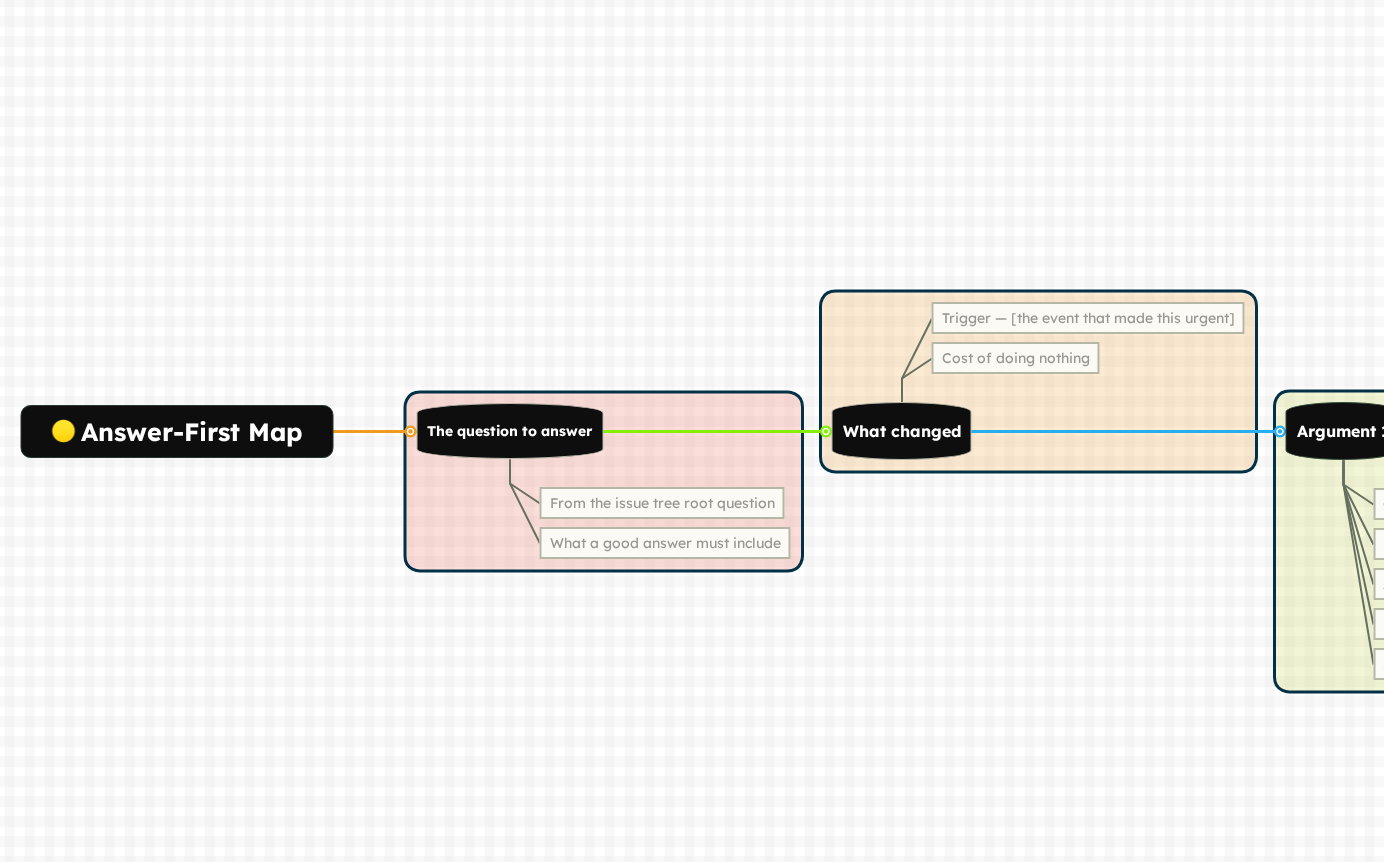
A top-down, answer-first storyline bridge connecting Issue Tree logic to Statement of Work deliverables before deck development. It translates key questions and hypotheses into defined workstreams, outputs, and a clear presentation structure.
Free with a Mindomo account. Opens your own copy in the editor.
This storyline answer-first template helps consultants, strategists, analysts, and business teams structure clear, persuasive communication by starting with the key answer and supporting it with logically organized arguments and evidence. It provides a visual framework for defining the main message, building supporting points, connecting insights, and shaping a coherent storyline before creating a presentation or report.
Use this template to clarify the core recommendation, organize supporting arguments, validate the logic of your story, identify evidence gaps, and ensure each section contributes directly to the main conclusion. It is especially useful for executive presentations, consulting deliverables, strategic recommendations, and other situations where concise, top-down communication is essential.
What’s inside this template
Central topic
Answer-First Map
Use this bridge template to turn an engagement question into an answer-first storyline that is both logically sufficient and contractually grounded. Start with the one-sentence answer, derive three mutually reinforcing arguments from the Issue Tree, and test that each argument lands in a scoped Statement of Work deliverable before the deck is written. An argument that cannot attach to a scoped deliverable is either out of scope or a potential change order.
Define the engagement question.
Enter the Issue Tree root question.
List the requirements for a complete answer.
Capture the change that created urgency.
Enter the event that created urgency.
Enter the consequence of inaction.
Develop the first supporting argument.
Write the claim for Argument 1.
List the evidence for Argument 1.
Name the issue-tree branch answered by Argument 1.
Name the scoped deliverable for Argument 1.
State why Argument 1 matters.
Develop the second supporting argument.
Write the claim for Argument 2.
List the evidence for Argument 2.
Name the issue-tree branch answered by Argument 2.
Name the scoped deliverable for Argument 2.
State why Argument 2 matters.
Develop the third supporting argument.
Write the claim for Argument 3.
List the evidence for Argument 3.
Name the issue-tree branch answered by Argument 3.
Name the scoped deliverable for Argument 3.
State why Argument 3 matters.
Review likely concerns.
Enter the main objection.
Enter the evidence-based response.
Enter the point to acknowledge.
Define the proposed next step.
Describe the first action.
Name the owner and first-30-day plan.
List the inputs needed to proceed.
Click “Use this template” and sign in with a free account.
Replace the topics and fill in the notes.
Share, present or export it, or switch it to an outline or Gantt view.
Storyline Answer-First Template
Free with a Mindomo account. Opens your own copy in the editor.