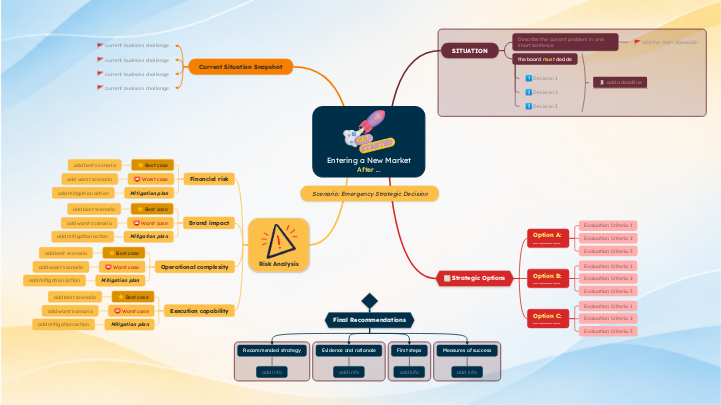
This interactive business strategy mind map template helps you analyze a company's revenue decline and evaluate possible solutions. Explore the current business challenges, compare strategic options such as entering a new market, launching a new product, or restructuring operations, and assess potential risks. Use the interactive instructions and placeholders to evaluate each option, develop mitigation plans, and make an informed strategic recommendation. Use this template to plan how your company will succeed when entering a new market, whether it is a new country, region or customer segment. Break your market entry strategy into clear parts: Add your findings to each branch to evaluate the opportunity and decide on the best way to enter the market. Recommend a strategy based on your findings. Explain your reasoning, outline immediate actions and define how results will be measured. Decide how the company will know whether its strategy is working. Add one measurable indicator, including a target or review period. Identify what should happen immediately after the board makes its decision. Add a specific first action. State who should do it and when. Support your choice with evidence and show why it compares favorably with alternatives. Add one fact, estimate or comparison supporting your recommendation. Choose the most suitable strategy based on your analysis, not just its potential upside. Name your preferred option and explain your main reason for choosing it. Use this scenario to practice making a board-level strategic decision. Complete the analysis before choosing a solution. Set a realistic deadline for the board's decision. Include the full date and allow time for reviewing evidence. Complete this strategic decision case. Describe the problem, compare three options, assess current challenges and risks, then recommend a course of action. Replace each placeholder with your own concise findings. For each risk area, describe a realistic best case, worst case and practical way to reduce the risk. Base your scenarios on explicit assumptions. Consider whether the company has the people, skills and capacity to carry out the decision. Identify how the company could reduce this execution risk. Add one practical action that would reduce execution risk. Imagine a realistic negative outcome for the company's ability to deliver. What could go wrong? Write one concise worst-case execution scenario. Imagine a realistic positive outcome for the company's ability to deliver. What conditions would make it possible? Write one concise best-case execution scenario. State an assumption if needed. Consider the effect on everyday processes, systems and coordination. Identify how the company could reduce this operational risk. Add one practical action that would reduce operational risk. Imagine a realistic negative outcome for the company's operations. What could go wrong? Write one concise worst-case operational scenario. Imagine a realistic positive outcome for the company's operations. What conditions would make it possible? Write one concise best-case operational scenario. State an assumption if needed. Consider how customers and partners might respond and how the company's reputation could change. Identify how the company could reduce this reputational risk. Add one practical action that would reduce reputational risk. Imagine a realistic negative outcome for the company's brand reputation. What could go wrong? Write one concise worst-case reputational scenario. Imagine a realistic positive outcome for the company's brand reputation. What conditions would make it possible? Write one concise best-case reputational scenario. State an assumption if needed. Consider the financial effects of the options: cash flow, profitability, costs and investment. Identify how the company could reduce this financial risk. add mitigation action Add one practical action that would reduce financial risk. Imagine a realistic negative outcome for the company's financial position. What could go wrong? add worst scenario Write one concise worst-case financial scenario. Imagine a realistic positive outcome for the company's financial position. What conditions would make it possible? add best scenario Write one concise best-case financial scenario. State an assumption if needed. Identify the main business challenges. State each problem briefly and distinguish the symptoms from possible causes. Add another challenge. Avoid repeating an issue already listed. Identify a further challenge that could affect the company's options. Add another challenge. Is it a cause of the problem or a symptom? Add a current business challenge. Keep it specific and supported by an observation. Evaluate each option using three relevant criteria. Choose criteria that reveal its costs, benefits, feasibility or risks. Use comparable evidence where possible. Replace the dotted line with the third strategic option. Consider different strengths and trade-offs. Choose a third criterion for Option C. Consider effects on teams or long-term operations. Choose a second criterion for Option C. Consider likely savings and implementation costs. Choose one criterion for Option C. What would determine whether the change is worthwhile? Replace the dotted line with the second strategic option. Evaluate it using three relevant criteria. Choose a third criterion for Option B. Consider required resources or time to launch. Choose a second criterion for Option B. Consider customer needs or expected demand. Choose one criterion for Option B. What would show whether the idea can work? Replace the dotted line with the first strategic option. Then choose three criteria to assess it. Choose a third criterion for Option A. Consider investment, expected impact or timing. Choose a second criterion for Option A. Consider potential obstacles or feasibility. Choose one criterion for Option A. What would you need to know before investing? Summarize the company's problem and the decision its board needs to make. List three realistic strategic responses to the problem. Keep them distinct so they can be compared. Name a third alternative for the board to consider. Name a second strategy that differs meaningfully from the first. Name your first possible strategy. Describe the action, not its expected result. Write one sentence describing the main business problem. Include the most relevant fact from the case. State the main negative consequence of the problem. What does it mean for the business? Every Mindomo template opens with its structure already in place and a default shape that new topics inherit. Templates on a subject add descriptive topics and guiding notes where people usually get stuck; blank layouts leave the content to you. Edit it in the browser, switch it to a concept map, outline or Gantt chart without redrawing anything, and export it in more than twenty formats. See how mind map templates work, or browse the full gallery by category.Market Entry Strategy Template
About this template
Market entry strategy template
Final Recommendations
Draft a short decision memoMeasures of success
First steps
Evidence and rationale
Record the source or assumptionRecommended strategy
add info
Scenario: Emergency Strategic Decision
add a deadline
Entering a New Market After ...
Add case assumptions or supporting figuresRisk Analysis
Execution capability
Operational complexity
Brand impact
Financial risk
Mitigation plan
Worst case
Best case
Current Situation Snapshot
Add supporting data or sourcescurrent business challenge
Strategic Options
Option C: .........................
Option B: .........................
Option A: .........................
Evaluation Criteria 3
Evaluation Criteria 2
Evaluation Criteria 1
SITUATION
the board must decide
Decision 3
Decision 2
Decision 1
Describe the current problem in one short sentence
add the main downside
Why use a Mindomo mind map template?
-
Products
-
Uses
- General Uses
- Mind Maps for Education
- Mind Maps for Business
- Mind Maps for Personal Development
- Assistive Technology
- Team Collaboration
- Campaign briefs for marketers
- Client discovery workshops for consultants
- Onboarding journeys for HR & L&D
- Knowledge Management
- Team Skills Matrix
- Engagement Library
- Roles
- Marketers
- HR & L&D
- Consultants
- Project Management
- Marketing campaign planning
- Employee training rollouts
- Scope of Work
- Idea Organization
- Issue Trees
- Training Needs Analysis
- Mind Mapping Benefits
-
Solutions
- Guides
- Make Presentations with Mind Maps
- How to Learn with Mind Maps
- Plan and Organize with Mind Maps
- Prioritize Tasks with Mind Maps
- Take Notes with Mind Maps
- Real Customer Stories
- Scaling educational content for 11,000 doctors
- Team workflow: from trial to indispensable in two months
- 10 years without slides: rethinking architecture lectures
- Read all stories
-
Resources
- Learn the basics
- What is a Mind Map?
- How to Mind Map?
- What is a Concept Map?
- Benefits of Mind Mapping
- Guides & Support
- Video tutorials
- Help center
- Forum
- Examples & templates
- Top 29 Mind Map Examples
- Concept Map Templates
- How to Make a Gantt Chart
- Mindomo's Efficiency in Education
- Feature pages
- Education
- Teacher Assignments
- Work & Personal
- Desktop
- The Mindomo blog
- Pricing
- Log In
- Sign Up
- Dashboard
Mind Mapping Benefits
Why visual thinking makes recall and planning easier.
Learn the basics
Guides & Support
Examples & templates
Feature pages
 Blog
The Mindomo blog
Guides, examples and research on visual thinking.
Browse all articles