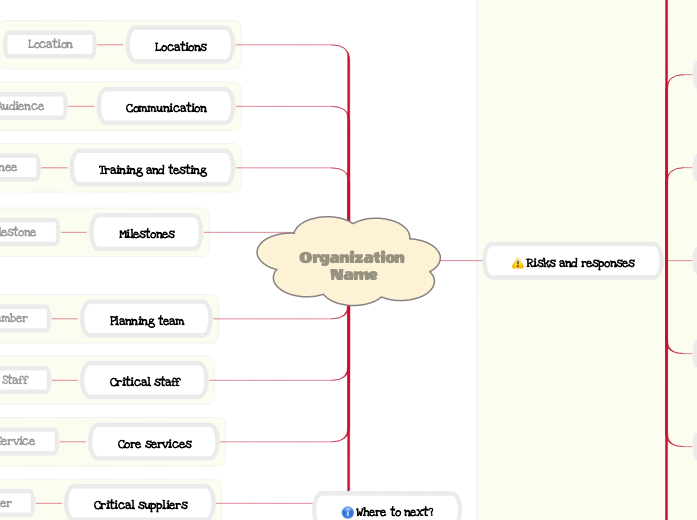
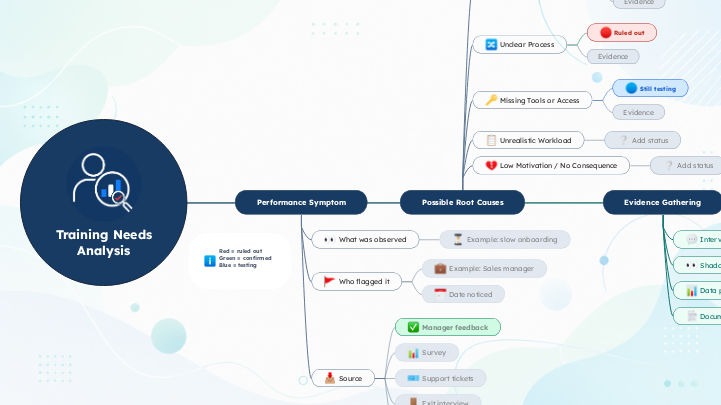
The Training Needs Analysis template helps teams identify performance gaps, evaluate possible root causes, gather supporting evidence, confirm training needs, plan next steps, and track their impact in one clear visual workflow. This training needs analysis template helps HR professionals, learning and development teams, managers, and business leaders identify performance gaps and determine whether training is the right solution. It covers key areas such as performance symptoms, possible root causes, evidence gathering, confirmed gaps, follow-up checks, next steps, and business impact. Use this template to document performance issues, evaluate skills and knowledge gaps, rule out non-training causes, collect supporting evidence, define recommended actions, and measure results. It provides a clear visual workflow for making evidence-based training decisions and aligning employee development initiatives with organizational goals. Start at Performance Symptom and work right. Each branch tests one possible cause before any training gets recommended. What does it cost to leave this unresolved? Use this to justify urgency, not to pad the case — pick what's actually true. Route to whoever actually owns the fix — this is very often not L&D. Set the re-check date now, while the original numbers are fresh. If Status comes back Recurred, reopen Possible Root Causes — don't start a new training request from scratch. Resolved / Recurred / Inconclusive Only fill this in once a root cause is Confirmed. If more than one cause is confirmed, mark each as Primary or Contributing — real cases are rarely one clean cause. Confidence: List every plausible explanation, not just the one that got mentioned loudest. Most performance problems have three to five candidate causes — training is usually the right answer for only one or two. Confirm if the person can do it, knows how, but has no reason to — usually a management or incentive fix, not training. Confirm if volume or headcount, not skill, is driving the symptom — usually an ops or staffing fix, not L&D's. Confirm if the person has the skill but not the system/permission/resource to use it. Confirm if the steps themselves are missing, contradictory, or undocumented — not a training issue, route to the process owner. Confirm only if evidence shows the person genuinely doesn't know how, not that they know how but aren't doing it. This is the level of analysis: Attach the actual file or link here— the survey export, ticket log, or exit interview notes. The evidence should be one click away, not a separate document someone has to go find. Every Mindomo template opens with its structure already in place: descriptive topics, guiding notes attached to the branches where people usually get stuck, and a default shape that new topics inherit. Edit it in the browser, switch it to a concept map, outline or Gantt chart without redrawing anything, and export it in more than twenty formats. See how mind map templates work, or browse the full gallery by category.Training Needs Analysis Template
About this template
Training needs analysis template
Red = ruled out Green = confirmed Blue = testing
Training Needs Analysis
Business Impact
Cost of inaction
Risk or compliance
Customer impact
Quality impact
Productivity impact
Next Steps
Share this with diagram them as a guest editor so they can review the evidence and fill in Approval themselves.Hand off: process owner
Hand off: training rollout
Hand off: skills matrix
Approval
Date:
Approved by:
Follow-up Check
Status
Actual result
Expected result if fix worked
Original metric, re-measured
Re-check date
Confirmed Gap
Evidence summary
High urgency
Scope: who / how many
Contributing factor
Gap description
Evidence Gathering
Note how the evidence was gathered and how many people or instances it covers — 'one manager mentioned it' and 'shadowed 6 of 9 reps' shouldn't carry the same weight.Documentation review
Data pulled
Shadowed observation
Interviews
Possible Root Causes
Low Motivation / No Consequence
Unrealistic Workload
Add status
Missing Tools or Access
Still testing
Unclear Process
Ruled out
Skill or Knowledge Gap
Evidence
Confirmed
Performance Symptom
Same symptom, different scale — name which one this is before you branch into causes.Source
Compliance deadline
Exit interview
Support tickets
Survey
Manager feedback
Who flagged it
Date noticed
Example: Sales manager
What was observed
Example: slow onboarding
Why use a Mindomo mind map template?
-
Products
-
Uses
- General Uses
- Mind Maps for Education
- Mind Maps for Business
- Mind Maps for Personal Development
- Assistive Technology
- Team Collaboration
- Campaign briefs for marketers
- Client discovery workshops for consultants
- Onboarding journeys for HR & L&D
- Knowledge Management
- Team Skills Matrix
- Engagement Library
- Roles
- Marketers
- HR & L&D
- Consultants
- Project Management
- Marketing campaign planning
- Employee training rollouts
- Scope of Work
- Idea Organization
- Issue Trees
- Training Needs Analysis
- Mind Mapping Benefits
-
Solutions
- Guides
- Make Presentations with Mind Maps
- How to Learn with Mind Maps
- Plan and Organize with Mind Maps
- Prioritize Tasks with Mind Maps
- Take Notes with Mind Maps
- Real Customer Stories
- Scaling educational content for 11,000 doctors
- Team workflow: from trial to indispensable in two months
- 10 years without slides: rethinking architecture lectures
- Read all stories
-
Resources
- Learn the basics
- What is a Mind Map?
- How to Mind Map?
- What is a Concept Map?
- Benefits of Mind Mapping
- Guides & Support
- Video tutorials
- Help center
- Forum
- Examples & templates
- Top 29 Mind Map Examples
- Concept Map Templates
- Plan projects with a Gantt Chart Maker
- Mindomo's Efficiency in Education
- Feature pages
- Education
- Teacher Assignments
- Work & Personal
- Desktop
- The Mindomo blog
- Pricing
- Log In
- Sign Up
- Dashboard
Mind Mapping Benefits
Why visual thinking makes recall and planning easier.
Learn the basics
Guides & Support
Examples & templates
Feature pages
 Blog
The Mindomo blog
Guides, examples and research on visual thinking.
Browse all articles
Blog
The Mindomo blog
Guides, examples and research on visual thinking.
Browse all articles