
Endangered Frogs Concept Map

Interactive map · Endangered Frogs Concept Map
Mind map: Endangered Frogs Concept Map

Endangered Frogs Concept Map

Free with a Mindomo account. Opens your own copy in the editor.

Explore Costa Rica’s endangered frogs with this interactive concept map template. Examine threats and population decline, ecological roles and human benefits, and conservation and recovery. Complete the input topics with explanations, examples and evidence from reliable sources. Use the labeled connections and wiki guidance to explain how the concepts relate and organise your findings for research, classroom activities or a report.

Free with a Mindomo account. Opens your own copy in the editor.

About this template

Endangered frogs concept map

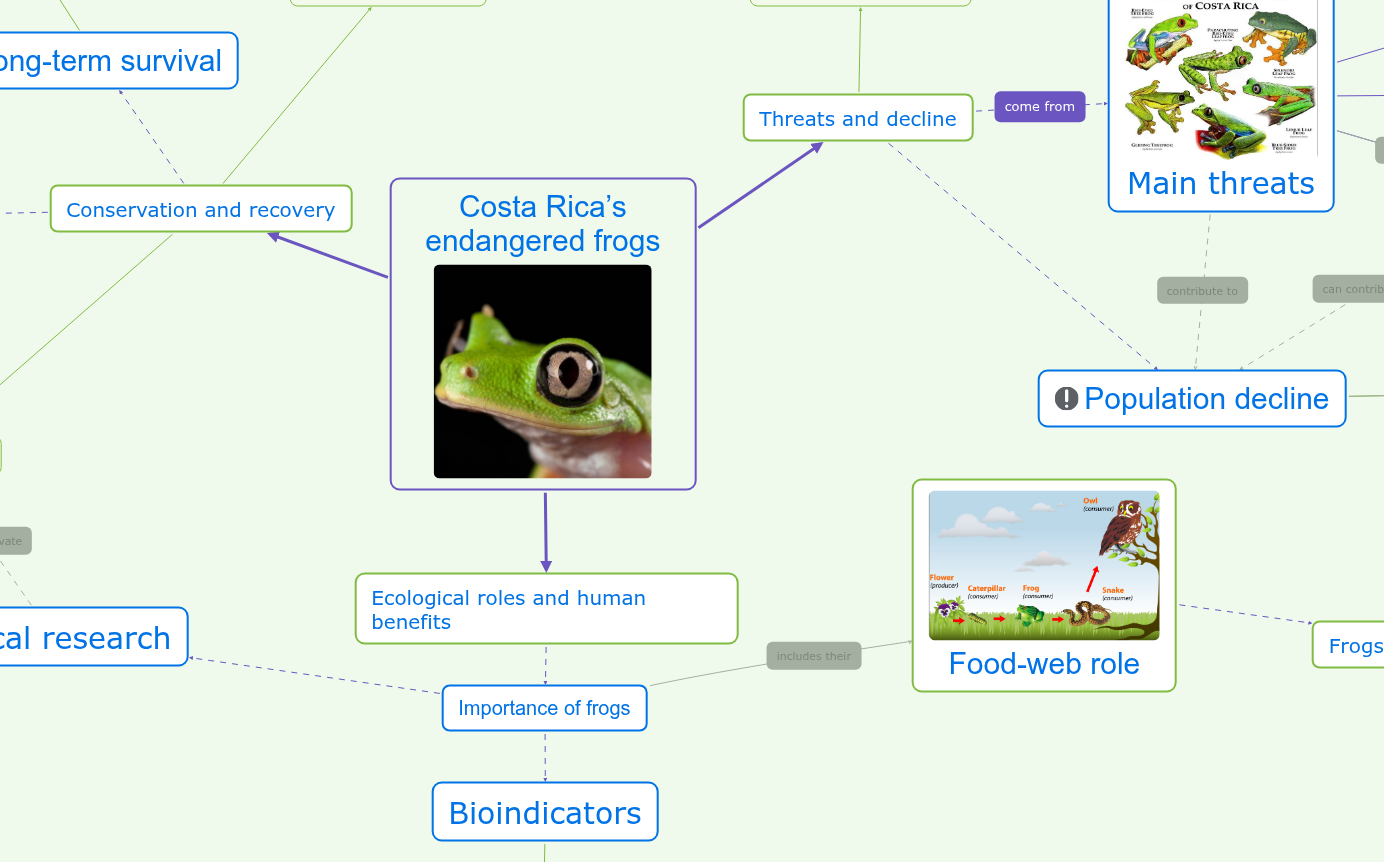
This endangered frogs concept map helps students research and present the conservation of Costa Rica’s endangered frogs. It organizes the topic into threats and population decline, ecological roles and human benefits, the frog’s place in the food web, and conservation and recovery efforts such as the Amphibian Rescue Project.

Use this template for science and biology projects, research reports, or class presentations. Students investigate threats like habitat loss, climate change, and chytrid fungal disease, explain why frogs matter as bioindicators and for medical research, and complete the input topics with evidence, verified statistics, and sources. Labeled links help them explain how each concept connects to the others.

What’s inside this template

Endangered Frogs Concept Map: what the map covers

Central topic

Costa Rica’s endangered frogs

Explore five themes: threats, population decline, ecosystem roles, human benefits and solutions. Read each labeled arrow as a statement linking two concepts. Fill in the green input topics using evidence and sources. Check the climate–fungus relationship against your sources: effects can depend on species, location and conditions.

Threats and decline

3 topics

Introduce the subject with an engaging opening. Explain the focus of your report and why your audience should care about frog conservation.

come from Main threats

Investigate the threats listed below. Explain how each threat affects frogs and support your explanation with a specific example or source.

contribute to Population decline cross-link

include habitat loss cross-link

  • habitat loss — Describe a way habitat loss affects frogs. Identify the habitat involved, the cause of its loss and a possible protection measure.

    can contribute to Population decline cross-link

    • Add a habitat-loss example: Name a specific example, explain its effect on frogs and include your source.
  • climate change — Explain a possible link between changing climate conditions and frog survival. Use evidence and distinguish documented findings from predictions.
    • Add climate evidence: Summarize one sourced finding linking climate conditions to frog survival. Include the source and date.
  • Chytrid fungal disease — Research the fungal disease mentioned in your source. Name it, explain its effects and cite the evidence you use.
    • Add a disease explanation: Name the disease, explain how it affects frogs and provide a source.

Add your opening question

Write one question that will engage your audience and introduce the conservation issue.

Population decline

Check the original source behind this statistic. Specify the date, geographic scope, animal group and what the percentage measures. Do not treat 'threatened', 'declining' and 'extinct' as interchangeable.

is documented by Add a verified statistic and source cross-link

  • Add a verified statistic and source — Record a verified statistic, the group and region it covers, its meaning, the assessment date and the source.
Conservation and recovery

4 topics

Bring together the main findings without introducing a new argument. State your key takeaway and propose a realistic action your audience can take.

Long-term survival

Explain what frogs need for long-term survival. Connect your explanation to conservation measures and support it with evidence.

  • Add your explanation — Explain this idea in your own words, based on your source. State any limitations or uncertainties.

Add your key takeaway

Summarize the most important message of your report in one or two sentences.

Add a call to action

Suggest one concrete, realistic action and explain how it supports conservation.

can support Amphibian Rescue Project cross-link

Amphibian Rescue Project

Identify the conservation project you are discussing, where it operates and its aims. Explain its methods, results and limitations using reliable sources.

uses Captive care and breeding cross-link

faces Conservation challenges cross-link

  • Conservation challenges — Identify one practical challenge facing the project. Explain its impact and suggest a realistic response.
    • Add a challenge and response: Identify one conservation challenge and explain a realistic way to address it.
  • Captive care and breeding — Verify the project's methods with a source. Explain the purpose of captive care or breeding and how it relates to longer-term conservation goals.
    • Add a project result and source: Record one documented project result. State the project name, location, date and source.

Ecological roles and human benefits

1 topic

Develop your main argument: why frogs matter, what the evidence shows and how conservation projects respond. Complete the supporting input topics with concise, sourced points.

Importance of frogs

Explain why conserving frogs matters. Explore their ecological roles and research value using specific examples.

includes their Food-web role cross-link

  • Bioindicators — Explain what a bioindicator is and investigate why frogs may be used as indicators of environmental conditions. Include an example and a source.
    • Add a bioindicator example: Explain one example of frogs indicating environmental conditions. Add a source.
  • Medical research — Investigate one example of medical research involving amphibians. Distinguish potential applications from established treatments and cite the research.

    can motivate Add a call to action cross-link

    • Add a research example: Describe a specific research example and its stage of development. Include a reference.

Food-web role

1 topic

Describe a simple food-chain example involving a frog. Identify its prey and a predator, and explain what could change if the frog population declined.

  • Frogs as predators and prey

How to use it

  1. 1

    Open the template

    Click “Use this template” and sign in with a free account.

  2. 2

    Make it yours

    Replace the topics and fill in the notes.

  3. 3

    Share it

    Share, present or export it, or switch it to an outline or Gantt view.