
Energy Sources Examples

Interactive map · Energy Sources Examples
Mind map: Energy Sources Examples

Energy Sources Examples

Free with a Mindomo account. Opens your own copy in the editor.

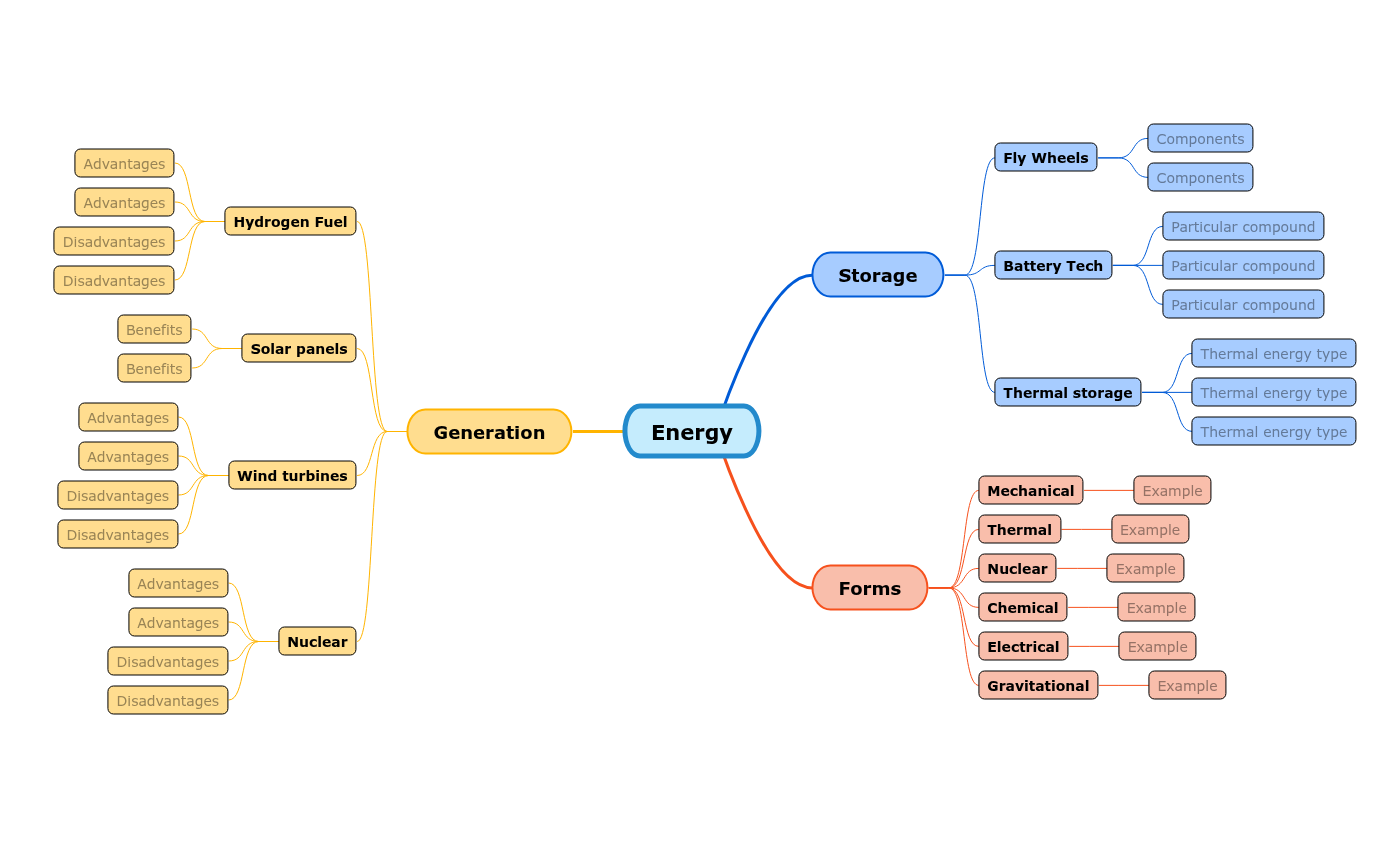
Use this mind map to learn more about the different forms of energy, how they are generated and stored, as well as their main advantages and disadvantages.

Free with a Mindomo account. Opens your own copy in the editor.

About this template

Energy

There are different types of energy: mechanical, thermal, nuclear, chemical, gravitational, and electrical energy. Complete this template to learn more about each type and its main advantages and disadvantages.

Some examples of energy that can be generated are solar energy, wind energy, nuclear energy, etc.

What’s inside this template

Energy Sources Examples: what the map covers

Central topic

In physics, energy is the quantitative property that must be transferred to an object in order to perform work on, or to heat, the object. Energy is a conserved quantity; the law of conservation of energy states that energy can be converted in form, but not created or destroyed

Storage

3 topics

Energy storage is the capture of energy produced at one time for use at a later time. A device that stores energy is generally called an accumulator or battery.

Fly Wheels

Flywheel energy storage (FES) works by accelerating a rotor to a very high speed and maintaining the energy in the system as rotational energy. Write down the main components of a typical flywheel.

Battery Tech

The battery acquires its charged condition either by recharging or in the manufacturing of the unit. During discharge, the chemical on the anode releases electrons, and ions in the electrolyte undergo an oxidation reaction. Name the particular compounds in which energy is stored:

Thermal storage

Thermal energy storage is achieved with widely differing technologies. Depending on the specific technology, it allows excess thermal energy to be stored and used hours, days, months later, at scales ranging from the individual process, to building or town. What are 3 types of thermal energy?
Forms

6 topics

There are many different types of energy, which all fall into two primary forms – kinetic and potential. Energy can transform from one type to another, but it can never be destroyed or created.

Mechanical

Motion energy or mechanical energy is the energy stored in objects; as objects move faster, more energy is stored. Examples of motion energy include wind, a flowing river, etc. Give more examples.

Thermal

Thermal energy is created from the vibration of atoms and molecules within substances. The faster they move, the more energy they possess and the hotter they become. Thermal energy is also called heat energy. Give examples of heat energy.

Nuclear

Nuclear energy is stored in the nucleus of atoms. This energy is released when the nuclei are combined (fusion) or split apart (fission). Nuclear power plants split the nuclei of uranium atoms to produce electricity. What element do they use to fuel nuclear power plants?

Chemical

Chemical energy is stored in the bonds of atoms and molecules. It is the energy that holds these particles together. Stored chemical energy is found in food, natural gas, etc. Give more examples.

Electrical

Electrical energy is the movement of electrons, the tiny particles that make up atoms, along with protons and neutrons. Electrons that move through a wire are called electricity. Give another example of electrical energy.

Gravitational

Gravitational energy is a form of potential energy. It is energy associated with gravity or gravitational force, in other words, the energy held by an object when it is in a high position compared to a lower position. Give examples.

Generation

4 topics

Hydrogen Fuel

Hydrogen fuel is a zero-emission fuel burned with oxygen. It can be used in fuel cells or internal combustion engines. Name the advantages and disadvantages of Hydrogen fuel.

Solar panels

Solar energy begins with the sun. Solar panels are used to convert light from the sun, which is composed of particles of energy called "photons", into electricity that can be used to power electrical loads. Write down the benefits of using solar panels.

Wind turbines

A wind turbine, or alternatively referred to as a wind energy converter, is a device that converts the wind's kinetic energy into electrical energy. Wind turbines are manufactured in a wide range of vertical and horizontal axis. Write down the advantages and disadvantages of Wind turbines.

Nuclear

Nuclear energy originates from the splitting of uranium atoms – a process called fission. This generates heat to produce steam, which is used by a turbine generator to generate electricity. Because nuclear power plants do not burn fuel, they do not produce greenhouse gas emissions. Write down the advantages and disadvantages of Nuclear Energy.

How to use it

  1. 1

    Open the template

    Click “Use this template” and sign in with a free account.

  2. 2

    Make it yours

    Replace the topics and fill in the notes.

  3. 3

    Share it

    Share, present or export it, or switch it to an outline or Gantt view.