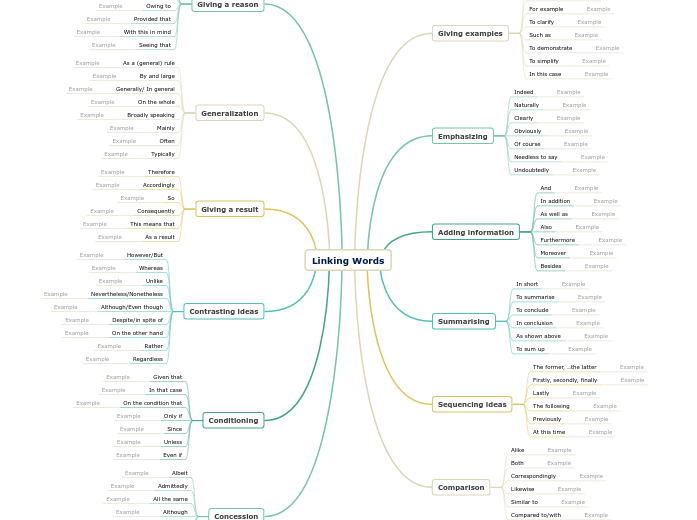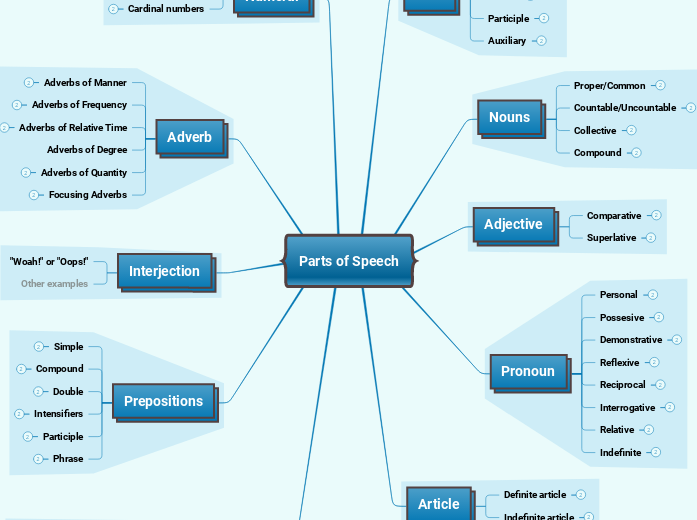

Learn the categories of linking words from this template and complete them with linking words examples to better understand them. Linking words help in connecting ideas and words in English. They are used to show contrast, connection, and condition between two things. Linking words used for giving examples: Linking words used for emphasizing: Linking words used for adding information: Linking words used for summarising: Linking words used for sequencing ideas: Linking words used for comparison: Linking words used for a concession: Linking words used for conditioning: Linking words used for contrasting ideas: Linking words used for giving a result: Linking words used for generalization: Linking words used for giving a reason: Linking words in any style of writing will help the reader to follow the flow of information. Use these words to accept a point or idea with reservation. These linking worss are used to provide a condition to what has been stated. However is the formal version of but. It is not normally used at the beginning of a sentence. Therefore, so, consequently and as a result are all used in a similar way. These words are used to make a general statement. Due to and owing to must be followed by a noun. Use these words to show how things are similar. These words are useful when you want to refer to one of two points, to list ideas. Use these words at the beginning of the sentence to give a summary of what has been said or written. Ideas are often linked by 'and'. In a list, you put a comma between each item, but not before and. These linking words are used to empashize a point. The most common way to give examples is by using for example or for instance. Write phrases to exercise! 心智圖能幫助您集思廣益、建立概念之間的關聯,並整理與激發想法。 而心智圖範本讓入門更容易,因為範本是已含特定主題資訊與引導說明的架構。換句話說,範本先替您搭好能涵蓋該主題所有要素的結構,可作為您個人心智圖的起點。無論用於商業或教育,心智圖範本都能為特定主題的心智圖提供實用的解決方案。 Mindomo 提供智慧心智圖範本,讓您輕鬆工作、順暢思考。 您可以從 Mindomo 商業版或教育版帳號中挑選各式心智圖範本,也可以從頭建立自己的範本。只要在主題上加入進一步的引導說明,任何心智圖都能變成心智圖範本。關於此範本
Linking words examples
Linking Words
These will show contrast, connection, condition between two things.Concession
Up to a point
Even so
And yet
Although
All the same
Admittedly
Albeit
Conditioning
Even if
Unless
Only if
On the condition that
In that case
Given that
Contrasting ideas
Although, despite and in spite of introduce an idea of contrast.Regardless
Rather
On the other hand
Despite/in spite of
Although/Even though
Nevertheless/Nonetheless
Unlike
Whereas
However/But
Giving a result
So is more informal.As a result
This means that
Consequently
So
Accordingly
Therefore
Generalization
Typically
Often
Mainly
Broadly speaking
On the whole
Generally/ In general
By and large
As a (general) rule
Giving a reason
Because of is followed by a noun and can be used at the beginning or in the middle of a sentence. Since and as also mean because.Seeing that
With this in mind
Provided that
Owing to
As
Since
Because of
Due to the fact that
Comparison
Compared to/with
Similar to
Likewise
Correspondingly
Both
Alike
Sequencing ideas
The following is a good way of starting a list.At this time
Previously
The following
Lastly
Firstly, secondly, finally
The former, ..the latter
Summarising
To sum up
As shown above
In conclusion
To conclude
To summarise
In short
Adding information
Recommended not to start a sentence with also. Use instead In addition, or In addition to this.Besides
Moreover
Furthermore
Also
As well as
In addition
And
Emphasizing
Undoubtedly
Needless to say
Of course
Obviously
Clearly
Naturally
Indeed
Giving examples
Namely refers to something by name.In this case
To simplify
To demonstrate
Such as
To clarify
For example
Namely
For instance
Example
為什麼要使用 Mindomo 心智圖範本?
範本提供多種功能: