
Balanced scorecard Project Management

Interactive map · Balanced scorecard Project Management
Mind map: Balanced scorecard Project Management

Balanced scorecard Project Management

Free with a Mindomo account. Opens your own copy in the editor.

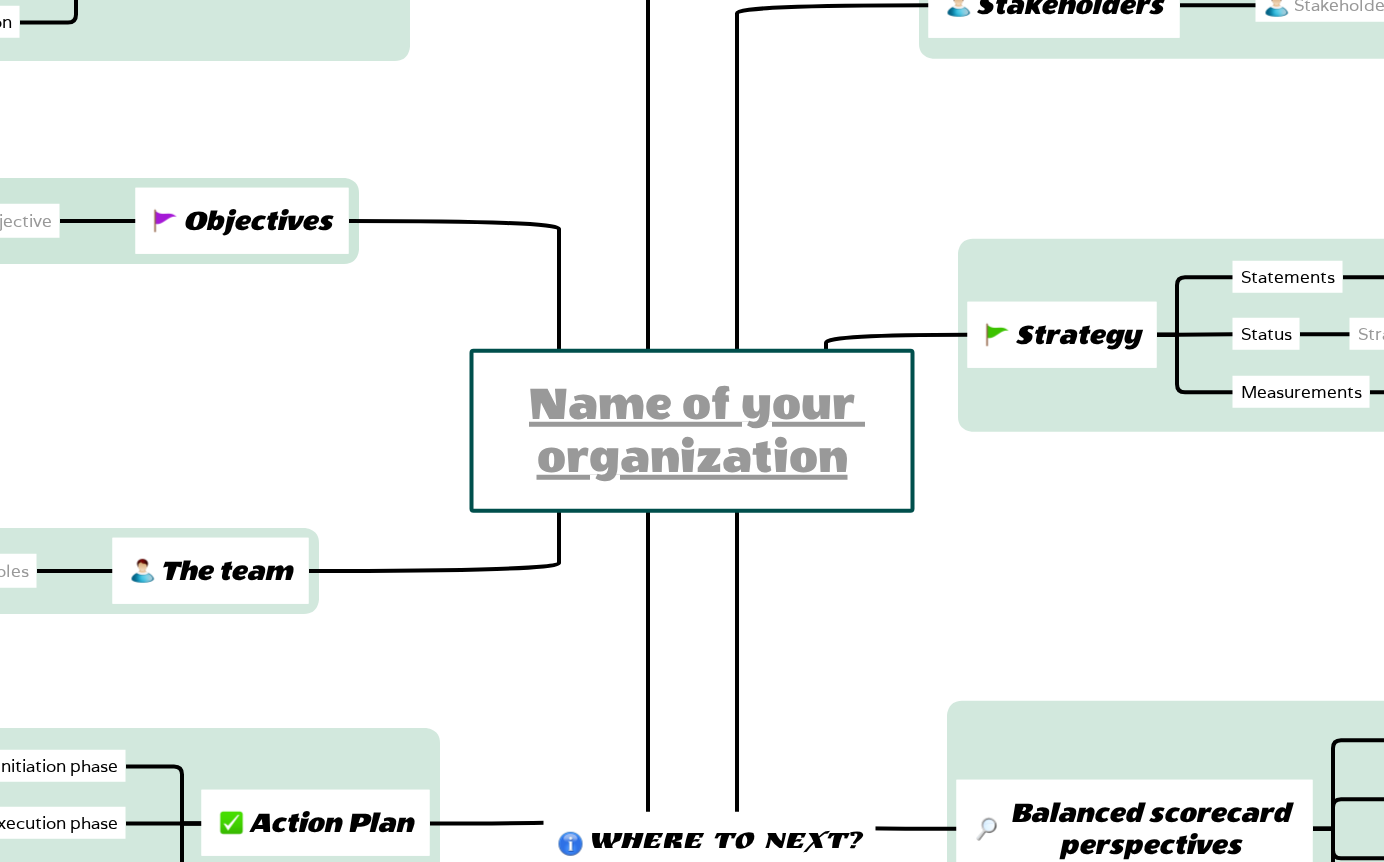
This mind map helps you plan a performance improvement project using the Balanced Scorecard.

This type of project requires a good knowledge of your company's strategies and operations. The technique works by establishing insightful measurement points in four areas of operations.

Free with a Mindomo account. Opens your own copy in the editor.

About this template

Balanced scorecard project management

Plan a project to improve your performance using this balanced scorecard project management template. This project will require resources and long-term commitment.

The completion of this mind map requires a good knowledge of the organization’s strategies and operations.

Add the stakeholders’ needs and measurements that show that you understand those needs. Then think about your organization’s mission, objectives, and strategies.

Look at the situation from the four perspectives of the balanced scorecard technique: financial perspectives, external customer perspective, internal business process perspective, and learning and growth perspective.

Continue completing this template by planning out some initial actions.

Add key players to your project. Establish objectives. Then communicate the results to your company.

What’s inside this template

Balanced scorecard Project Management: what the map covers

Central topic

Name of your organization

Begin by entering your organisation's name in the central topic, then press Enter.

Stakeholders

1 topic

Stakeholder

In order to identify measurements that give insights into performance, be clear about the needs of all the stakeholders in your company. Add a stakeholder who has an interest in the success of your organization. You can choose from the suggestions, or better, add stakeholders that are specific to your company. Customers Consumers Owners Shareholders Staff Members Regulators The community Partners Suppliers

  • Needs
    • Needs: Add a stakeholder's need or requirement that plays a major role in your project. What are the needs of this stakeholder? How will they judge your performance? What does success look like to them? What will keep them engaged and supportive?
  • Measurements
    • Measurement: Add a measurement that shows you understand stakeholder's needs and are meeting them. Where stakeholders have a choice, how well are you performing in comparison to your competitors? What measurements could you make that would show whether you are meeting their needs?
Strategy

3 topics

Identify areas for measurement and management by thinking about your organization's mission, objectives and strategy.

Statements

  • Strategy statement — Add a statement about your mission, objectives or strategies. If you are not clear on these, then consider using a VMOST analysis to create them.

Status

  • Strategy status — Add comments about the status of your strategy today. Is it: Clearly defined and well communicated? Clearly defined, but not well known or understood? Defined, but known to be out of date? A bit informal or changeable? Not really defined at all? What action do you need to take?

Measurements

  • Measurement — Add a measurement against objectives or strategy. Measurements should be: Capable of consistent measurement Agreed to be more fact than opinion Can have a meaningful target value set Capable of improvement, by taking action Agreed as representative by the people taking action Not easy to manipulate to simulate success Not a "blame" factor that picks out individuals

Communications

3 topics

Continually communicating the results of your Balanced Scorecard project is vital.

Distributing and sharing

  • Action — How will the results of your project, and the background information that supports it, be distributed in your company? Add an action for sharing the measurements from your project.

Designing dashboards

  • Action — What factors will influence the design of your dashboards, to keep people informed? Add an action for designing your dashboards to communicate measurements and improvements.

Reviewing and taking action

  • Action — Who will review the results, and what actions can they take? Add an action for reviewing and applying the measurements.

Objectives

1 topic

A Balanced Scorecard project will require resources and long-term commitment, and the results must be used to implement change, otherwise, it will die. In the same way that Balanced Scorecard is based on measurements, you should identify the KPIs for the project itself by agreeing on objectives and measuring progress towards them.

Project objective

Add an objective for your Balanced Scorecard project. Think about: Establishing an environment of management by measurement Identifying and correcting imbalances between internal/external factors and past/future indicators Identifying areas for improvement, taking action and evaluating results Identifying and reacting to trends Communicating strategy Aligning action with strategy Assessing whether strategy is being followed Assessing whether strategy is working

The team

1 topic

Support for your project is vital. If your project is successful at identifying the need for significant change, then you can be sure there will be barriers to change and people to convince.

Key roles

Add a key player to your project. Think about: A project manager Corporate sponsors to influence and authorise change Buy-in from senior management Buy-in from team leaders who will need to implement change Buy-in from people already involved in other improvement initiatives Buy-in from anyone who is likely to resist focus on performance and change External expertise

Balanced scorecard perspectives

4 topics

The four perspectives of the Balanced Scorecard technique help ensure that you are making measurements across all the important areas of your business. Use the sections below to help identify further measurements, and to group any measurements that have already been identified by examining your stakeholder needs and strategy.

Financial perspectives

  • Measurement — Measurements in the Financial perspective show whether your company has performed well financially, where improvements can be made, and whether it is in a secure position. Add a financial measurement that reflects achievement and progress.

External customer perspective

  • Measurement — Add an external customer measurement that reflects future potential. Choose from the typical ones suggested, or preferably create your own. Measurements should be: Capable of consistent measurement Agreed to be more fact than opinion Can have a meaningful target value set Capable of improvement, by taking action Agreed as representative by the people taking action Not easy to manipulate to simulate success Not a "blame" factor that picks out individuals Market share Customer acquisition Customer retention Customer satisfaction Customer profitability Product or service attributes Customer relationships Image and reputation

Internal business process perspective

  • Innovation processes
    • Measurement: Add an innovation measurement that reflects innovation in your organization. Measurements should be: Capable of consistent measurement Agreed to be more fact than opinion Can have a meaningful target value set Capable of improvement, by taking action Agreed as representative by the people taking action Suggestions made Suggestion adopted Savings made Innovation projects started Innovation projects completed Product launches Time to market Time to break-even Patents and rights
  • After-sales service processes
    • Measurement: Add an after-sales service measurement that reflects the performance of customer support. Measurements should be: Capable of consistent measurement Agreed to be more fact than opinion Can have a meaningful target value set Not easy to manipulate to simulate success Not a "blame" factor that picks out individuals Complaints Support requests Support turnaround Returns Repairs Repair turnaround Service Level Agreements
  • Operations processes
    • Measurement: Add an operations measurement that reflects the production performance. Measurements should be: Capable of consistent measurement Agreed to be more fact than opinion Can have a meaningful target value set Capable of improvement, by taking action Not easy to manipulate to simulate success Procurement Stock levels Quality measures Lead times Throughputs Scrap rates Yield rates Defect rates Waste levels On-time deliveries

Learning and growth perspective

  • Employee capabilities
    • Measurement: Add an employee capability measurement that reflects the skills, knowledge and performance of your employees, and predicts future capabilities. Measurements should be: Capable of consistent measurement Agreed to be more fact than opinion Can have a meaningful target value set Capable of improvement, by taking action Not easy to manipulate to simulate success Employee productivity Strategic skills Emerging skills Skills gaps Skills coverage ratio Training levels Training initiatives
  • Information systems capabilities
    • Measurement: Add an information systems measurement that reflects the quality and accessibility of information available to your employees. Measurements should be: Capable of consistent measurement Agreed to be more fact than opinion Can have a meaningful target value set Capable of improvement, by taking action Accuracy of information Availability of information Timeliness of information Accessibility of information Communications efficiency
  • Motivation, empowerment and enlightenment
    • Measurement: Add an employee motivation measurement that reflects the attitude of your staff and predicts future performance. Measurements should be: Capable of consistent measurement Agreed to be more fact than opinion Can have a meaningful target value Capable of improvement Agreed as representative by the people taking action Employee motivation Employee satisfaction Employee retention Improvements achieved Team performance Targets reached & exceeded Strategic awareness

Action Plan

3 topics

In this part of the map, plan out some initial actions for your Balanced Scorecard project. Use this map to develop the plan further and keep track of actions as you make progress.

Initiation phase

  • Action — Add an action for the initiation phase of your project. Think about: Getting corporate sponsorship Communicating and selling your project Forming a team Getting buy-in from those affected Identifying and helping those who may react negatively Resolving any lack of clarity over mission and strategy Communicating mission and strategy

Execution phase

  • Action — Add an action for the execution phase of your project. Think about: Identifying strategic measurements that reflect progress and potential for improvement Finalising a shortlist of a handful of measurements Designing measurements so that they have integrity and can be relied upon Agreeing measurements and targets with the people who will be affected by initiatives for change Creating a first set of benchmarks Communicating results for all to see Explaining what the measurements mean Working out what actions to take, and taking them

Maintenance phase

  • Action — Add an action for the maintenance phase of your project, once the first round of improvement initiatives have been made. Think about: Regularly repeating measurements and reviewing trends Rewarding improvements Reviewing the effectiveness of the process Improving measurements for better results Realigning the programme with updates to objectives and strategy Maintaining communications and training Soliciting and acting on feedback

Where to next?

Where next? You can return to this map and re-use the Wizard as many times as you like. Save the map as a normal Mindomo map and continue to work with it, using more of Mindomo's features. Good luck with your project!

How to use it

  1. 1

    Open the template

    Click “Use this template” and sign in with a free account.

  2. 2

    Make it yours

    Replace the topics and fill in the notes.

  3. 3

    Share it

    Share, present or export it, or switch it to an outline or Gantt view.