
Individual Development Plan Template

Interactive map · Individual Development Plan Template
Mind map: Individual Development Plan Template

Individual Development Plan Template

Free with a Mindomo account. Opens your own copy in the editor.

Map current role, target skills, and the gap between them in one structured plan with this Individual Development Plan (IDP) HR template. Designed for HR teams, managers, and learning and development professionals, this template helps document current proficiency levels and interests, define target skills with observable behaviours, plan development actions across formal training, stretch projects, and mentoring, agree the support and budget required, and record evidence as proficiency improves. Use it to run development conversations, keep growth plans realistic with built-in prioritisation rules, schedule check-ins, connect individual goals to business needs, and support career progression, internal mobility, and retention.

Free with a Mindomo account. Opens your own copy in the editor.

About this template

Individual development plan template

This individual development plan template helps employees, managers, HR teams, and L&D professionals create a clear, structured roadmap for professional growth. It brings together career goals, development priorities, strengths, skill gaps, learning activities, support needs, and success measures in one visual workspace.

Use this template to set short- and long-term goals, define actionable development steps, assign target dates, track progress, and prepare for regular review conversations. It supports career planning, performance development, upskilling, leadership growth, and internal mobility by making each employee’s development journey clear and easy to follow.

What’s inside this template

Individual Development Plan Template: what the map covers

Central topic

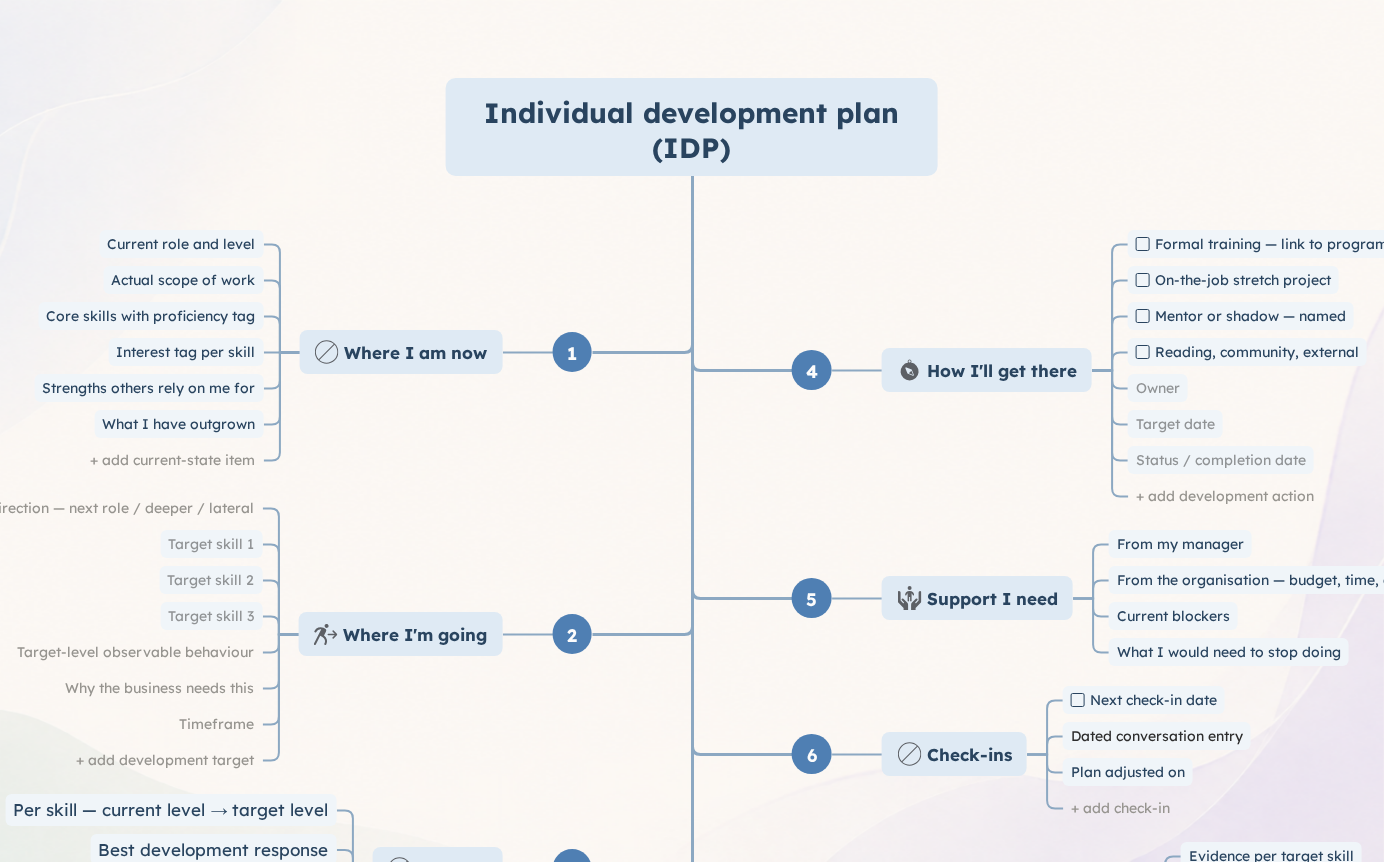
Individual development plan (IDP)

Use one copy per employee and review period. The employee drafts branches 1, 2, and 5; the employee and manager agree branches 3, 4, 6, and 7. The manager confirms priorities, resources, responsibilities, and sign-off. HR or L&D owns the shared guidance in branches A and B. Keep the plan active throughout the review period and use check-ins to record progress and agreed changes. Use observable evidence and consistent proficiency definitions. An IDP supports development; it does not by itself guarantee promotion, a pay change, or a role change. Follow your organisation's policies for privacy, access, record retention, and performance management.

4

1 topic

How I'll get there

For each action, record an owner, target date, status, and expected outcome or evidence. - Choose a mix of formal, experiential, and social learning based on the goal; do not treat any fixed ratio as a requirement - Name real projects and, with their agreement, real mentors or people to shadow - Spread activities realistically across the review period and check dependencies in Gantt view

  • Formal training — link to programme — Add the relevant course, workshop, certification, or learning resource and link to enrolment or programme details.
  • On-the-job stretch project — Name a real project, scope, expected outcome, support required, and target date.
  • Mentor or shadow — named — Name the person, confirm their availability, and describe the mentoring or shadowing activity.
  • Reading, community, external — Add supporting resources or communities.
  • Owner — Assign an owner.
  • Target date — Set the target date.
  • Status / completion date — Record the current status — not started / in progress / blocked / completed — and add the actual completion date when finished.
5

1 topic

Support I need

The employee leads the first draft; the manager discusses and responds to the requests. - Capture practical support such as budget, protected time, access, feedback, workload changes, or permission to deprioritise work - Distinguish support that can be agreed now from requests that need further approval - An empty branch may mean no support is currently needed or that the discussion is incomplete; use open questions rather than assumptions

  • From my manager — Describe the support you need from your manager.
  • From the organisation — budget, time, access — List budget, protected time, access, or permissions needed.
  • Current blockers — Describe what is currently in the way.
  • What I would need to stop doing — Name work that may need to be deprioritised.

6

1 topic

Check-ins

Add one dated entry per development check-in. - Record progress, obstacles, feedback, agreed changes, and next actions - Keep prior entries according to your organisation's retention policy so progress can be reviewed over time - Avoid recording sensitive personal information that is not necessary for the development plan - Set the next check-in date before closing the map

  • Next check-in date — Set the next check-in date.
  • Dated conversation entry — Date — what moved / what stalled / what changed.
  • Plan adjusted on — Date and reason for the adjustment.

7

1 topic

Evidence and outcomes

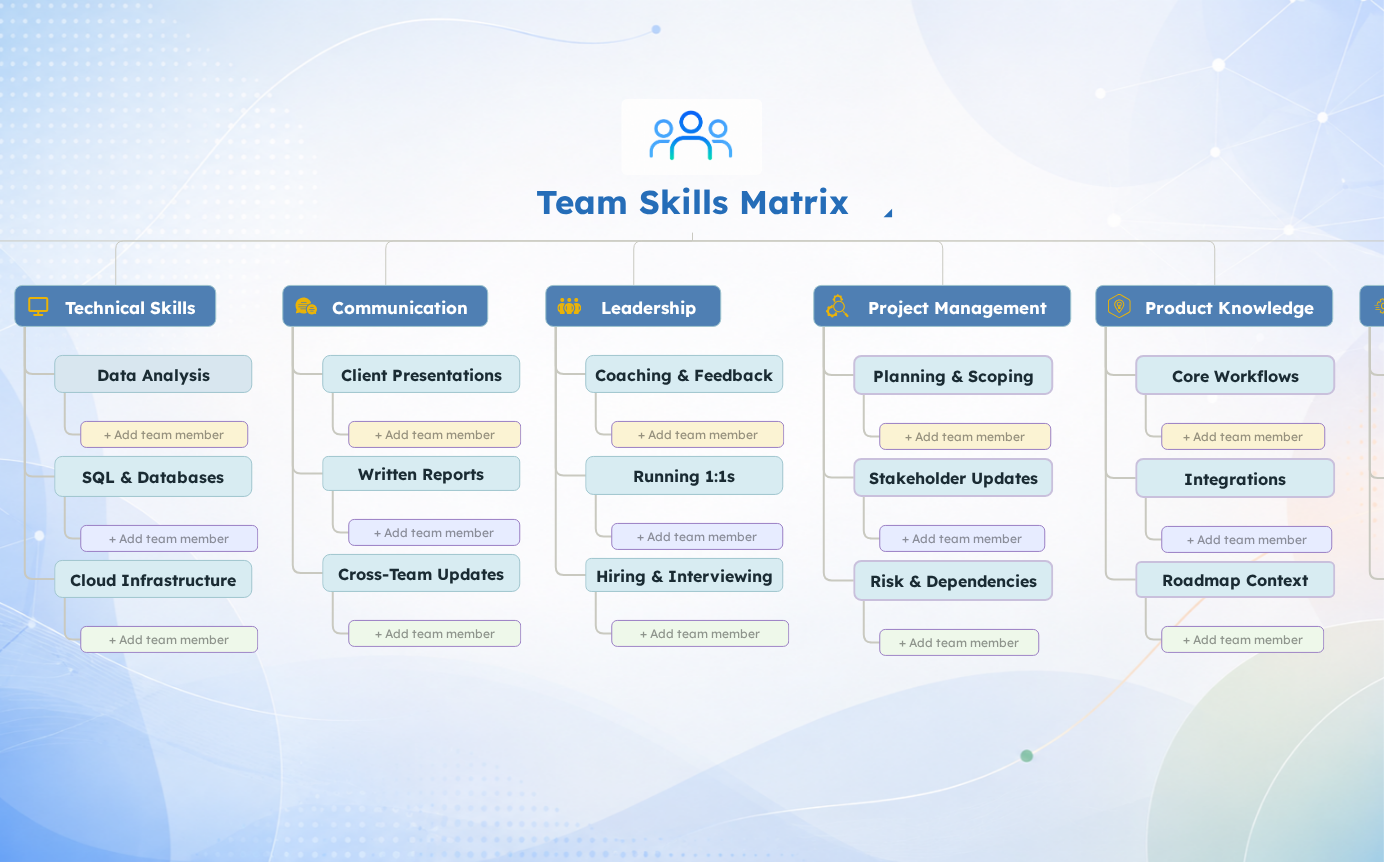
Use relevant evidence from more than one source where possible, such as work outputs, observed behaviour, feedback, metrics, completed assignments, and employee reflection. - Review evidence before changing a proficiency level and calibrate ratings according to organisational policy - Record outcomes, dropped targets, and items carried forward - Update the team skills matrix when applicable and authorised

  • Evidence per target skill — Add concrete evidence for each target skill, such as a work product, observed behaviour, stakeholder feedback, a relevant metric, or a completed assignment.
  • Proficiency raised from → to — Record the previous and new levels using branch A, together with the supporting evidence, reviewer, and review date. Change a level only after the evidence has been reviewed and the rating calibrated where required.
  • Targets dropped and why — Name dropped targets and the reason.
  • Carry forward to next period — List what should continue next period.

B

1 topic

Prioritisation

Use this branch to confirm that the plan fits within the time and resources realistically available during the review period.

  • Available hours per month — Agree the number of hours that can genuinely be protected each month after normal workload and recurring commitments.
  • One primary skill — Choose one target skill that receives most of the available development time and attention.
  • Maximum two secondary skills — As a default, add no more than two secondary skills so the primary goal remains adequately resourced. Adjust only when capacity and organisational guidance support it.
  • Allocate hours by skill — Assign monthly hours to the primary and secondary skills so the total can be compared with available capacity.
  • Check learning-method mix — Use a suitable mix of experience, social learning or coaching, and formal learning. The 70:20:10 model can be a planning prompt, but its ratios are not mandatory targets; choose methods based on the goal, context, evidence, and available support.
  • Cut until it fits — When allocated hours exceed capacity, remove or defer targets and activities rather than assuming more time will appear.

1

1 topic

Where I am now

The employee completes this branch first and discusses it with the manager. - Rate skills using the shared proficiency scale and observable evidence - Add an interest tag to show whether each skill is a growth, maintenance, or lower-priority area - If a rating differs from the team skills matrix, flag it for review and calibration; do not assume either rating is automatically correct

  • Current role and level — Enter current role and level.
  • Actual scope of work — Describe the work you actually own.
  • Core skills with proficiency tag — Add a core skill and tag its proficiency level using branch A — Proficiency scale. Include observable evidence for the selected level.
  • Interest tag per skill — Use a consistent set of tags, for example: growing / maintaining / deprioritising.
  • Strengths others rely on me for — Add a strength others regularly depend on.
  • What I have outgrown — Add work, responsibilities, or routines you have outgrown.

2

1 topic

Where I'm going

Choose a development direction, not only a future job title; deeper expertise or a lateral move can also be valid. - Focus on one to three priority skills, adjusted to realistic capacity - For each skill, choose a target level from branch A and define observable behaviour at that level - Link the objective to the employee's career goals and relevant role, team, or organisational needs

  • Direction — next role / deeper / lateral — Choose one direction and describe it.
  • Target skill 1 — Name the first target skill.
  • Target skill 2 — Name the second target skill.
  • Target skill 3 — Name the third target skill.
  • Target-level observable behaviour — For each target skill, describe observable behaviour or work output that would demonstrate the selected target level.
  • Why the business needs this — Explain how this development objective supports the role, team, customer, or organisational priorities.
  • Timeframe — Set the target timeframe.

3

1 topic

The gap

Diagnose the underlying gap before selecting an intervention. - Consider knowledge or skill, practice and experience, tools or process, resources, role clarity, feedback, and management support - A gap may need formal learning, guided practice, stretch work, coaching, a job aid, a process change, or a combination - The employee and manager should agree the gap, evidence, and proposed response

  • Per skill — current level → target level — Use the definitions in branch A — Proficiency scale. Example: Developing → Independent. Record evidence for the current level and the observable outcome required for the target level.
  • Best development response — Select the most appropriate response: formal learning, guided practice, stretch work, coaching or mentoring, job aids, process or resource changes, or a combination. Explain why it fits the diagnosed gap.
  • Blockers already known — List known blockers.

A

1 topic

Proficiency scale

This template uses four assessed levels plus level 0 for not yet assessed. Adapt the labels to your organisation's competency framework, use them consistently, and apply them only for purposes permitted by your HR policy.

  • Choose skill level — Example scale: 0 — not yet assessed; 1 — foundational, needs guidance; 2 — developing, applies with some support; 3 — proficient, works independently; 4 — advanced, can guide others and improve practice. Replace these labels if your organisation has an approved scale.
  • Set baseline once — Record the baseline level and supporting evidence when the plan begins. If the baseline is later corrected, retain the reason and date of the change.
  • Set target level — Choose a realistic target level for each priority skill based on the development goal, role needs, evidence, and available time. Not every skill needs the highest level.
  • Define observable proof — Write what good looks like at the chosen target level in branch 2 for each skill.
  • Record differing ratings — When employee and manager ratings differ, record both, compare the evidence, and follow the organisation's calibration process. Do not force agreement without reviewing the evidence.
  • Link proficiency policy — Before publishing this template, HR should link or attach the organisation's approved proficiency, calibration, privacy, and permitted-use guidance.

How to use it

  1. 1

    Open the template

    Click “Use this template” and sign in with a free account.

  2. 2

    Make it yours

    Replace the topics and fill in the notes.

  3. 3

    Share it

    Share, present or export it, or switch it to an outline or Gantt view.