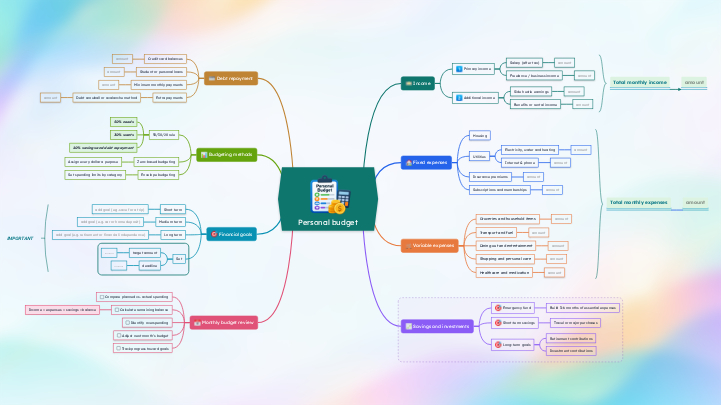
Use this Personal Budget Template to organize your monthly income, expenses, savings, debt repayments, and financial goals. Follow the guided placeholders and helpful tips to plan your spending, manage your money, and stay on track with your financial goals. Take control of your money with this personal budget template. It shows you where your money comes from and where it goes, so you can plan your spending, cut unnecessary costs and save for the things that matter to you. Start by listing all your sources of income, then add your fixed expenses, such as rent, utilities and loan payments, and your variable expenses, such as groceries, transport and entertainment. Compare the totals to see how much you can put aside each month. Set clear savings goals, like an emergency fund, a holiday or a large purchase, and review your budget regularly to keep your finances on track. Use this template to plan one month's income, spending, savings and debt repayments. Enter estimates before the month begins and actual amounts at month end. Use one consistent currency. Select a budgeting method and review progress monthly. At the end of the month, add real figures and record the changes needed for the next budget. Record the progress made toward each savings or debt-repayment goal, such as amount saved, outstanding balance, or percentage complete. Decide which limits or savings allocations to adjust next month based on what you learned. Prioritize essential bills and realistic targets. List the categories where actual spending exceeded the planned limit. Identify recurring causes rather than one-off exceptions. Compute monthly income minus expenses and savings contributions. Treat debt repayments consistently so they are not subtracted twice. Calculate money remaining after planned expenses and savings allocations. Keep required loan payments in only one category to avoid double-counting. Compare each category's planned amount with the actual amount spent. Note the biggest differences and why they occurred. Add goals you want to fund. Enter target amount, expected deadline, and monthly saving contribution. Specify a measurable savings target and deadline for your goal. Divide the remaining amount needed by the number of months available to estimate a monthly contribution. Enter your target completion date. Review whether the monthly saving required to reach it is affordable. Enter the total amount you want to save for this goal, using the same currency as the rest of your budget. ........... Add a long-term goal, such as retirement savings or financial independence. Keep its time horizon and progress measure visible. Add a medium-term goal, such as a car or home deposit. Estimate the amount needed, target date and monthly contribution. Add a goal you want to reach soon, such as a trip or a new device. Write the target amount and how much you can set aside each month. Choose one approach that fits your needs; these are alternatives, not three separate expenses. Adjust the percentages when necessary. Assign limits to categories (physical or digital envelopes) and track purchases against each limit. Set a monthly limit for each spending envelope (for example groceries, transport, or entertainment). Reduce the remaining envelope balance as purchases occur. Allocate all available income to spending, saving and debt categories until the planned unassigned amount is zero. Give every unit of available income a planned purpose: bills, flexible expenses, saving, debt, or a buffer. Aim for zero money left unassigned in your plan. A starting guideline: 50% of after-tax income for needs, 30% for wants and 20% for saving and debt repayment beyond essential obligations. Adapt it to your situation. Illustrative allocation: about 20% of after-tax income toward savings and repayment beyond required minimum debt payments. Adjust as necessary. Illustrative allocation: about 30% of after-tax income for optional spending such as dining out, hobbies and entertainment. Illustrative allocation: about 50% of after-tax income for essential costs such as housing, groceries and necessary transport. Adjust for your situation. Add each outstanding debt. For every debt, enter the balance and monthly payment; choose a repayment priority. Choose how much above minimums to allocate toward debt. Snowball generally tackles the smallest balance first; avalanche generally targets highest interest rates first. Choose a repayment approach: snowball prioritizes smaller balances; avalanche prioritizes higher interest rates. Enter the extra monthly payment for your chosen debt. Enter the sum of all required minimum debt payments for the month. Avoid counting the same payment twice elsewhere in your budget. Record student, personal, or other loan balances and monthly payments. Add separate entries if you have more than one loan. Enter each credit card's current outstanding balance and the monthly payment you plan to make. Separate the balance owed from the amount paid this month. Choose savings destinations and add a monthly contribution for each. You can insert more goals or investment categories. Record regular retirement and investment contributions based on your own priorities. Record your planned monthly investment contribution. Keep it separate from short-term cash savings and emergency reserves. Enter how much you intend to contribute monthly to a retirement account or pension. Use an amount suitable for your circumstances. List purchases and trips you plan to fund within the next few years; divide the amount needed by the number of months available. Name a near-term purchase or experience, set a target amount and date, and estimate how much to save each month. Estimate three to six months of essential expenses as a possible savings target, adjusted to your circumstances. Calculate your essential monthly expenses and multiply by 3–6 for an illustrative emergency-fund target. Adjust this target to your own circumstances. Add flexible spending categories as needed. Give each one a monthly spending limit and compare it with actual spending. Estimate out-of-pocket health expenses such as prescriptions, appointments, and medical supplies. Budget for clothing, cosmetics, haircuts, and other personal purchases. Distinguish necessities from optional spending. Set a spending limit for restaurants, takeaway food, cinema, events, and other leisure activities. Budget for public transport, fuel, parking, rideshares, and routine travel. Include costs you expect during this month. Set a realistic monthly amount for groceries, cleaning products, and household essentials. Compare it with actual spending at month's end. Add any other regular bills not already shown. Each expense should have its own monthly amount. List recurring subscriptions and memberships (streaming, software, gym, etc.). Include only services you currently pay for. Add monthly insurance costs such as health, home, car, or life insurance. Convert annual premiums into a monthly amount if needed. Enter each monthly utility cost. Add the services you pay for and enter the expected or actual amount. Enter your monthly home internet and mobile-phone bills, including any recurring service charges. Enter the combined monthly cost of electricity, water, and heating, or break them down into separate items. Seasonal averages can help with estimates. Enter your monthly housing costs. Add Rent or Mortgage as relevant, then enter an amount. Other housing costs can include fees and property charges. Record monthly take-home income (after tax). Include only money you reasonably expect to receive. Add sources as needed; irregular income can be estimated conservatively. Include side work, benefits, rent and other extra earnings. Avoid counting uncertain future income as guaranteed. Add monthly benefits, rental income, or other regular extra income, using the amount you actually receive. Include extra earnings from part-time work, selling services, or occasional gigs. Estimate only the amount you reasonably expect this month. List reliable recurring pay sources, such as net salary or business drawings. Use monthly net amounts. Enter estimated monthly net earnings from freelance projects or your business, after business costs and taxes. For irregular work, use a conservative average. Enter your total monthly take-home salary, after taxes and mandatory deductions. If paid weekly or biweekly, convert your expected pay into a monthly amount. amount Every Mindomo template opens with its structure already in place and a default shape that new topics inherit. Templates on a subject add descriptive topics and guiding notes where people usually get stuck; blank layouts leave the content to you. Edit it in the browser, switch it to a concept map, outline or Gantt chart without redrawing anything, and export it in more than twenty formats. See how mind map templates work, or browse the full gallery by category.Personal Budget Template
About this template
Personal budget template
Total monthly income
Total monthly expenses
IMPORTANT
Personal budget
Monthly budget review
Track progress toward goals
Adjust next month's budget
Identify overspending
Calculate remaining balance
Income − expenses − savings = balance
Compare planned vs. actual spending
Financial goals
Set
deadline
target amount
Long term
add goal (e.g. retirement or financial independence)
Medium term
add goal (e.g. car or home deposit)
Short term
add goal (e.g. save for a trip)
Budgeting methods
Envelope budgeting
Set spending limits by category
Zero-based budgeting
Assign every dollar a purpose
50/30/20 rule
20% savings and debt repayment
30% wants
50% needs
Debt repayment
Extra payments
Debt snowball or avalanche method
Minimum monthly payments
Student or personal loans
Credit card balances
Savings and investments
Long-term goals
Investment contributions
Retirement contributions
Short-term savings
Travel or major purchases
Emergency fund
Build 3–6 months of essential expenses
Variable expenses
Healthcare and medication
Shopping and personal care
Dining out and entertainment
Transport and fuel
Groceries and household items
Fixed expenses
Subscriptions and memberships
Insurance premiums
Utilities
Internet & phone
Electricity, water and heating
Housing
Income
Additional income
Benefits or rental income
Side hustle earnings
Primary income
Freelance / business income
Salary (after tax)
Why use a Mindomo mind map template?
-
Products
-
Uses
- General Uses
- Mind Maps for Education
- Mind Maps for Business
- Mind Maps for Personal Development
- Assistive Technology
- Team Collaboration
- Campaign briefs for marketers
- Client discovery workshops for consultants
- Onboarding journeys for HR & L&D
- Knowledge Management
- Team Skills Matrix
- Engagement Library
- Roles
- Marketers
- HR & L&D
- Consultants
- Project Management
- Marketing campaign planning
- Employee training rollouts
- Scope of Work
- Idea Organization
- Issue Trees
- Training Needs Analysis
- Mind Mapping Benefits
-
Solutions
- Guides
- Make Presentations with Mind Maps
- How to Learn with Mind Maps
- Plan and Organize with Mind Maps
- Prioritize Tasks with Mind Maps
- Take Notes with Mind Maps
- Real Customer Stories
- Scaling educational content for 11,000 doctors
- Team workflow: from trial to indispensable in two months
- 10 years without slides: rethinking architecture lectures
- Read all stories
-
Resources
- Learn the basics
- What is a Mind Map?
- How to Mind Map?
- What is a Concept Map?
- Benefits of Mind Mapping
- Guides & Support
- Video tutorials
- Help center
- Forum
- Examples & templates
- Top 29 Mind Map Examples
- Concept Map Templates
- How to Make a Gantt Chart
- Mindomo's Efficiency in Education
- Feature pages
- Education
- Teacher Assignments
- Work & Personal
- Desktop
- The Mindomo blog
- Pricing
- Log In
- Sign Up
- Dashboard
Mind Mapping Benefits
Why visual thinking makes recall and planning easier.
Learn the basics
Guides & Support
Examples & templates
Feature pages
 Blog
The Mindomo blog
Guides, examples and research on visual thinking.
Browse all articles