

Benefits of mind mapping: 6 ways it helps you learn and work
The main benefits of mind mapping are that you remember more, break complex information into manageable parts, understand what you read, think more creatively, solve problems step by step and enjoy learning more. A mind map gets there by putting one idea in the center and the ideas related to it on branches around it, in keywords, colors and images instead of lines of text.
Below is what each benefit means, what the research says about it and how to get it from your own maps.

Benefits of mind mapping
On this page
The 6 benefits, and how to get each one
All six mind mapping benefits come from the same few features of a mind map: one central topic, branches that radiate from it, a keyword or short phrase on each branch, and color and images to tell the branches apart.
1. Remember more of what you learn
A mind map turns a page of notes into a picture with a shape, and a shape is easier to recall than a list. Each branch has its own color and position, and a keyword on a branch is a cue that brings the rest of the idea back with it.
In a study of medical students, those who studied a text with the mind map technique tended to recall more of its facts a week later than students who used their usual study method.
Try this: map a chapter in Mindomo, and the next day collapse its branches. Recall what is under each one before you expand it: whatever you missed is what to review.
2. Break complex information into parts
A long report, a chapter or a project brief is hard to hold in your head at once. On a map, each main idea becomes a branch and each detail a subtopic under it, so you can work on one branch at a time and still see where it fits. Drawing the parts out also helps you understand them: in one study, students who explained a complex system by drawing it learned more than students who explained it in words, partly because a drawing shows when a part is missing.
Writing a keyword instead of a sentence forces you to decide what each part is really about, which is where most of the simplifying happens.
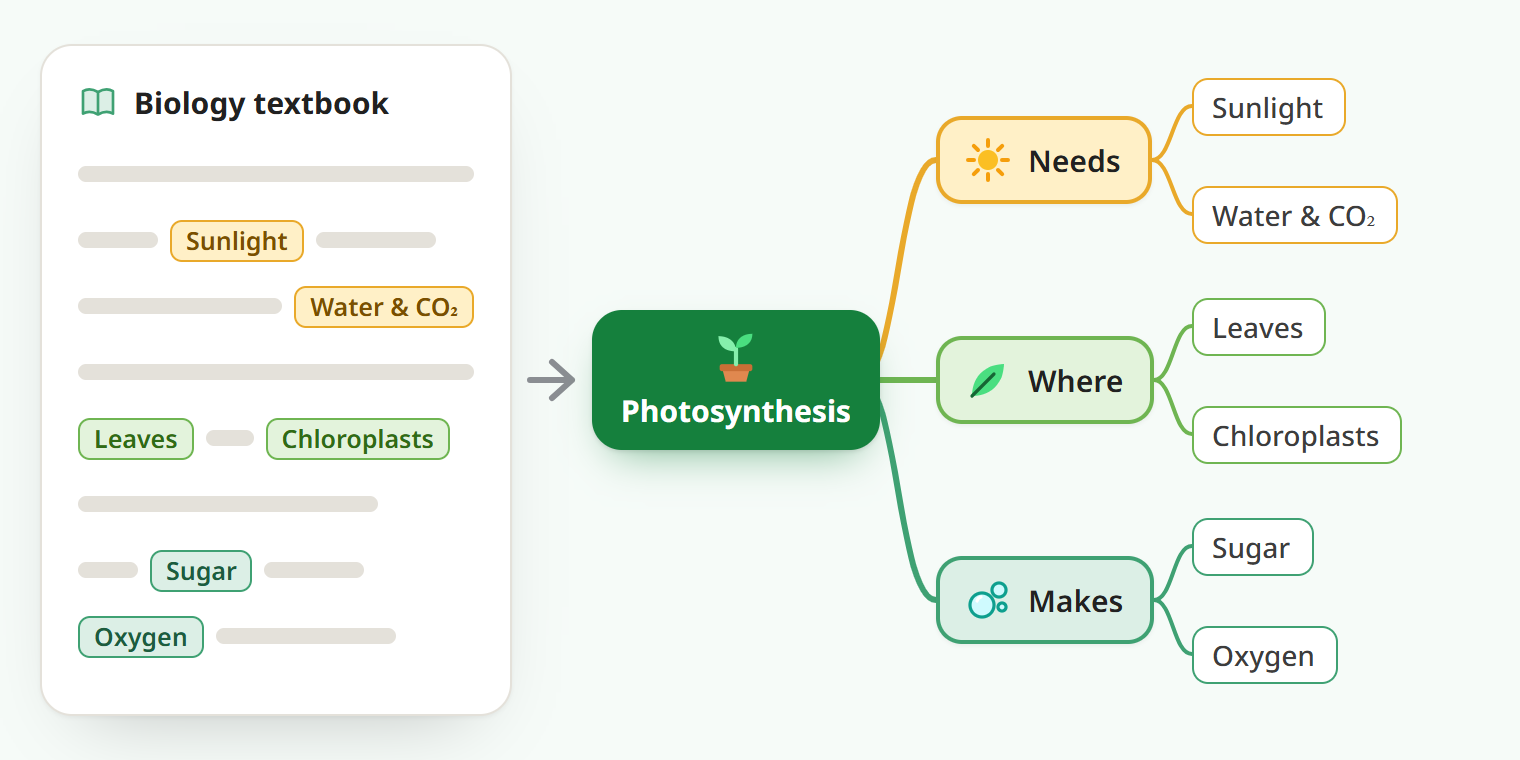
Try this: keep to five to seven main branches, with only a keyword or short phrase on each topic. If one branch outgrows the rest, move it to a map of its own and link the two.
3. Understand what you read
You understand something new when you can connect it to something you already know. A map makes that connection visible: a new idea has to go on a branch, next to the ideas it belongs with, and you cannot place it without deciding what it relates to. Building maps pays off: across the studies in a 2006 meta-analysis by Nesbit and Adesope, students who built concept and knowledge maps learned more than students who read a text or listened to a lecture on the same material.
Mapping a chapter as you read also shows you where you are lost. A branch you cannot fill in is the part you have not understood yet.
Try this: as you read, add each new idea to the branch it belongs to. If you can’t decide where an idea goes, reread that part: you haven’t understood it yet.
4. Think more creatively
Psychologist Sarnoff Mednick described creative thinking as joining ideas that seem far apart into new combinations. A mind map helps in three ways:
- Divergent thinking. A map has no last line, so there is always room for one more idea. Brainstorming maps push you to come up with many possible answers before you pick one.
- Lateral thinking. With every idea on one page, you notice links between branches that look unrelated, and that is where most new ideas start.
- Visual thinking. Images, colors and shapes let you look at a problem as a picture rather than a list, which often shows it from a new angle.
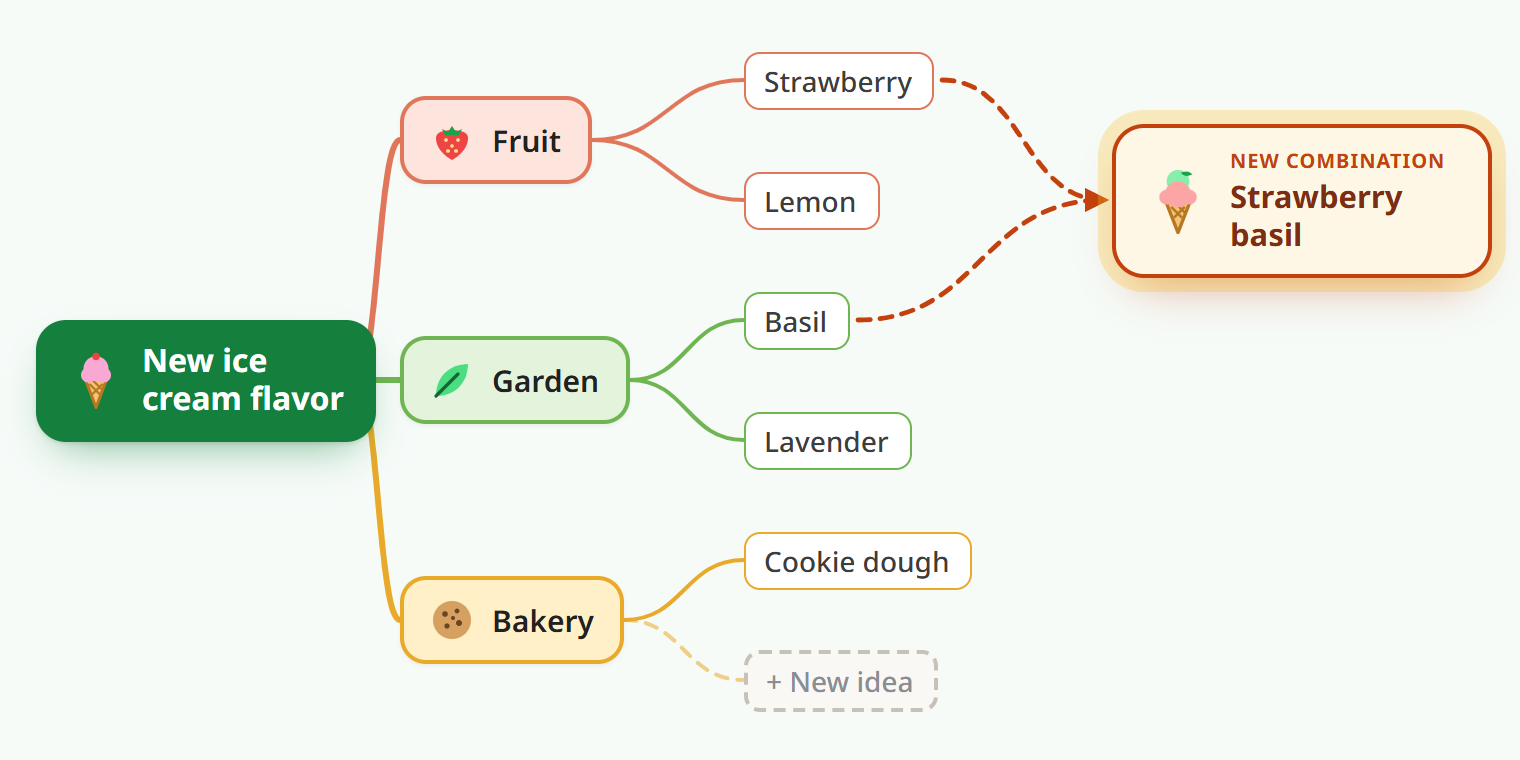
Try this: give yourself ten minutes to add as many ideas as you can, without judging any of them. Then pick two branches that seem unrelated, ask what connects them, and link them.
5. Solve problems step by step
Building a map walks you through the steps a careful problem-solver takes, whether the problem is personal, professional or a school assignment:
- Put the problem in the center.
- Gather everything related to it on branches: causes, facts, constraints, people involved.
- Remove what does not matter, until only the relevant information is left.
- Link the branches that affect each other. The solution often lies where the links meet.
Seeing the whole problem at once also keeps you from fixing one symptom while ignoring the cause on the next branch.
Try this: phrase the central topic as a question (“Why are deliveries late?”) and give each possible cause its own branch. Add solutions only after that, each on the cause it fixes, so you treat the cause and not the symptom.
6. Make learning more engaging
Students of all ages and abilities can use mind maps in any subject: for note-taking, brainstorming, essay and project planning, research and revision. A map gives them the freedom to organize ideas in the way that makes sense to them. They decide where each idea goes and which keyword sums it up, so they spend their time thinking about the subject rather than copying it out.
That makes them more involved. In a study of nursing students in an anatomy and physiology course, those taught with mind maps reported more motivation than classmates taught by lecture alone, and they scored higher on the final test.
For teachers, a student’s map shows at a glance how they understand a topic, gaps included.
Try this: let students build maps in pairs, then compare them as a class: where the maps differ is where the discussion starts. Our list of mind map ideas for students has topics for every subject.
Why mind maps work: what the research says
27% of the human cerebral cortex is mainly visual, more than hearing, touch and movement combined
~10% more facts recalled a week later by medical students in one study who learned a text with a mind map than by those using their own method (an estimated 15% with equal motivation)
Sources: Van Essen (2003), The Visual Neurosciences; Farrand et al., Medical Education (2002)
These mind mapping benefits rest on a few well-established findings about how we take in information:
- We are built to process visuals. About 27% of the human cerebral cortex is mainly visual in function, more than hearing, touch and movement put together, according to neuroscientist David Van Essen’s atlas of the cortex.
- Pictures are remembered better than words. Psychologists call this the picture superiority effect, and molecular biologist John Medina makes it one of the rules in his book Brain Rules: information that comes with a picture stays with us far longer than information we only hear or read.
- We read images in an instant. MIT neuroscientists found that the brain can process an image seen for as little as 13 milliseconds.
- New thoughts come quickly. A 2020 study measured about 6.5 transitions from one thought to the next every minute, more than 6,000 a day by its authors’ estimate. A map gives each new thought a place next to the one it came from, instead of at the bottom of a list.
Studies of mapping itself point the same way. Beyond the medical-student study above, a 2006 meta-analysis by Nesbit and Adesope found that students learned more when they built or studied concept and knowledge maps, close relatives of the mind map, than when they read a text or listened to a lecture.
The medical-student study comes with a caveat, though: students who had just learned the technique were less motivated by it than the others were by their usual method, and the authors estimate that with equal motivation the gain in recall would have been 15% instead of 10%. With 50 students, the 10% on its own could still have been chance; the 15% could not. A new technique feels slower than the one you know, so give it a few maps before you judge it.
Who uses mind maps and what for?
- Students and teachers use them for note-taking, summarizing, lesson planning and interactive assignments.
- Researchers and academics use them to review the literature, connect their findings and build an argument, from the claim to the evidence behind it and the objections against it.
- Writers and content creators use them to collect ideas, plan content for each channel, build plots and develop characters.
- Business professionals use them for strategic planning, running meetings, analyzing issues, finding new solutions and organizing group sessions.
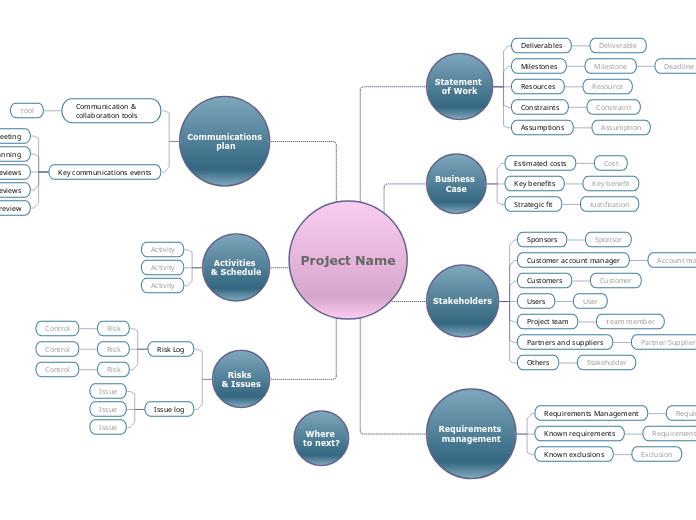
- Project managers use them in every phase of a project, from defining its scope and stakeholders to scheduling the work and tracking risks and issues.
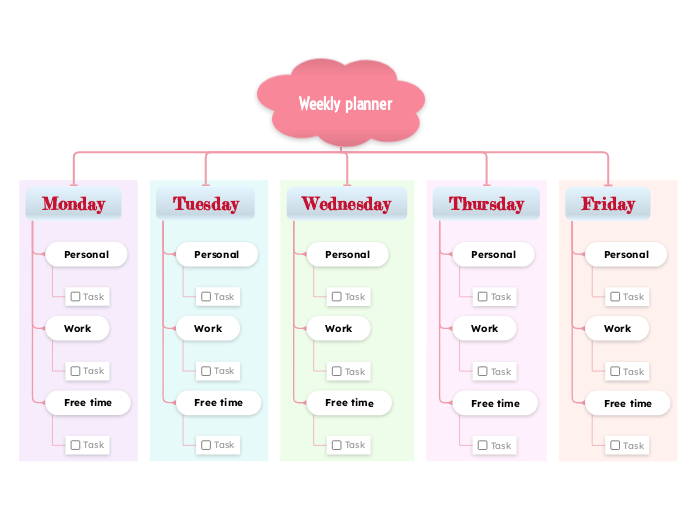
- Anyone working on personal development can use them for goal setting, weekly planning or career mapping.
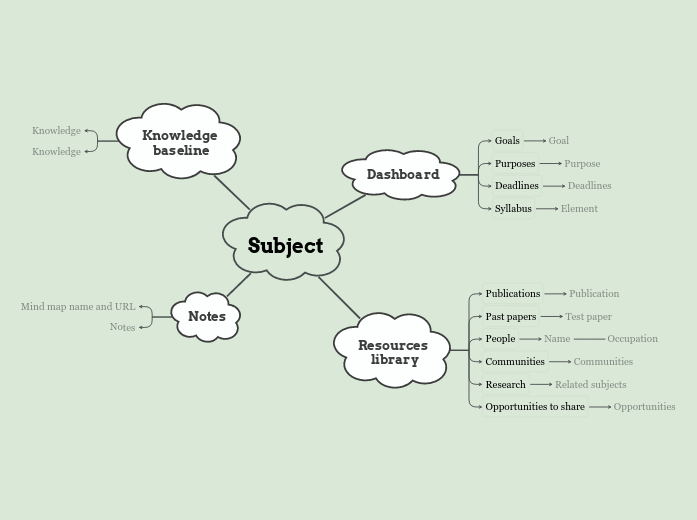
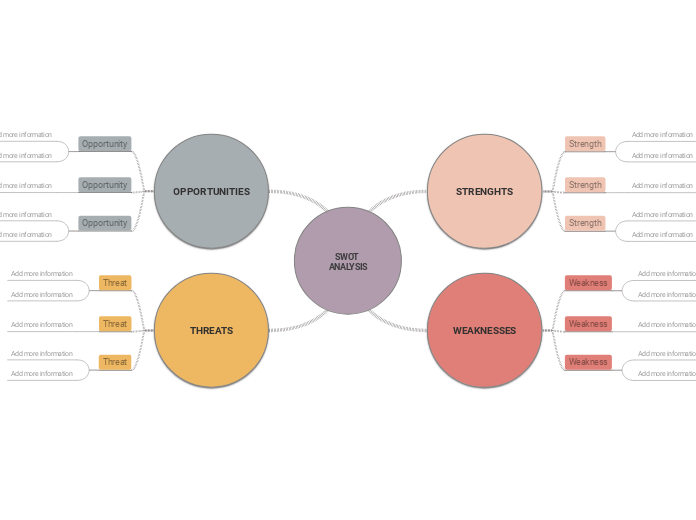
The templates below are ready-made maps for several of these uses. Copy one and adapt it:
-

-
-

-
-
-
Browse the Mindomo template library for more, or see our mind map examples for ideas.
Mind mapping on paper or in an app?
You get the benefits either way, so pick the medium that suits the task.
Paper needs nothing but a few colored pens, and linking ideas by hand, watching them turn into a web of colorful lines and bubbles, is satisfying in its own right. But the page runs out, a branch is hard to move once it is drawn, and the map exists in one place only.
Mind map software such as Mindomo gives you an endless canvas and drag-and-drop topics, so the map can grow and be reorganized as your thinking changes. You can attach images, links and videos, work on the same map with others in real time, keep it in the cloud and turn branches into tasks. With the mobile apps for Android and iOS you can add an idea whenever it comes, on the way to work, in a meeting or away from your desk.
For a point-by-point comparison, see paper vs digital mind maps.
Tip
Sketch on paper when you are thinking alone for ten minutes. Move to an app when the map needs to grow, be shared or become a plan.
What a mind map is and where it comes from
Mind mapping is a visual thinking technique: ideas flow freely and connect around a central theme. However you draw a map, it has the same four parts:
- a central theme: a concept, a problem or just a thought;
- associations branching out from the central theme;
- keywords or short phrases that sum up each idea;
- colors, images and shapes that make the map easier to read, memorize and recall.
For the full definition, the types of mind maps and examples, read our guide on what a mind map is. The video below shows how to build one in Mindomo.
Plays from YouTube. Google may set cookies once you press play.
A brief history of mind maps
The term “mind map” was made popular in the 1970s by the British author and broadcaster Tony Buzan, above all through his 1974 BBC series Use Your Head. The idea of drawing knowledge as a branching diagram is much older.
The earliest known example is usually credited to Porphyry of Tyre, a 3rd-century philosopher who organized Aristotle’s categories as a tree. Ramon Llull drew branching diagrams of knowledge in the 13th century, and Leonardo da Vinci’s notebooks mix sketches, keywords and arrows on the same page. What Buzan added was the radial shape around one central image and the rules for keywords and color that the benefits above rely on.
Plays from YouTube. Google may set cookies once you press play.
Mind mapping benefits FAQ
What are the benefits of mind mapping for students?
Students remember more of what they study, understand texts better because they have to decide how each idea connects to the others, and revise faster because a whole topic fits on one page. Mind maps also help with planning essays and projects, and making one keeps students thinking about the subject instead of copying out notes. See the six benefits above for how to get each one.
Is mind mapping scientifically proven?
There is good evidence for mapping in general, and some for mind maps in particular. A small study of medical students found that those using the mind map technique tended to recall more a week later, and a 2006 meta-analysis found that building concept and knowledge maps, close relatives of the mind map, helps students learn more than reading a text or listening to a lecture. The research section has the details. Results depend on how you use the technique, so make your own maps rather than only reading other people’s.
What are the disadvantages of mind mapping?
A mind map takes some practice before it feels faster than notes, and it suits ideas that branch out better than strict sequences or long arguments, which read better as a list or an outline. A map someone else made is also less useful to you than one you built, because building it is where most of the learning happens. In Mindomo, the same map can be shown as an outline when you need the linear view.
Can I make a mind map for free?
Yes. Mindomo’s free plan includes 3 mind maps, with no time limit. For more maps and features such as PDF export, choose a premium subscription.